Posted under India
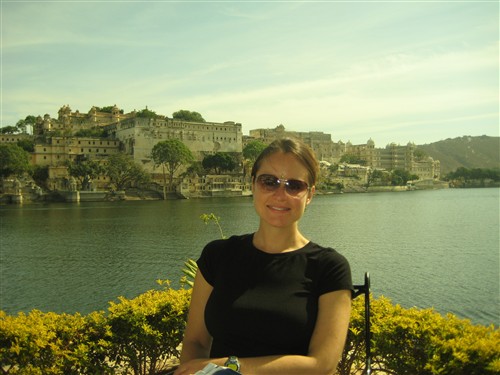 Set on the edge of a sparkling lake and nearly surrounded by mountains, the whimsical, romantic city of Udaipur has a distinctly European feel. From the sunny lakeside patio of Ambrai Restaurant, where we enjoyed our best meal in India, the afternoon sunlight glitters on the tiny ripples of the lake. Local men, women and children bathe and wash clothes at the sun-soaked ghats along the water’s edge. The sound of the women beating the wet clothes clean echoes across the town.
Our first day in Udaipur was blissful and stimulating – one of the best days we’ve had on the trip so far. The morning began with a quiet breakfast on the whitewashed rooftop of our hotel with panoramic views of the lake and the city. When we were sufficiently fueled by hot masala chai, we ventured out to wander the streets of Udaipur. The narrow city streets were lined with vendor stalls selling the usual array of textiles, jewelry, antiques, and miniature paintings; the shopkeepers all greeting us as we walked by and beckoning us inside. We stopped for an impromptu tour of a 350-year-old Jain temple – its interior made almost entirely of glass with many beautiful mosaics. Inside the inner altar, two men were worshipping as we tiptoed around them.
We continued down the road to the immaculate City Palace, one of four residences of the current maharaja of Udaipur, for a guided tour. The palace was elaborately decorated with glass mosaics, colorful stained glass windows, cheerfully painted apartments, tranquil courtyards, windows and entryways carved in traditional Rajasthani style. Rajasthanis have a particular affinity for bright colors and ornate designs, which usually include flower patterns, probably because there are few vivid colors or flowers in the natural desert terrain. From the City Palace balconies, we took in the best views of the city and of the glassy Lake Pichola. The serene lake, only twelve feet deep, surrounds two small islands both of which are entirely encompassed by palaces: the opulent, whitewashed Lake Palace Hotel and the equally magnificent palace on Jagmandir Island, which was built by Maharaja Karan Singh in 1620. Mughal emperor Shah Jahan, who commissioned the famous Taj Mahal, is said to have gained inspiration for the design of the Taj when he stayed on Jagmandir Island in 1623-24. Our City Palace tour came to an end at a series of government-run souvenir shops, which are said to donate sixty-percent of their profits to the poor citizens of Udaipur. The shops contained more beautiful, expertly-handcrafted, and more expensive versions of the wares available on the streets but we were already entranced by the romance of the city and wanted to wrap ourselves in its exotic rhythm. We walked through the buzzing streets and made our way back to the hotel for a quick siesta; then, in a brief recess from my fantasy, we ended up in a cardboard box-like internet café.
Let me digress for a moment to explain that many small towns in India have yet to comprehend the café aspect of internet café. In these depressing and claustrophobic venues, you walk into a tiny room with four cement walls and a few computer carrels. Not only are they devoid of character but there is ne’er a refreshment to be found. In this particular nameless internet café in Udaipur, the proprietor and his visiting acquaintance proceeded to light cigarettes in the unventilated cell. They were polite enough to leave the room when they noticed that I had covered my nose and mouth (and my disgusted scowl) with a handkerchief. When the proprietor returned later, he asked me if I had an allergy to cigarette smoke to which I replied, “No, I just don’t want to die from lung cancer.” He seemed taken aback by my matter-of-fact response but perhaps he’ll think twice before subjecting someone else to the increased prospects of a slow and painful death. In truth, I’ve probably inhaled enough first-and-secondhand smoke in my indulgent and fearless twenties to do the trick but JUST IN CASE I’ve somehow been spared the ultimate penalty for my smoky indiscretions, I don’t want to push the envelope by allowing unnecessary dirty air into my shrine. There’s enough air pollution on the streets of India already from auto emissions, burning trash and cow patties.
After surviving the internet café, we made our way on foot to the City Palace jetty for a sunset cruise on the lake. The boat departed promptly at five p.m. and glided leisurely along the city’s edge. The sun was beginning its slow descent on the opposite side of the lake, which brushed the majestic sandstone buildings and their watery reflection in a magical, golden luminescence. The boat continued along its course, rounding the beaming white Lake Palace Hotel and cruising toward Jagmandir Island, where we disembarked to explore the palace. Across the lake, the city of Udaipur had taken on a hazy glow and we joined the throngs of tourists snapping numerous photos from the scenic upper terrace. We walked around the palace courtyard with musicians playing soft melodies from one of many intimate, curtained alcoves in the opulent background. Tempted to further indulge in the tranquil ambience by sipping overpriced Indian wine at a candlelit cocktail table overlooking the water, we hurriedly boarded the boat before we had a chance to change our minds. We had plans to attend a musical performance of traditional Rajasthani dances across town. The show was called Dharohar and was performed in the courtyard of an 18th century haveli museum on the water’s edge. Havelis are traditional, ornately decorated, Rajasthani residences, many of which are now used as museums, restaurants and guest houses. We purchased our tickets with about an hour to spare and wandered through a city gate behind the haveli to one of the bathing ghats, where a kind-faced musician in colorful turban was demonstrating his handmade string instrument for a small crowd. In the pale moonlight, his tunes were mesmerizing and I found myself actually considering buying one of his exotic instruments. Thankfully, Aaron’s sweet tooth pulled me away to a small café across from the haveli before I was lured further down the path of almost certain buyer’s remorse.
Dharohar was a dazzling performance of music and dance. We, the gracious audience, sat on blankets in the small square courtyard while a succession of lovely ladies in bright-colored costumes with delicate embroidery and gold embellishments leapt and twirled to the sounds of three faithful musicians. Each dance had a fiery uniqueness: performers spun with potted flames upon their heads; two feisty divas rang out a choreographed tune on small cymbals sewn into unusual places on their costumes; gold glittered from spinning dresses; and, as the grand finale, a dancer pranced, swayed, stood on the edges of a pie plate and walked barefoot on glass with an astonishing stack of nine clay pots stacked on her head. The audience roared with excitement and applause as the show ended and everyone shuffled around in search of their shoes. We felt a natural euphoria in the air – everything seemed to be bathed in an incandescent glow – and we decided that an elegant dinner was in order.
We took a rickshaw across the bridge to a boutique hotel called Udai Kothi and ascended about five flights of dark, narrow stairs to its stunningly beautiful and serene rooftop restaurant. As we skirted the iridescent pool, lined with colorful cushions and low tables, the maitre d’ showed us to a table in the center of the candlelit dining area under a starry sky. Musicians played soft dinner music as we basked in our gorgeous surroundings, drank some of that overpriced Indian wine after all, and dined on saucy paneer and tandoori vegetables. It was the perfect end to a perfect day.
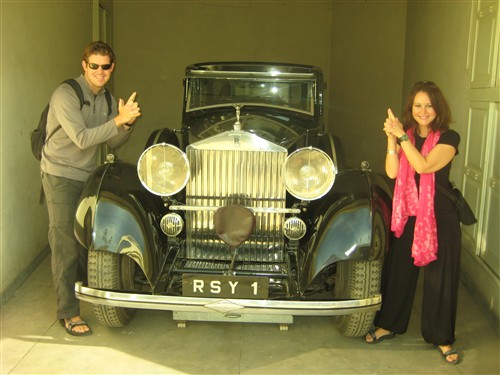 Our next two days in Udaipur were lovely. We lingered longer on sunny terraces, checked out a few shops, and kept our activities to a minimum. On day two, we took a rickshaw to see the maharaja’s vintage and classic car collection. Each of the twenty-two splendid automobiles had its own garage and an extraordinarily personable guard opened them, one by one, speaking of each car with pride and affection. Neither Aaron nor I are car buffs but we were awed by the beautifully restored historic vehicles nonetheless. Most impressive was the 1934 Phantom Rolls Royce used in the James Bond film Octopussy, which was partly filmed in Udaipur.
After viewing the cars, we asked our rickshaw driver to drive us to the Spice Box which, according to our guide book, offered recommended cooking classes. Since we are crazy about Indian cuisine and, in our past domestic life, both loved to cook, we thought a cooking class sounded wonderful. The driver dropped us off at a hotel and ushered us inside. “Is this the Spice Box?” I inquired of the proprietor as there was not a sign to be found. “Yes, yes.” he said and pointed us upstairs to the cooking classroom to make arrangements with the instructor personally. Her name was Sushma and we liked her immediately as she began to tell us about the class. Although the class fee was double what we’d expected to pay, we were more or less already sold when she let us sample some of the dishes that we would be learning to make and that definitely sealed the deal. Paneer butter masala – our favorite dish! We would join the cooking class at 3:30 the following afternoon and catch a sleeper bus to Jodhpur that same night at 10:15. We ran into an American couple whom we’d briefly met in Wilderness, South Africa, and told them all about our class and urged them to join.
At some point during the next morning, it suddenly occurred to me that the business card that Sushma had given us read Sushma’s Cooking Classes. It didn’t say anything about the Spice Box. I recalled various warnings in our guide book about rickshaw drivers taking you to a similar place to the one you requested and trying to pass it off as the requested place in order to receive commission from the proprietor. I also recalled our rickshaw driver sticking around the hotel lobby for a suspiciously long time after he’d dropped us off. We ran into the American couple later that day who said that they registered for the afternoon cooking class at the real Spice Box and, after their description confirmed that it was in fact a different place, I explained to them how we had unknowingly been scammed. Despite the hotel proprietor’s role in that deception, we were too excited about making paneer butter masala with Sushma to care.
We were the eager beavers of the cooking class, arriving first and grabbing two seats in the front row, center. We took copious notes throughout the class, took turns stirring, and exchanged delicious glances as we tasted each dish. After class, the ten students sat around a large table on the rooftop and dined on an extravagant meal of the dishes that had just been demonstrated: masala chai tea, paneer butter masala, eggplant bhurta, aloo ghobi (potato with cauliflower), dal makhani, saffron rice, stuffed paratha, and fresh made chapati. We stayed at the table long after dinner had ended, visiting with our classmates. It was a lovely evening and we were sad to go as we hurriedly departed to catch our bus to Jodhpur.
Udaipur was a jewel in the Rajasthani desert; the romantic rooftops, whirling beauties, picturesque cityscapes and sunset cruises collectively made our stay there feel like a second honeymoon. The streets were filled with that endearing Rajasthani chaos of cows, stray dogs, working donkeys, rickshaws, motorcycles, bicycles, beggars and chattering shop owners. So much life happens on the streets of Udaipur that your senses are constantly overloaded by the sights, sounds and smells. Even though the buzz can make you crazy at times, you find yourself strangely addicted to it.
Comments Off on A Perfect Day in Udaipur
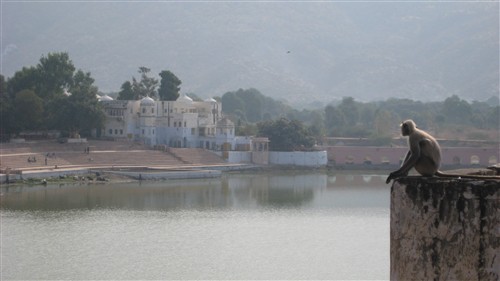
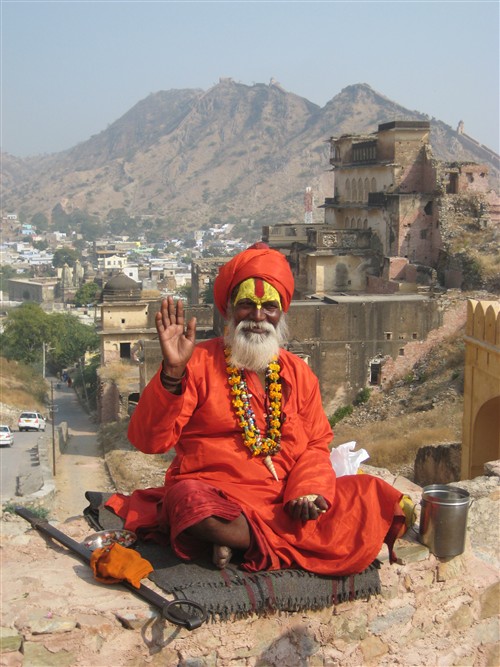
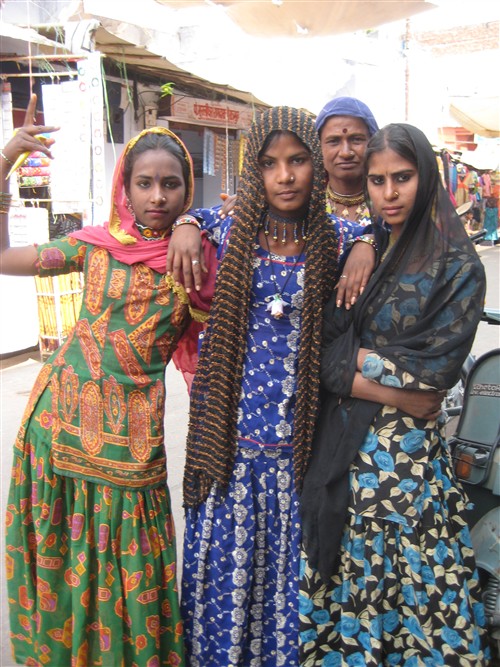 The people of Pushkar, and our ability to interact closely with so many of them, were by far the highlight of our visit. They are vibrant and charming and clad in even brighter and more vivid garments than those we have seen thus far in India. We could literally spend hours photographing each and every fascinating person and many people – especially the elderly panhandlers carrying their shiny collection buckets – are happy to be snapped for a few rupees. Now that we know the game, we always carry small change in our pockets and hand it out like Halloween candy. The elderly panhandlers are docile and entertaining but there are also the nasty little child beggars who are persistent and ruthless. One little girl was begging with a baby in her arms. When we tried to shoo her away, she lifted the baby’s garment to display its back full of red sores. Another boy tried, with average success, to engage us in a whole debate about the value of taking our money to the grave versus giving it all to him. The next day, the same boy followed us again. I told him that he should go to school. He replied, “If I go to school, who will get my Mama chapati?” That made me sad because it was probably true. So young to have such worries.
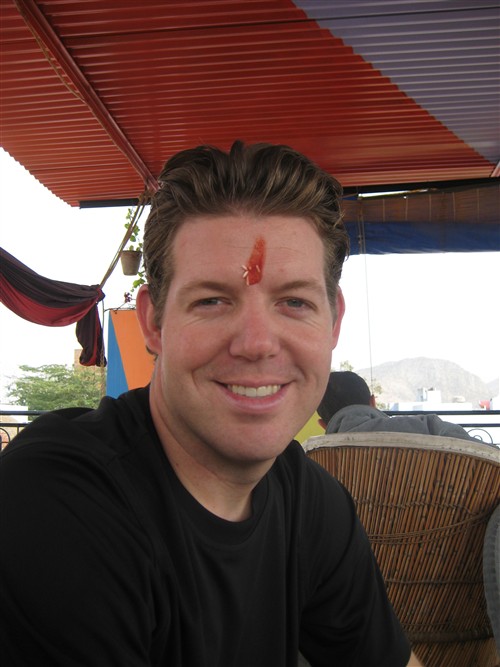 The priest led me through a series of prayers, alternating in heavily accented English and Hindi, with me repeating after him. I dutifully followed his instructions to wash my hands in the holy water, then place my wet fingers on my forehead, eyes, shoulders, heart and stomach, blessing each with my touch. I prayed for peace and love and good health and a long life and the same for those in my immediate family. At the conclusion of these prayers he dipped his wet thumb in the red powder on my plate, creating a red paste, and gently smeared it on my forehead between the eyes. I was finally allowed to walk to the water’s edge and pour the contents of my plate into the lake. I returned to the mat and the priest informed me that in order for the Gods to answer my prayers, I must make a donation to the poor, solemnly promising to feed no fewer that one thousand of India’s impoverished citizens. He spoke quickly, implying a minimum commitment of “One Food”, or one thousand rupees, about $25. Handing me a coconut and slowly dripping holy water onto it, he asked me repeatedly how many people I intended to feed. “One Food? Two Food? Three Food?” I initially balked at the promise, knowing that I had no intention of donating his asking price, but he would not let me complete my prayers without commitment. He again submerged his hand in the holy water, removing it and once again he let it drip methodically onto the outstretched coconut. “How many food?” His words clamped down like a vise on my conscience. I agreed to “One Food” and moments later, with my prayers official, I was ushered to a small table at the top of the steps where a man waited with an official receipt book.
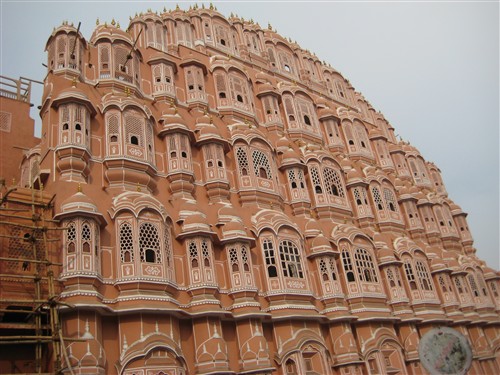 We flew from Mumbai to Jaipur, which is the capital of the Indian state of Rajasthan, and took a taxi to the Hotel Pearl Palace, near the city-center. Our room was not quite ready so we ventured up to the rooftop for a drink. Our room was tastefully decorated with local textiles and modern amenities. After settling in, we set out for a walk to the train station to purchase train tickets to our next few destinations. We only made it a half-block from the hotel before an autorickshaw-wallah convinced us to let him drive us around. Rickshaws are two or four-seater cabs or carts with a single driver’s seat in front. Autorickshaws have motors and can maneuver through traffic like a motorcycle. Bicycle rickshaws are slightly cheaper and good for short distances. We arrived at the train station and booked tickets to Ajmer, Udaipur and Jaisalmer. Our driver, Munna, was so friendly that we took him up on his offer to take us sightseeing around town for the rest of the day.
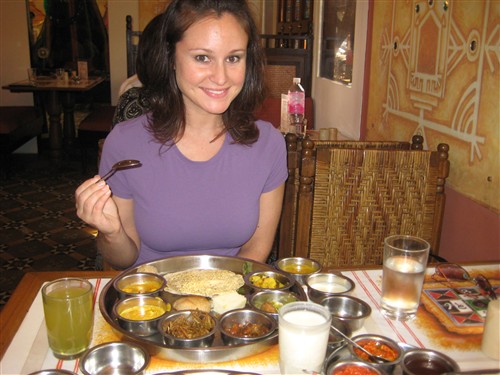
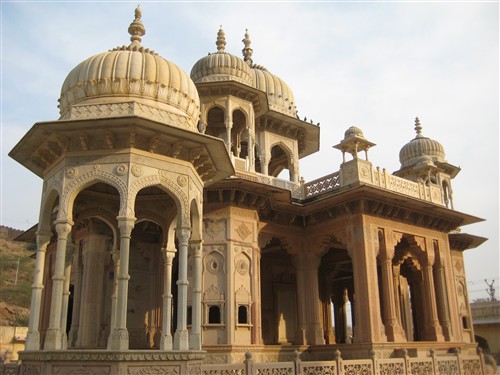 Munna recommended a good place for thali and we made a quick lunch stop before moving on. We were the only tourists inside the dim restaurant, which is a good sign. The thali was great, though much less elaborate than Chetana, and it energized us for our next stop: the Royal Gaitor. The royal cenotaphs, or tombs of the Maharajas of Jaipur, were set against dry, rocky mountains. They are beautifully carved monuments with intricate details, carved out of marble from Italy, India and many parts of Asia.
 Next stop: Amber Fort. Set on a mountain top about 11km north of Jaipur, the pale pink looks vast enough to encapsulate a small city. We declined offers of jeep and painted elephant transport to traverse the road leading to the fort entrance on foot. The courtyard of the fort was full of activity and, while Aaron waited in line to buy tickets, I was accosted by every variety of trinket-seller. Luckily, my pest-evasion skills are sharp these days and I was able to escape them with minimal effort. As we wandered through the fort’s many buildings, courtyards and labyrinthine hallways (the Maharaja’s passageways to his various wives and concubines), we admired the traditional Rajasthani architecture: elaborate entryways, beautiful city views from corner towers, and the intricate designs in the Hall of Victory and Hall of Pleasure. We could easily envision the Maharaja attending to his amorous desires between royal responsibilities.
 After waiting almost two hours on the tarmac at O’Hare for our plane to be de-iced, we were off on a rather uneventful eighteen-hour journey to Mumbai (formerly Bombay). We enjoyed the spiciest and most delicious Indian airplane food; in one meal, I ate a pepper (which looked like a green bean) that set off a four alarm fire in my mouth. As the plane touched down at Mumbai International Airport, two friendly Indian women gave us homemade chapati (Indian flatbread, similar to a tortilla) after Aaron helped them with their bags. Before we had even set foot on Indian soil, we felt warmly welcomed.