Posted under China
After checking off the Forbidden City, Tiananmen Square, and the Great Wall in our first two days in Beijing, we felt sated and slowed our pace. There was still plenty to see in the capital of what is forecasted to be the world’s next great Superpower – a city of sixteen million people, well on its way to becoming a bastion of consumerism; a city that is furiously preparing itself to host the 2008 Olympics in less than two months.
We set off early for the Summer Palace, a UNESCO World Heritage Site which formerly served as a vacation home for Chinese royalty. We rode the metro as far as we could and then caught a city bus the rest of the way. A female American expat scientist that we’d run into on the train offered to show us which bus to take, which was great because we had no idea. We talked a bit on the walk from the train station to bus station. She mentioned that she has worked in Hong Kong and China for the last ten years but the most interesting piece of information that she gave us was regarding the living conditions of some of her Chinese colleagues. She said that the government gives them a residence only three square meters in size. It is so depressing at home that the employees come to work very early in the morning, shower there, and stay late into the night, either working or playing computer games. I would have loved to spend the entire day listening to her talk about her experiences as a female expat in China but she was on her way to work.
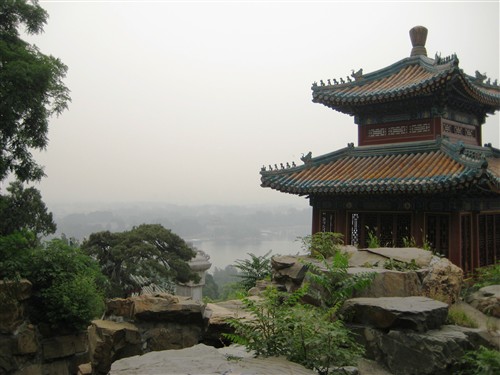
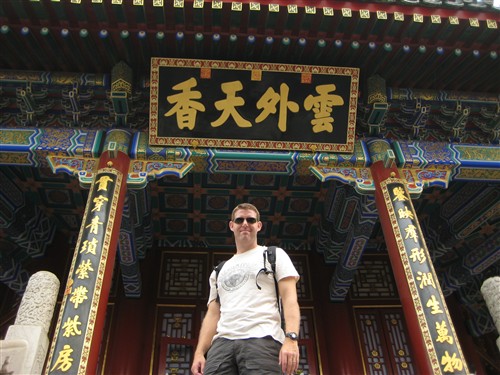 The architectural design of the entrance to the Summer Palace was strikingly similar to that of the Forbidden City – a pagoda-like structure ornamented with the same ornate patterns of red, gold, green and blue. Once inside, we wove our way through the throngs of tour groups – each group with its own matching hats – in the courtyard. We emerged at the edge of the sparkling blue Lake Kunming, which occupies three-quarters of the palatial grounds. A bluish-purple haze – likely a combination of clouds and smog – cast a mystical glow across the glassy surface of the lake and obscured the “templescape” on the northern shore. An elaborately decorated ferry cut through the glass as it carried visitors back and forth across the lake while paddleboats and rowboats careened about on the breezeless day.
We made our way toward the north side of the lake where most of the buildings were situated around the gentle slopes of Longevity Hill. The Buddhist temples, halls and corridors were all of intricate, colorful design and bore marvelous names such as the Hall of Benevolence and Longevity, Cloud Dispelling Hall, and Temple of the Sea of Wisdom. The focal point of the hill was the Buddhist Fragrance Pavilion – a vibrant, cylindrical pagoda overlooking the lake.
As we continued north, we came upon a shaded courtyard where approximately two hundred middle-aged Chinese women were practicing a choreographed dance routine, similar to the Electric Slide, while music blared from a large speaker. We couldn’t decide whether it was some kind of dance aerobics or they were learning the routine for an event related to the Olympics. In any case, they were in the early stages of instruction and were adorably focused on their task. It was quite a spectacle as the women skipped, shimmied and gyrated about the courtyard.
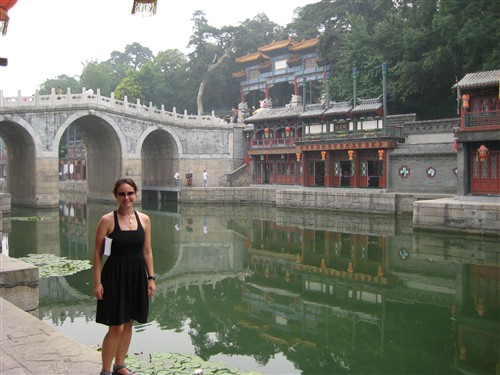 Past the dancers, we came upon my favorite area of the Summer Palace – Suzhou Street. Crossing an arched stone bridge, we caught our first glimpse of the traditional, red-laced shopfronts edging around a narrow canal. Suzhou Street was created as a replica of Jiangsu, a famous Chinese canal town. Its charming shopfronts were fully functional with tea houses, souvenir shops, Chinese calligraphers, painters, and photography studios in which visitors could dress in traditional Chinese silk costumes. A lone flute-seller demonstrated his instrument on the walkway, filling the entire canal town with his eerie, tranquil notes. We took a single leisurely lap around the riverside walkway and were beckoned inside every shop, gallery and tea house that we passed, which detracted only slightly from the charm of the experience.
As we made our way back through the courtyard, we noticed that the dancing women had dispersed and I was sorry that I hadn’t snapped a photo of them earlier. We found our way back to the lake and took the ferry across to the south side, near our exit.
The Summer Palace was symbolic of the grandeur and excesses of the early Chinese rulers. More than simply a vacation home, the palace was a royal playground fit for an emperor who needed a walled-in sanctuary like the Forbidden City to isolate him from his subjects. Seeing the decadence in which the historical rulers lived, we cannot help but wonder about the living conditions of the average citizen at that time. Was the whole of the empire living so large as to justify such palaces? Or were citizens enslaved to toil over palatial labors while they themselves lived in squalor?
China is the world’s longest continuous civilization. As Americans, it is difficult for us to fathom such long cultural history, that which predates Christ. As we visit countries like China and Egypt, we often find ourselves wondering why nations like these that seemed architecturally, artistically, socially and technologically so advanced fell steps behind later emerging nations. The trend seems to support the idea that man’s biggest enemy is always himself. Even a very advanced and economically dominant Superpower can fall victim to its leaders’ greed and proclivity for war. The world balance of power is dynamic…it is ever-changing. While the warring and decadence of old China may have caused the country to fall from grace, today’s China, according to countless analysts, seems to be on its way to the top.
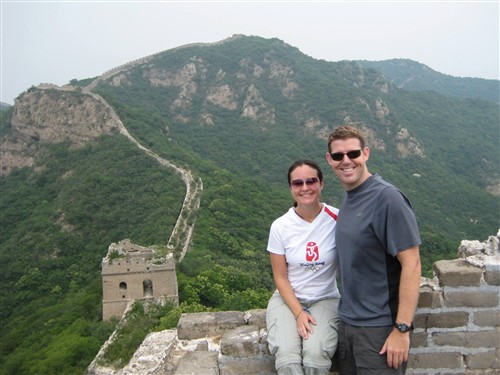
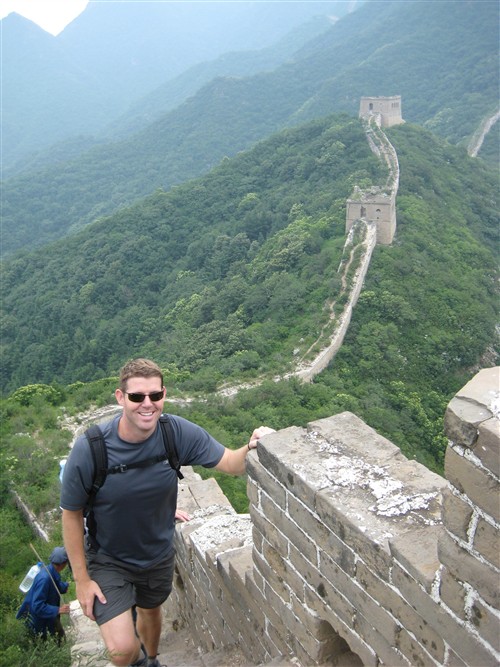 Our Chinese guide was a little old man (perhaps sixty, though it is always hard to tell with Asians because they age so well) who spoke only one word of English: “okay”. We never caught his name; he was introduced simply as “the guide” when we picked him up on the side of the road. From now on, I’ll refer to him as Wang because he needs a name. Wang led our group in slow, measured steps up the mountainside, on a narrow, rocky trail encroached upon by thick brush from both sides. The slow but steady pace of the ascent made the otherwise rigorous terrain quite manageable, even for a little whiner like me who hates steep inclines. Wang clearly felt no sense of urgency and everyone in the group was in fine spirits.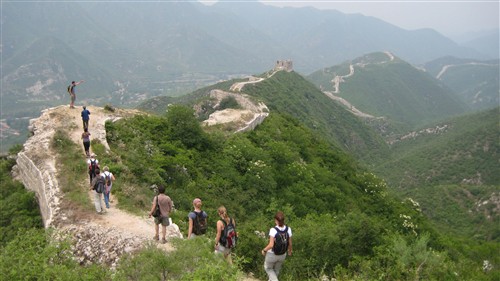
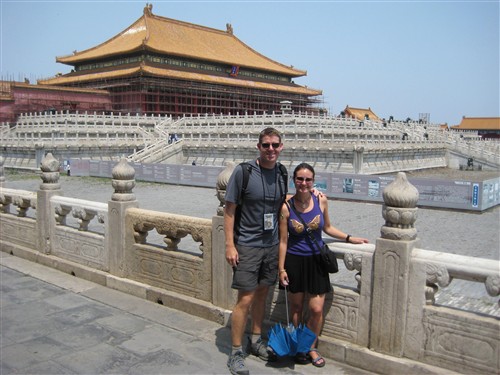
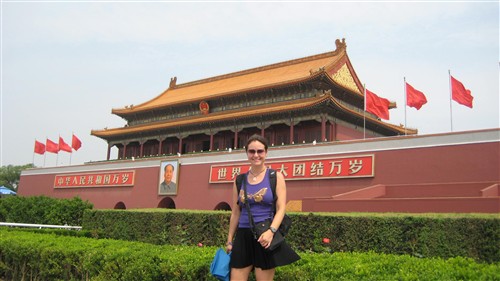
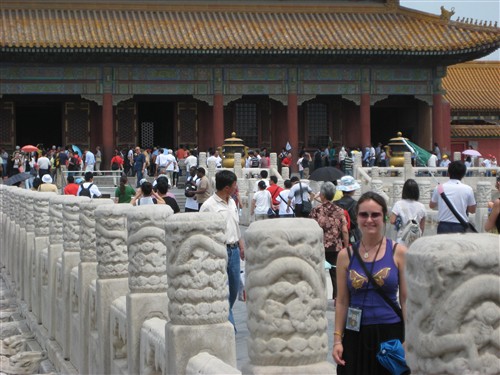 The Forbidden City lies adjacent to Tiananmen Square. We headed toward the entrance, drawn to the colorful rooftop of the hall towering over the Meridian Gate. We rented an audio guide with a built-in GPS system and walked inside. The Imperial Palace, now know as the Forbidden City because it was off-limits for 500 years, was constructed during the Ming dynasty in the 15th century and served as a secluded palace home to two dynasties of Chinese emperors: the Ming and the Qing. The compound was designed such that the emperors rarely had to leave its decadent, insulated confines. With a 2.6 million square foot area of halls, galleries, gardens and courtyards, it is not difficult to imagine living an entire life inside the foreboding city walls. The emperors held court, gave public speeches, received felicitations on special occasions, hosted foreign dignitaries, studied, amassed a great many treasures and lived their daily lives within the city walls. The main areas of the city were its various great halls, built in perfect alignment through the center of the compound. Each hall had a specific function and was richly decorated in blue, green, red and gold. The design of the halls and their opulent adornments were intended to acknowledge the divine right of the emperor to rule the people.
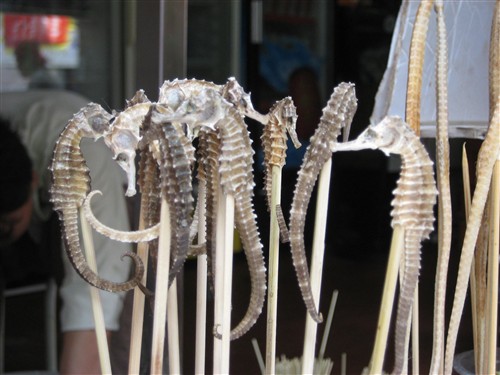 We had worked up quite an appetite and decided to walk to a narrow side street in the nearby Wangfujing district, nicknamed “Snack Street”. In reality it was more like an alleyway ornamented with a large colorful archway at the entrance. It was lined with food stalls and a few small restaurants. One vendor displayed skewers of scorpions, seahorses, snakes, starfish, and a variety of insects which could be fried upon request. I found it quite disturbing, especially the seahorses, which are so rare and beautiful. We passed on the exotic fare and were instead lured into one of the restaurants where there was no menu whatsoever and no one spoke English. We managed to order some dumplings and noodles (although we actually got noodle soup instead). We have found the food in China to be oily and mediocre so far but, after a long, hot day of walking in the Forbidden City, we were happy just to sit.