Posted under Italy
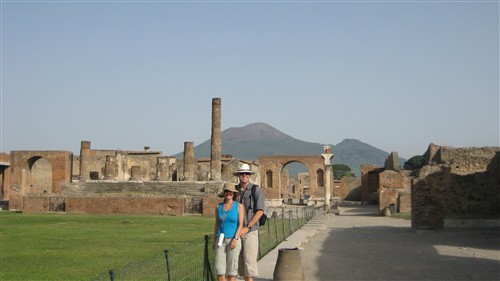
The fast ferry delivered us from Amalfi to Naples in just over two hours. The ride was pleasant and the view from the sun deck spectacular. As we neared the Naples port, we could see the mischievous Mount Vesuvius looming in the background. Having spent as much of the day as possible in Atrani, we arrived in Naples in the early evening. Naples is the city responsible for introducing pizza to the world and Aaron was licking his cheeky chops long before our arrival. Before disembarking the ferry, he had already decided on Pizzeria Da Michele – Naples’ most famous pizza joint – as our dinner venue. While I am generally in charge of the family nutrition, Italy is pizza country and Naples in pizza town. We had to indulge. The hand-tossed thin crust pies were to die for, layered with double mozzarella and the freshest ingredients.
The next day was devoted to Pompeii and, despite the incessant drunken racket of the obnoxious twentysomethings that kept us up half the night, we woke early to beat the crowds and the sweltering heat. We were among the first inside and, with our audio guides and our very stylish hats, we began to explore.
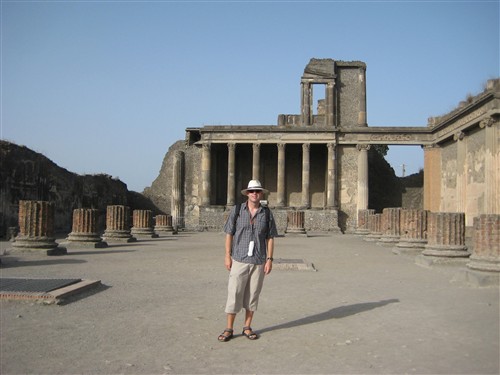 Pompeii, a Roman city that had been in existence for centuries, began to flourish in the 2nd century BC. In AD 79, Mount Vesuvius erupted, covering Pompeii in several meters of toxic volcanic ash. The ancient city remained buried beneath the ash for centuries until traces of it were discovered and excavation began in the 1700s. As fate would have it, the cocoon of ash actually preserved the structures and many of their original frescoes and, after hundreds of years of excavation, most of the remnants have re-emerged.
What is shocking about the ruins of Pompeii is the sheer size of the city and its level of development. The stone streets are arranged in a grid system. The city has government buildings, temples, two theatres, a stadium, a market, bakery, public baths, public swimming pool and athletic field, storehouse and hundreds of individual houses, some with elaborate floor plans. Many of the buildings have beautiful painted frescoes, stone and marble columns and mosaic tile floors that remain quite well intact after almost two thousand years. The most affluent homes have garden courtyards, which were the style of the time, and the gardens have been replanted to look as they probably did before the eruption. Walking through the old stone streets, peering into the ruins of two thousand year old homes, you really get a sense of what life in Pompeii must have been like. You can easily imagine the streets full of activity: children playing, women cooking and sewing, men discussing business or politics on the lawn, young men competing at sport.
One of the most interesting buildings to walk through was the brothel. It had several tiny rooms, each with a stone bed where the prostitutes would service their clients. Only slaves and middle class citizens patronized the brothel. Wealthy clients received working women in their homes. Above the tiny brothel rooms, interesting frescoes depicting various erotic positions are visible. Etched into the brothel walls are names of some of the most beautiful prostitutes as well as client names and complaints about venereal disease.
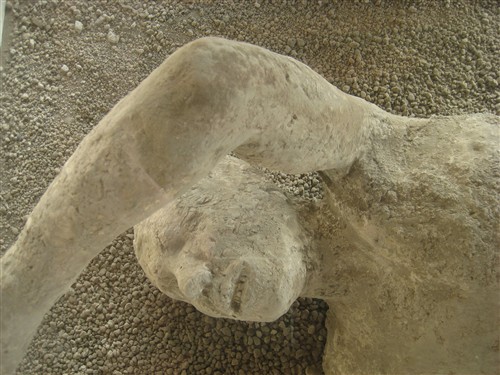 The most fascinating things that we saw among the Pompeii ruins were the bodies. As the volcanic ash began to fall from the sky, many people suffocated and were buried in the meters of ash. When they died, their bodies became petrified in their final agonizing positions. When the bodies decayed, their petrified shapes remained. They were an eerie sight. There was even one body of a dog that had been chained inside its house, its contorted death pose petrified for eternity.
We’ve seen a lot of ruins on this trip, but Pompeii is unique in its level of preservation, the modernity of the city plan and buildings, and the fascinating tale of its destruction. Pompeii reminds us of how small we are in the scheme of our world and in relation to the passage of time and also how quickly we can disappear from this earth if it is the will of God. The thriving, bustling, affluent city disappeared beneath layers of ash for 1,500 years – an entire city gone in a matter of a day.
Touring the ruins was a hot, dusty, exhausting experience and also a rewarding one. We finished off the excursion with frozen lemon- and orange-ades, made from fresh-squeezed juice, and gigantic salads with the ripest, reddest tomatoes and the freshest buffalo mozzarella. We had spent about three hours in the ruins and, on the bus ride back to Naples, we sat in near silence. Pompeii left us with much to ponder.
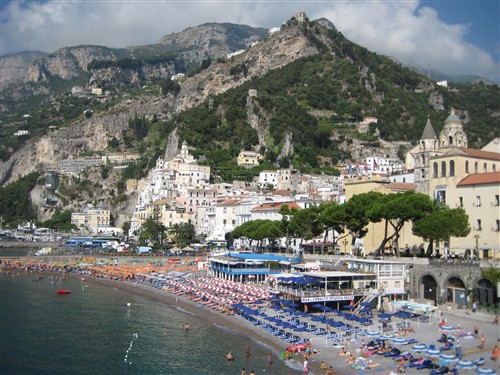
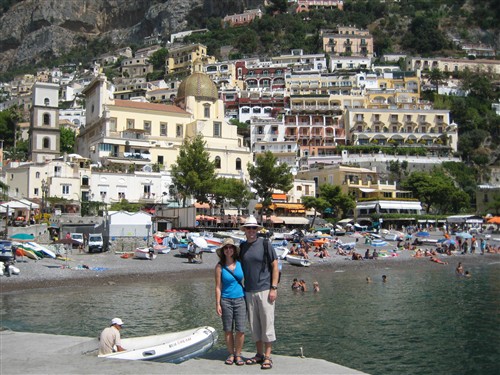 The Amalfi Coast is as stunning as it sounds. The coast itself is a Unesco World Heritage site composed of whitewashed towns built into sheer cliffs on the perfect blue Mediterranean. Small strips of black volcanic sand, peppered with smooth pebbles and beach glass, dotted with striped beach umbrellas line the coast and, on any given day, there are as many locals swimming as tourists. The waves are gentle and the coast sits at such an angle that the sun lights up the cliffside towns both morning and afternoon.
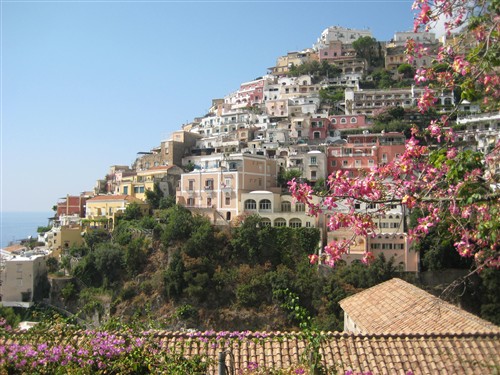 Positano stretches around a crescent moon-shaped bay with each end elevated on a cliff side, which makes for excellent photography. The pretty building facades, painted white, yellow and terra cotta, light up beautifully against the steely cliff. The bus from Amalfi stops at one end and by the time you make it down the hill and into town, you have used up half your camera battery and are brimming with excitement. We began by wandering through the tangle of whitewashed alleys with colorful shops around every corner. By mid-morning it was already hot and we treated ourselves to some terribly stylish hats and a few other treasures, letting ourselves pretend to be two-week vacationers just for a day. We sat for lunch at one of the beachside cafes and shared a pizza and, after a bit more wide-eyed wandering, headed back to Atrani. Both Positano and Amalfi have pretty beaches but we were drawn to our own beach at Atrani, mostly because it was close to our piazza.
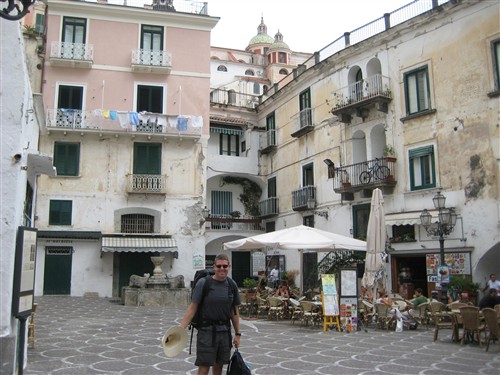 The Amalfi Coast was the perfect place to spend our anniversary because its many delicious similarities to Santorini – the whitewashed buildings, black sand beaches, and pristine blue waters of the Mediterranean – recalled wonderful memories of our honeymoon. We recounted the many blessings in our lives and the happy dream that has been this year traveling the world. Highlights from our great adventures flash through my mind as I sit in our piazza staring out at the ocean and I am tickled by the blooms of our rather unconventional decision just over a year ago. At this moment, in this beautiful place, my heart is full of happiness and I suddenly realize that the pain and hardships that we must endure in our lives make the joyous moments so much sweeter. I realize that, today, I finally feel whole again, my once-faltering faith restored after our recent loss.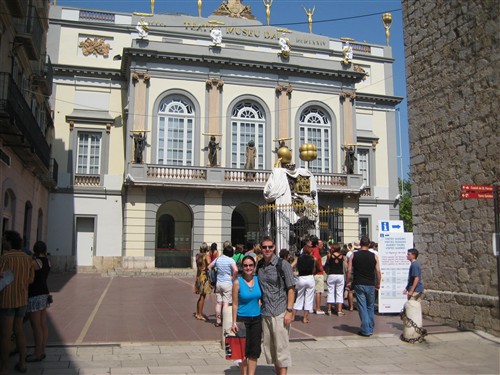
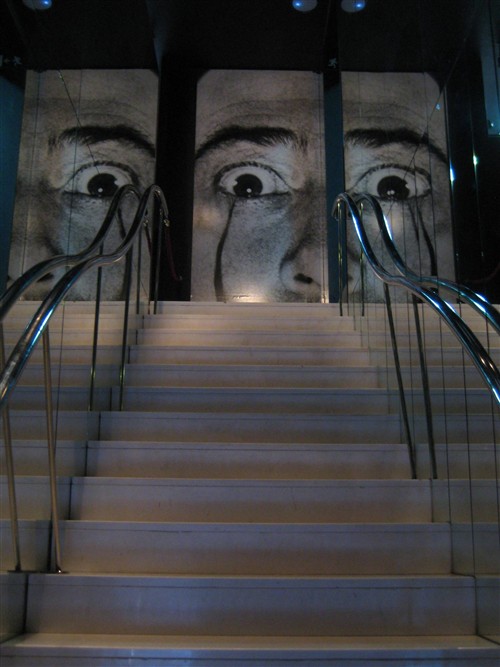 The Figueres’ former municipal theater, burned and destroyed during the Spanish civil war, was personally converted by Dali to create the museum. A brochure that we picked up at the museum entrance suggested that “the Dali Theatre-Museum should be seen as a whole, for Dali conceived and designed everything in it with the aim of offering the visitor a veritable aesthetic experience, and the opportunity of entering the artist’s unique, fascinating world.” And what an amazing world it was, filled with Dali’s psychedelic and spectral images! Tina is unshakably convinced that there must have been some fantastic hallucinogens in Gaudi and Dali’s time. After two hours of wandering around the multilevel amphitheatre we were both overwhelmed by the artist’s unique and varied creations – paintings, drawings, sculptures, gold, jewels, and installations. Dali was certainly not confined to the medium of painting for which he is most famous. He liked to paint his wife, Gala. He liked to create things that move. Filled with cartoon-like sketches, enormous wall-covering paintings, surrealistic oil paintings, doorways morphed into giant faces, and a chaotic array of sculptures and installations, the museum left us speechless. It was easily one of our favorite museums in the world.
 Our tickets granted us entry to another of Dali’s museums nearby, the Dali Joies (Dali Jewels). In the 1940’s, Dali was commissioned to design a collection of jewelry. The result was an eclectic display of beautiful bejeweled anthropomorphic creations including The Eye of Time, an eye-shaped mosaic of platinum, ruby and diamonds and The Royal Heart, a solid gold heart with an inset ruby-encrusted, mechanized heart that appeared to beat. Dali summarizes his collection best. “The jeweled pieces – ornaments, medals, crosses, objets d’art – you find are not conceived to rest soullessly in steel vaults. They were created to please the eye, uplift the spirit, stir the imagination, express convictions. Without an audience, without the presence of spectators, these jewels would not fulfill the function for which they came into being. The viewer, then, is the ultimate artist. His sight, heart, mind – fusing with and grasping with greater or lesser understanding the intent of the creator – gives them life.”
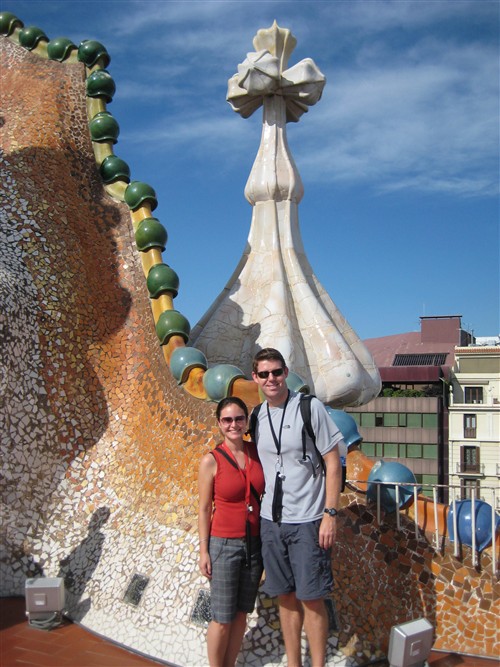 Never again will we underestimate the contributions of the Spanish to the overall beauty of the world…and I’m not just talking about the dark hair, Mediterranean skin and heaving cleavage. We have waded into the Barcelona art scene, a playground of Picasso and Modernista architect, Antoni Gaudi. With six nights to play, we felt sure that we could visit Barcelona’s most impressive sights with plenty of time leftover for sangria and the beach. We were mostly right.
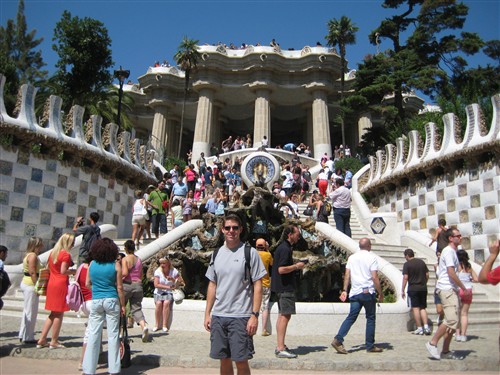 We devoted an entire day to admiring Gaudi’s brilliant work, beginning with a visit to Park Guell. The project began in 1900, on a piece of prime real estate overlooking the sea, as a housing development for the wealthy but ended fourteen years later as a commercial failure. The city later purchased the incomplete development and turned it into a public park. From the metro stop, a series of escalators carried excitable tourists up the side of a steep hill. Once inside the park, landscaped gravel walking trails wound around the hillside overlooking the Mediterranean. The trails eventually led to the remnants of Gaudi’s creations for the original housing development project: two “gingerbread” gatehouses, a colorful, curvy plaza and 3km of roads, walks and steps. The park was a beautiful place for a picnic and many people had copped a squat in the pillared pavilion at the entry while musicians played for tips. The plaza was a large open area surrounded by a squiggly mosaic bench and it was there that I really began to visualize the potential of the original project. It would have been like living in a fun house with pretty touches everywhere to make people smile. That was Gaudi’s way.
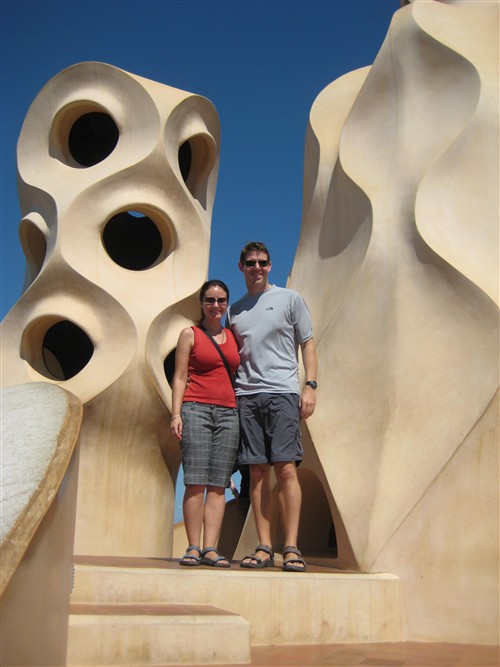 After the park, we moved on to another one of Gaudi’s creations – La Pedrera – an apartment building commissioned by a well-to-do couple. “La Pedrera”, meaning stone quarry, was a nickname given to the building because it looks like it is carved out of stone. The completed building consists of two blocks of apartments, each with its own interior courtyard, and with one continuous façade that curves around a corner lot. An apartment on the fourth floor was decorated as it would have been in the early 1900’s, when it was inhabited by the Barcelona bourgeois. The floor plan encircled a large interior courtyard, filling the apartment with light. From the swirling ceilings and parquet floors to the moulding, door knobs and other ornamental embellishments, every detail of the interior has Gaudi’s personal touch.
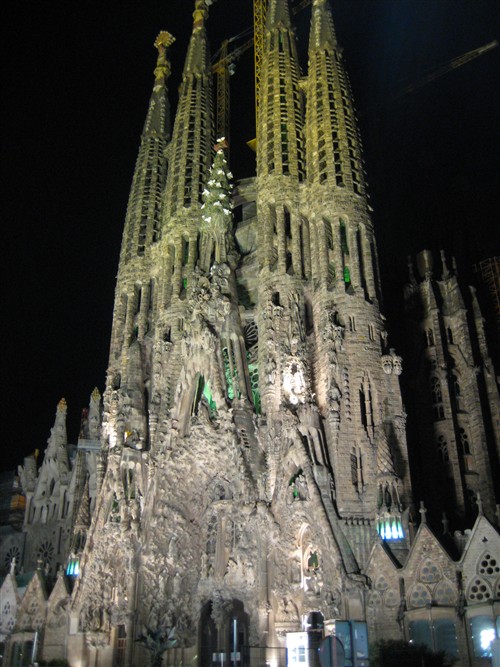 Exhausted but still trudging along, we made our way to Gaudi’s most famous creation and Barcelona’s most famous work-in-progress: La Sagrada Familia. Begun in 1882, the church was the project to which Gaudi dedicated the latter part of his life and was left incomplete when Gaudi died in 1926. It is an awe-inspiring synergy of a traditional Gothic design and Gaudi’s shocking Modernista flair. Stunning sculptured façades seem to jump off the church and the narrow pointed towers are breathtaking to behold. La Sagrada Familia looks more like a fairy tale castle than a church. Work continues slowly, according to Gaudi’s original designs. The completed structure will be a glorious monument to an artist who left an unforgettable mark on Barcelona. The photos simply do not do it justice. It is a church unlike any the world has ever seen.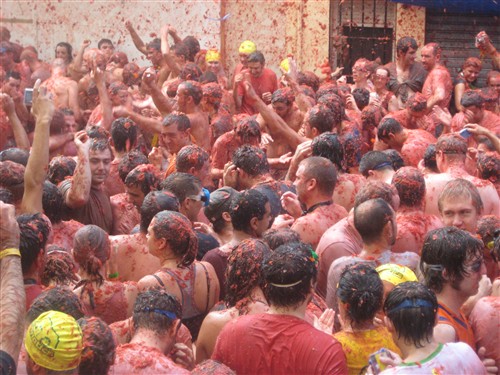
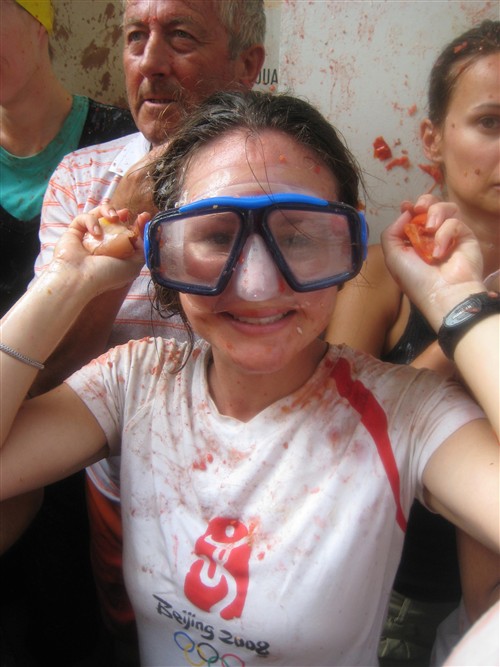 We checked into our three-star hotel in Valencia – the cheapest room we could find during La Tomatina – joking that it was three more stars than we usually get. The tomato fight takes place in Buñol, a town of about 8,000 people, 40 kms away, but Buñol has little in the way of accommodation so everyone stays in Valencia and trains in for the event, with the exception of those who drink all night in Buñol the night before and sleep on the street. That’s not really our style.
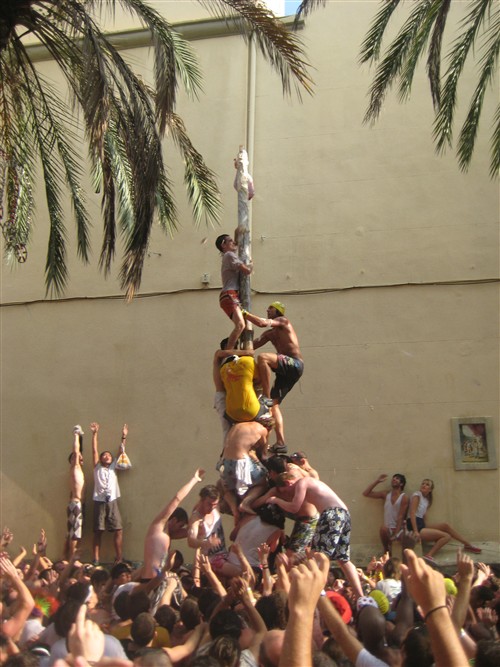 The ham pole went up around nine. An integral part of the annual tomato fight, a telephone pole with a ham leg tied to the top is fastened into the ground. The pole is slathered from top to bottom with a thick layer of what looked like animal lard but smelled more like soap. Per tradition, the crowd must climb the pole and cut down the ham before the tomato fight can begin. With two hours and a little coordination, that should be no problem, I thought to myself. Wrong!
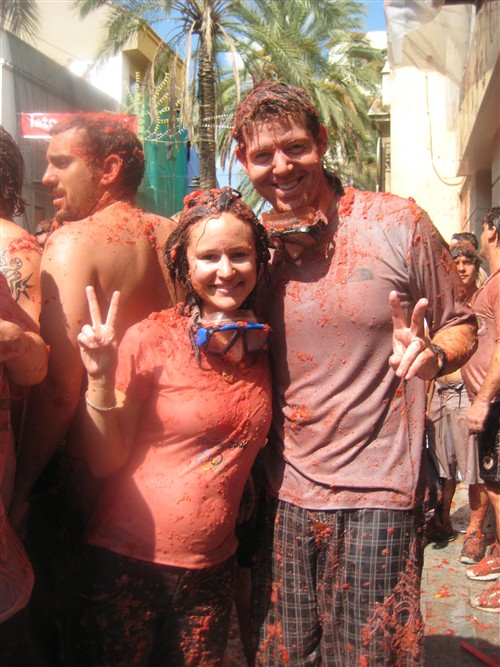 Thankfully, Aaron and I had established a rendezvous point and found each other again shortly before the bell rang to announce the end of the tomato fight. We were exhilarated, exhausted, and covered in tomato from head to toe. It was caked in my hair, stuck to our clothes, and coming out of our ears. Luckily, our scuba masks had worked perfectly, leaving our eyes the only body part immune from the mess. As the crowd shuffled slowly back uphill toward the train station, the sun which had remained sympathetically hidden behind the clouds all morning, made its glorious entrance and I began to feel the acidity of the tomatoes on my skin. Many good-spirited locals sprayed hoses into the crowd but there were so many people vying for the same sprinkles. We arrived at the train station to find long lines everywhere…long lines for the now disgustingly vile portable toilets, long lines for the makeshift showers, and long lines for the trains. We paid our dues in all three lines over a span of two hours before finally boarding the train back to Valencia.