Warning: Use of undefined constant ‘wppa_setup’ - assumed '‘wppa_setup’' (this will throw an Error in a future version of PHP) in /home/youngs/public_html/wp-content/plugins/wp-photo-album/wppa.php on line 28 Youngs Around the World » Europe
As self-proclaimed wine connoisseurs – a passion cultivated over years of devoted “study” – we have been privileged to visit wine-producing regions around the world and sample the fruits of their land and labors. From Napa to South Africa to Australia and New Zealand, we have been enthralled with the art of wine tasting. It has always been a stress-free, happy experience. Not so in Bordeaux.
While most wine regions around the globe warmly welcome visitors on a walk-in basis, the Bordeaux wineries require visitors to make an appointment. While decidedly inconvenient, if that were the sole obstacle to enjoyable wine tasting in Bordeaux, I would not even bother to mention it. From the office of tourism, we had obtained literature describing the various wineries in the region. Next to each listing was a picture of one or more national flags, indicating what languages could be accommodated at the winery. The problem was that when I called the supposed English-speaking wineries to make appointments, almost no one on the other end of the lines was willing or able to speak English. Now, Aaron and I both studied French for four years and, while no one would mistake us for French, we are both functional French speakers. When I attempted to make appointments using my functional French, no one would accommodate us. It was bizarre and frustrating. I dialed nearly twenty of Bordeaux’s “English-speaking” wineries and got two appointments. I felt like I was making cold calls for a sales job!
As it turned out, our two tasting appointments were wonderful and we left them both smiling and happy. We decided to take a drive along a well-known “chateau trail” as outlined on our map from the tourist office. The Bordeaux region boasts upwards of 5,000 wine-cultivating chateaux. We drove along, stopping at leisure to photograph the lovely facades, including the much-admired Chateau Margaux.
While we were disappointed by the chilly reception of the Bordeaux wineries, we made the most of our experience there and still ended up tasting plenty of local wines. Our California red-soaked palates have developed a financially unfortunate affinity for French wines. For those interested in “doing Bordeaux”, we might suggest booking an organized tasting tour in advance. While the haughty French attitudes were difficult to endure, the wines were wonderful!
Our road trip continued south toward Bordeaux where bright yellow fields of sunflowers were soon interspersed with sprawling vineyards. On the way, Aaron found the picture-perfect patch of sunflowers so we got out of the car and leaped a narrow ravine (at which time I was reminded that I wasn’t ready to be leaping ravines just yet) to capture the moment. On the way back, a chivalrous gent with big cheeks carried me across like a princess. We arrived in Bordeaux in mid-afternoon and Aaron and Valerie ventured out for a walk while I opted for a few solitary hours of recovery time.
The next morning began with a leisurely stroll through the Bordeaux Sunday market. The rows of vendor stalls selling fruits and vegetables, fresh fish, bread, pastries, meats, cheeses, olives, wine, locally harvested oysters, and scrumptious tapas and prepared foods lined the wide River Garonne and filled the air with tantalizing aromas. Locals abounded with their signature French woven baskets, filling them with items for the day’s meals. After perusing every stall, we selected a large bowl of mussels béarnaise and a baguette for a picnic brunch.
Our destination for the day was the historic town of St Emilion, known for its vineyards and full-bodied red wines. The scenic 40km drive landed us in the medieval stone village before noon. We stopped to admire the golden-hued stone walls and the expanse of vineyards beyond. The town’s only tourist site was a monolithic church built underground by monks from the 9th-12th centuries. We stopped into the tourism office to buy tickets for the English tour and then had a couple of hours to tool around town on our own before it began.
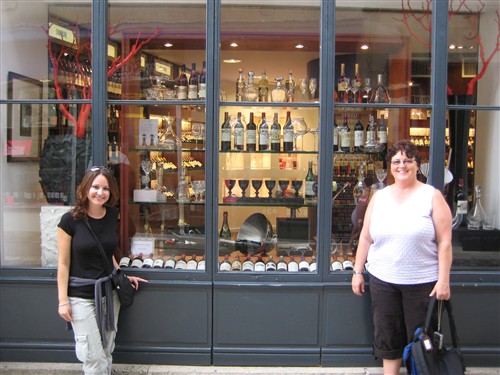
The village was built entirely of limestone. Once a wheat-producing community, the St Emilion of today is entirely devoted to wine. The narrow cobbled streets are lined with boutique wine shops, restaurants and hotels oozing charm. So dedicated is the village to wine tourism, that there is one wine shop for every four residents. Window shopping among these wine boutiques enticed us to indulge and, after a tasting in one of the shops, we decided to relax at one of the ubiquitous sidewalk cafés, sipping wine until tour time. The quartet of musicians that had lured us to that particular square stopped making merry just after we sat down but there were plenty of interesting people to keep us entertained.
The town was named after a monk, Emilion, who settled there in the first century, living a hermit’s life in a stone cave for 17 years. Our tour began with a short descent into Emilion’s cave, which consisted of two “rooms” with a bed, a meditation seat, and a small pool from an underground river. Our guide explained that Emilion’s meditation seat is believed to have powers of fertility and that 70-80% of women who sit on the seat send letters attesting to its magic. Guess whose buns were the first ones onto that seat? And once more on the way out…just in case the power didn’t soak in the first time.
We descended next into the historic town crypt where monks, men of status, and male babies were once buried. In those days, women were believed not to have souls so they were buried in the outlying fields. The crypt had long since been plundered of its treasures and remains but we were able to see the individual underground graves carved into the stone and the tiny carve-outs for the babies.
Finally, we entered the monolithic church. “Monolithic” means one level or one piece. The church was built underground for protection from Vikings and violent religious persecutors. Limestone blocks were excavated through small openings at the top. The depth of the interior was astonishing. There were only faint remnants of the original iconography and the limestone pillars had been recently reinforced by sturdy metal braces but the cool, damp, cavernous interior enveloped our senses and called to mind visions of devout worshippers bowed in candlelit prayer. On one Sunday each month, services are held in the monolithic church in commemoration of its founders.
As we exited the church into a burst of golden sunlight, I turned to gaze upon the entrance once again. I imagined the intense labor involved in creating this massive underground church by hand. Naturally, it would have been easier to build the church above ground but the reality of religious persecution forced the community to conceal and protect themselves in practicing their faith.
The draw of St Emilion is certainly its wine but the town has a fascinating history, which can be absorbed in less than an hour. Like so many charming French towns, the artistry, architecture and bright summer flowers create an ambience that makes you feel as though you’re walking around in a painting. France makes me want to fling my crusty backpacker duds onto a rooftop, don a pretty dress and stylish chapeau, and fold artfully into the scene.
Having missed our planned day trip to Chartres due to my surgery, we decided to take a detour (a big one – almost all the way back to Paris) between Normandy and Tours. Our love of churches and the carefree, adventurous nature of our trio outweighed the pain from the exorbitant price of European petrol – almost $10/gallon! The town of Chartres was awash with bright summer flowers and we soon forgot the distance of our detour.
A UNESCO World Heritage Site, the Cathedrale Notre Dame de Chartres is most interesting for its two grand spires, each of a different design: a 16th century Gothic spire on the left and a 12th century Romanesque spire on the right. While the Gothic design is characteristically ornate and the Romanesque spire is classically plain, the two blend seamlessly together to create a stunning and foreboding façade. Inside, a dark, almost ghastly ambience is imbued by the grey stone interior walls and the famously deep-hued stained glass windows filtering the only daylight. The sheer height of the domed ceiling is humbling. We spent our time walking around the altar, silently contemplating the Biblical sculptures and stained glass.
The most venerated object in the cathedral’s treasury is a veil that is purported to have been worn by the Virgin Mary when she gave birth to Jesus. Unfortunately, the section of the cathedral where the veil is usually displayed was under construction so we were not able to view it.
Back on the road, we continued toward Tours in the Loire Valley, famed for its lavish chateaux. The region was once known as a playground for 15th to 18th century royalty and nobility. We were an hour outside Tours when I began to realize that the hotel I’d booked for us was at least an hour’s drive from Tours and in the direction opposite of all of the chateaux that we wanted to visit. My heart sank further and further into my chest as we passed Tours and continued well into the remote countryside. My companions were great sports, however, and didn’t give me too hard a time. We finally arrived at a golf resort with two rows of charming two-storey villas on a spacious green property. As we checked into one of the upper floor apartments, we were delighted to discover a fully stocked kitchen and sitting room in addition to two bedrooms. It was the loveliest and most quiet place in which we have stayed in France, which almost made up for its location.
The next morning, we headed out for a day of touring chateaux. The two early birds in our trio were slightly annoyed with the late bird for snoozing late, lingering over a cappuccino, and then taking too long to get ready. The late bird was unconcerned by this, however, for three reasons: 1) she was post-surgical; 2) we were still on the road by mid-morning; and 3) the late bird knew that she was outnumbered and would be a slave to the early bird schedule soon enough.
A near two-hour drive finally landed us at Chateau de Chambord around lunchtime and we ate a quick picnic in the parking lot upon arriving. The chateau, commissioned by Francois I in 1519 as a hunting residence and taking 15 years to complete, is often toted as the grandest of all the chateaux in France. Interestingly, Francois only resided in it for 42 days during his reign (Lonely Planet France: Jan 07). A single glance at the magical exterior was enough to channel the vivid imagination of a childhood princess, conjuring the castle of her dreams. The Chateau de Chambord, with its many ornate domes, chimneys, and towers, could easily have been cartooned into a Disney film.
The chateau was set on a spacious property with vast, tree-lined fields. The entrance was so far from the parking lot that I had already exhausted my very limited walking stamina by the time we reached the foyer and I could go no further. I found a bench between two enormous tapestries and spent the next hour eavesdropping on guided tours in three different languages while Aaron and Valerie explored the interior. When we reunited, they cheerily reported that the exterior was the best part anyway.
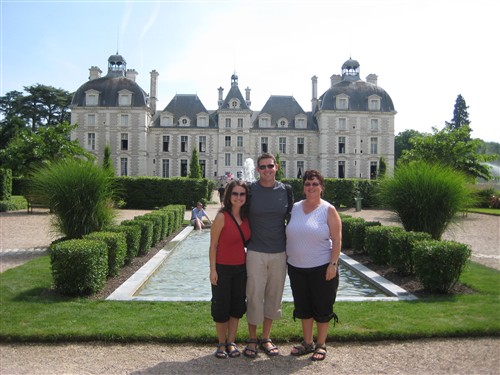
The highlight of the day (in my biased, dog-loving opinion) was our final stop at Chateau de Cheverny. I had rested in the car between stops so that I would have maximum stamina for our late afternoon visit. The classical façade, pristinely manicured gardens, expansive grounds and magnificent period furnishings were a true pleasure to admire. However, we had come for a different thrill: the soupe des chiens, or feeding of the dogs. “As was the custom among the nobility of centuries past, Marquis Charles-Antoine de Vibraye – whose family has owned Cheverny since it was built – hunts with dogs.” Most of his 100 canines are a cross between English fox hounds and French poitevins. (Lonely Planet France: Jan 07).
After leisurely touring the chateau and grounds, we made our way to the kennels to secure a front row spot for the 5:00pm feeding. When we first arrived, the dogs were laying about in the lower outdoor area of their two-level residence. They were truly beautiful, resembling Beagles in color and body type, though they were larger in size. The sheer number of them created a magnificent spectacle of fur and floppy ears.
One of Cheverny’s two dog trainers (both of whom are purported to know every dog by name and lineage), who bore an uncanny resemblance to Adam Sandler, entered the kennel and opened a gate to an upper outdoor terrace. The dogs, knowing this to be the commencement of the feeding ritual, scurried up the stairs to the terrace after which the trainer closed the gate at the bottom of the stairs. By this time, about 4:40pm, a crowd had gathered around the perimeter of the kennel. With the dogs watching intently from above, the trainer hosed down the cement surface of the kennel. He then disappeared and returned shortly thereafter with a huge wheelbarrow of raw and plucked chicken and duck carcasses. He dumped the load into a pile and used a rake to spread the parts into a line across the kennel. Next he brought out a huge sack of kibble and spread it over the carcasses. The dogs became increasingly excited with each passing minute and all eyes were glued to the trainer as he nonchalantly leaned back against the opposite wall of the kennel to wait for 5:00 sharp. The dogs eyed their dinner ravenously for almost a full ten minutes before the bell of the chateau clock rang five gong-like chimes. At the sound of the clock, the dogs went wild! The trainer did not move; did not change his facial expression from the confident authoritative smirk with which he’d attended to all of his tasks.
When he’d reminded the pack that it was he, not the clock, who controlled their meal privileges, he walked slowly toward the gate and opened it. The dogs shuffled out and lined up a few feet in front of the food, barking madly. The trainer stood between the dogs and their food, gently waving his whip back and forth across the line as the maniacal pack inched toward the food. One fight erupted but the two culprits quickly melted into the pack. Then suddenly the trainer moved aside and carnal chaos ensued as the entire pack made a simultaneous mad dash for the meat. Not every dog would get a piece of meat; it was every dog for itself. Only the strong shall survive. Scuffles erupted over the meat and weaker dogs lost their booty to the alphas. Blood was shed from furry faces, necks and ears. Only when the meat was consumed did the nuggets of kibble begin to disappear. The entire spectacle lasted only two or three minutes but they were some of the most intense minutes of my life, witnessing the nature of the beast. As we walked back to the car, our hearts were racing with excitement. The soupe des chiens was one of the most amazing things that we’ve seen on the road and although my body was screaming “Too much!” by the end of the day, I will never forget the thrill of that experience.
On the way back to the country, the late bird happily pointed out to the early birds that, had the trio not gotten a late start that morning, we would surely have missed the 5:00 feeding. Forget the worm; in the Loire Valley, the late bird catches the dogs!
With the car packed up, we left Paris and set out for Normandy. My parents had recommended a stop in the historic seafaring town of Honfleur along the way and we decided that we should not miss it. The picture-perfect town was situated around a small harbor full of extravagant pleasure boats. Surrounding the harbor were outdoor cafes and boutique shops in gorgeous old buildings with flower boxes in every window.
Since I couldn’t walk far, Aaron dropped us off in the main square and parked the car. We made one slow, careful lap around the harbor, stopping for a lovely lunch of salads and mussels on the water and again for cones of gelato. The town was drenched in bright summer flowers and overtaken with impeccably dressed French and foreign tourists. I found myself longing for a sundress, pretty sandals, and an afternoon to wile away sipping French wine on the deck of my sailboat. We took some last photos, vowing to return someday with the budget of two-week vacationers, and said goodbye to beautiful Honfleur.
Hours later, we reached our destination for the night – the tiny town of Ceaux in Lower Normandy, just ten minutes from Mont Saint Michel. We could see the abbey in the distance as we searched for our hotel and, after quickly settling into our room, we went right for it.
Rising from the flat golden plains like a Gothic fairy tale castle against a backdrop of ocean meets sky, Mont Saint Michel casts an awe-inspiring silhouette. The Mont sits atop a small rock island connected to the mainland by a natural bridge. At low tide, the island is surrounded by flat white sand and is only fully surrounded by water during seasonal equinoxes. A tiny town with a population of only 42 rounds the circumference of the Mont within an old stone wall. Catering to the throngs of tourists, the lower floors of the buildings have all been converted to souvenir shops and restaurants, creating an avenue of crowded commercialism around the abbey, though Mont St Michel remains a fully functioning town complete with a post office and garbage service. My post-surgical handicap precluded me from tackling the many stairs inside the Mont so I parked myself inside a café with a Nutella crepe while Aaron and Valerie ventured further inside.
On our way out of town the next morning, we stumbled upon a beautiful field of wildflowers edging the pale blue ocean. Aaron and I hopped the low barbed wire fence and waded into the patch of red, white, violet and pink blossoms. By the time we’d finished frolicking, at least four more cars had stopped along the shoulderless two-lane highway to join in. The French traffic was not amused and conveyed as much with their annoyed honking. We didn’t care, though; the wildflowers in Normandy were simply too beautiful to miss.
Back in Paris, we have acquired a traveling companion for the next few weeks – Aaron’s mom. She arrived in the morning with big smiles, big hugs and lots of presents! I felt awful that she would have to endure a bit of our stressful medical issues during her vacation but, at the same time, I was glad to have her with us.
We spent four nights in Paris during which I was in and out of commission as determined by my “ailment”. Together we visited the Eiffel Tower, the Louvre (one of my favorite places in the world), walked along the picturesque Seine and down the Champs-Elysees. Our pace was much slower than that of our trip to Paris during which we excitedly rushed around to see everything.
On Sunday, we arrived early at the Champs-Elysees, where we would camp out all day in the sun to mark our spot for the finish of the Tour de France. This was Aaron’s day and he was decked out in the Tour’s signature yellow for the occasion. We claimed a prime spot near the Arc de Triomphe next to a nice American family with whom we visited throughout the day. The hours passed surprisingly quickly and, as mid-afternoon approached, the crowds grew increasingly dense. When the caravan arrived, it was ten times as raucous and rowdy as it had been in Grenoble. By this time, we could no longer sit down but had to stand for the last several hours to maintain our front row spot.
The racers arrived over an hour past the printed schedule time but the crowd was immediately forgiving; it wailed in unison as the triumphant athletes performed eight laps around the Champs-Elysees. As Aaron explained, the winner of the race and le maillot jaune (the yellow jersey) had already essentially been decided in an earlier stage. The final laps around the Champs-Elysees were more like victory laps for the entire peloton.
From our prime position along the northern curb, the riders were within an arms length of us. In fact, we had to be careful when reaching our cameras over the barrier not to clothesline the outermost riders in the peloton. The scene was electrifying – a brilliant spectacle of bright colors and finely-chiseled bodies cheered by a madly roaring crowd. At the end of the day, we were utterly exhausted. We braved the crowded metro system back to Montmartre, picked up dinner on the street, and hibernated until morning.
On Monday morning, we were back at the hospital for another ultrasound followed by emergency surgery, though it was more of a scheduling emergency than a medical one, since we planned to depart from Paris on our road trip the next morning.
Having endured this surgical procedure twice now, once in Texas and now in Paris, has provided a basis for comparison between American medical and French medical care. While I would characterize my experience in the British-French hospital as adequate (and worlds above the standards in China and Nepal), I have a newfound appreciation for the American standard of service as applied to surgical care. Subtle differences in my Texas surgery, involving pre- and post-surgical service, made a big difference in the comfort and quality of my overall experience. I have heard and participated in discussions for years, usually around election time, about the need for American health care reform. While I cringe at the cost of prescription drugs and ever-increasing co-pays and the cost of medical care in general, I hope that whatever reforms are implemented in the coming years do not diminish the rigorous quality standards of American medical care.
My surgery had been completed by one p.m. but I was not discharged from the hospital until six. Aaron and Valerie had picked up the rental car that afternoon and Aaron drove us back to Montmartre. I had a box of painkillers and the reluctant blessing of my surgeon to travel the next morning if I was feeling up to it. Barring any obvious complications, I was quite certain that I would be.
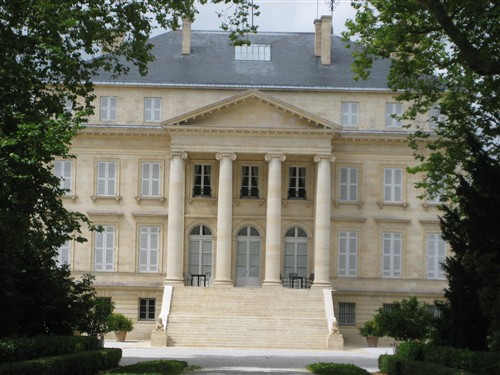
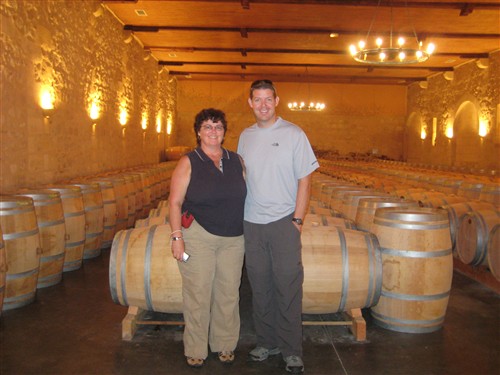 As it turned out, our two tasting appointments were wonderful and we left them both smiling and happy. We decided to take a drive along a well-known “chateau trail” as outlined on our map from the tourist office. The Bordeaux region boasts upwards of 5,000 wine-cultivating chateaux. We drove along, stopping at leisure to photograph the lovely facades, including the much-admired Chateau Margaux.
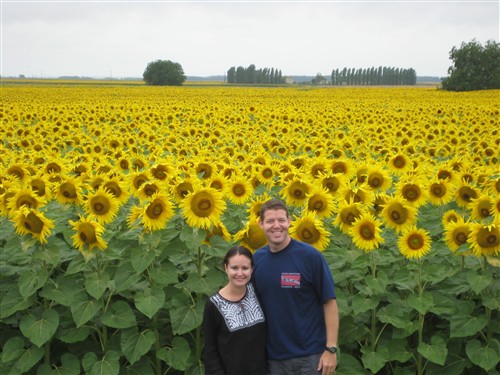 Our road trip continued south toward Bordeaux where bright yellow fields of sunflowers were soon interspersed with sprawling vineyards. On the way, Aaron found the picture-perfect patch of sunflowers so we got out of the car and leaped a narrow ravine (at which time I was reminded that I wasn’t ready to be leaping ravines just yet) to capture the moment. On the way back, a chivalrous gent with big cheeks carried me across like a princess. We arrived in Bordeaux in mid-afternoon and Aaron and Valerie ventured out for a walk while I opted for a few solitary hours of recovery time.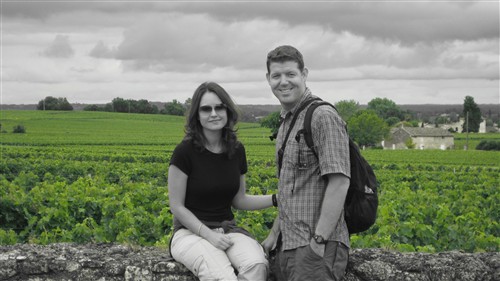
 The town was named after a monk, Emilion, who settled there in the first century, living a hermit’s life in a stone cave for 17 years. Our tour began with a short descent into Emilion’s cave, which consisted of two “rooms” with a bed, a meditation seat, and a small pool from an underground river. Our guide explained that Emilion’s meditation seat is believed to have powers of fertility and that 70-80% of women who sit on the seat send letters attesting to its magic. Guess whose buns were the first ones onto that seat? And once more on the way out…just in case the power didn’t soak in the first time.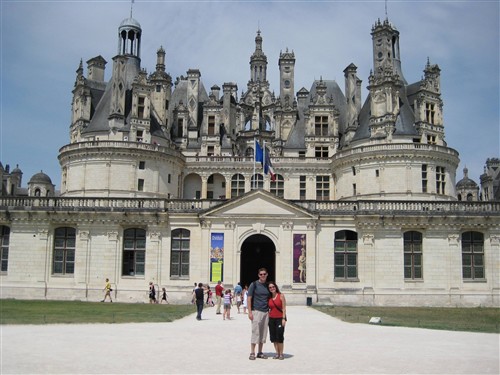
 The highlight of the day (in my biased, dog-loving opinion) was our final stop at Chateau de Cheverny. I had rested in the car between stops so that I would have maximum stamina for our late afternoon visit. The classical façade, pristinely manicured gardens, expansive grounds and magnificent period furnishings were a true pleasure to admire. However, we had come for a different thrill: the soupe des chiens, or feeding of the dogs. “As was the custom among the nobility of centuries past, Marquis Charles-Antoine de Vibraye – whose family has owned Cheverny since it was built – hunts with dogs.” Most of his 100 canines are a cross between English fox hounds and French poitevins. (Lonely Planet France: Jan 07).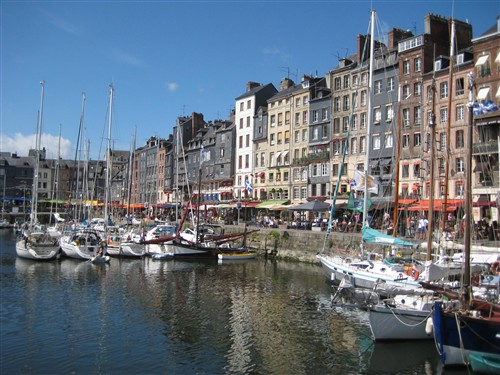
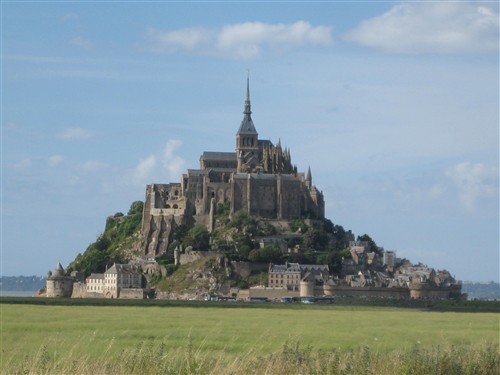 Rising from the flat golden plains like a Gothic fairy tale castle against a backdrop of ocean meets sky, Mont Saint Michel casts an awe-inspiring silhouette. The Mont sits atop a small rock island connected to the mainland by a natural bridge. At low tide, the island is surrounded by flat white sand and is only fully surrounded by water during seasonal equinoxes. A tiny town with a population of only 42 rounds the circumference of the Mont within an old stone wall. Catering to the throngs of tourists, the lower floors of the buildings have all been converted to souvenir shops and restaurants, creating an avenue of crowded commercialism around the abbey, though Mont St Michel remains a fully functioning town complete with a post office and garbage service. My post-surgical handicap precluded me from tackling the many stairs inside the Mont so I parked myself inside a café with a Nutella crepe while Aaron and Valerie ventured further inside.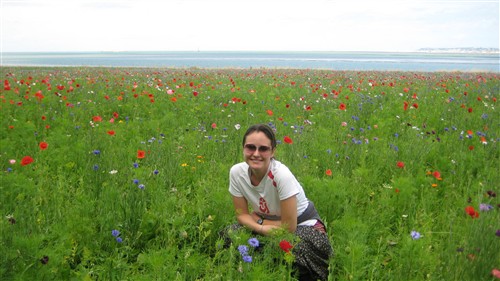
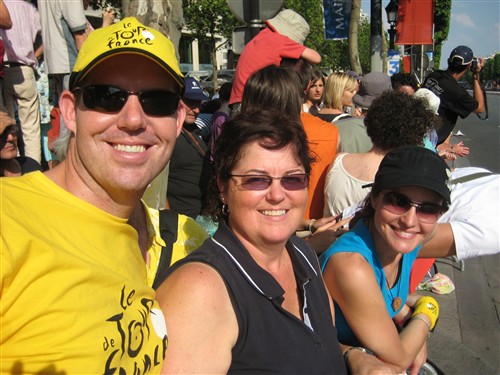
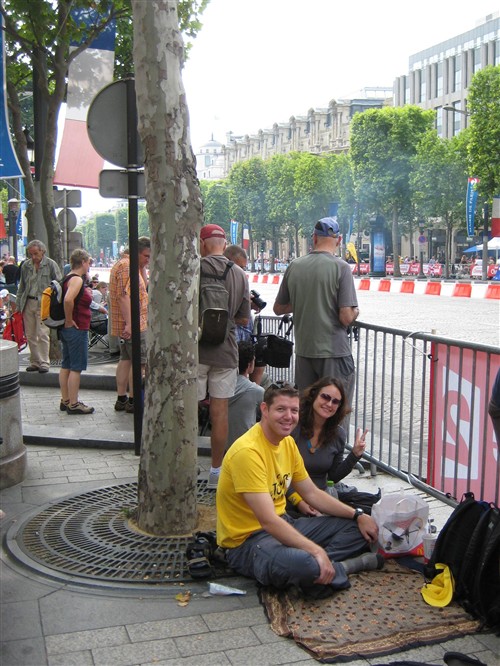 On Sunday, we arrived early at the Champs-Elysees, where we would camp out all day in the sun to mark our spot for the finish of the Tour de France. This was Aaron’s day and he was decked out in the Tour’s signature yellow for the occasion. We claimed a prime spot near the Arc de Triomphe next to a nice American family with whom we visited throughout the day. The hours passed surprisingly quickly and, as mid-afternoon approached, the crowds grew increasingly dense. When the caravan arrived, it was ten times as raucous and rowdy as it had been in Grenoble. By this time, we could no longer sit down but had to stand for the last several hours to maintain our front row spot.