Posted under Jordan & Middle East
 We checked into the Petra Gate Hostel and, after our rather adventurous passage to Petra, we decided to treat ourselves to a nice, uneventful evening. We awoke refreshed at about 7:30 the next morning, intending to beat the rush of tourists to the ancient city, but were enticed into having breakfast at our hostel. The scrambled eggs, fresh pita with apricot jam, and hot coffee were a perfect start to our day but the best part of breakfast, the part that kept us at the table for over an hour, was the company. David, a Swiss native, has been working for the Red Cross for the past couple of years. He has been stationed in Sudan and Nepal but, most interestingly, is now working with Iraqi detainees in American military prisons in and around Baghdad. We sat around the table in wild-eyed amazement, listening to his fascinating stories. David and his team, as a neutral party, go into the prisons to assess the conditions of detainees; they help the prisoners contact their families, try to resolve prisoner complaints, and try to improve individual situations. David has met with the family of Saddam Hussein as well as members of his cabinet. He said that this is his most frustrating assignment because the conditions are so unstable that he is only able to spend about thirty percent of his time in the field. He is doing noble work and we felt honored to make his acquaintance. We also spoke with a Danish couple who were traveling with their three young boys. They had traveled extensively and were so friendly and interesting. The table conversation was of war, politics, religion, and travel from three very unique points of view.
After breakfast, we walked with David to the ancient city of Petra. He had been there the previous day and knew the way, which was about fifteen minutes of steep downhill walking. At midmorning, Petra was crawling with tourists, most of whom were Sri Lankan. We were fascinated by their attire – business casual shirts, slacks and dress shoes for the men and colorful, flowing dresses for the women – in the rocky, dusty hiker’s paradise.
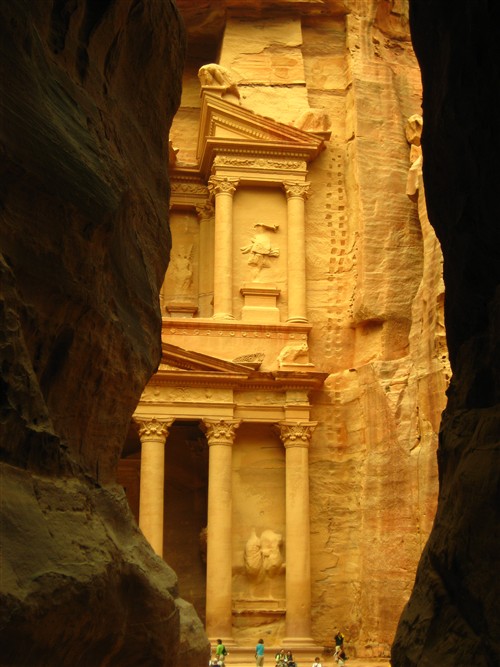
The entrance to the ancient city is the bed of a deep, narrow canyon where, thousands of years ago, a river eroded an eighty meter deep gorge into the sandstone. As you walk through it, you cannot help but marvel at the rolling curves, varying colors and unique formations, created by nature, in the cliffs on either side of you. Just as you are beginning to get lost in the nooks and crevices, you suddenly catch a glimpse of the most well-known monument in Petra – the Treasury. The morning sun illuminates the façade of the Hellenic-style building, carved into the side of the rock, so at first you only see a thin slice of the glowing façade between the dark, shaded canyon walls. Only when you emerge from the canyon do you get the magnificent full view of the Treasury. It is 43 meters tall and 30 meters wide; with two stories of Greco-Roman pillars, the design combines round, rectangular and triangular shapes with intricate and ornate detail, creating an artistic majesty that rivals the architectural and engineering genius.
The old city of Petra was built by the Nabataeans, an ancient Arabian tribe that migrated to Jordan. The city was built over five centuries, beginning around 200 B.C., and flourished as a result of its location along the busy trade route between Africa and the Middle East. The Nabataeans were in the caravanning business and were thus exposed to a variety of foreign influences, which is evidenced by the facades of the many sandstone buildings combining Greco-Roman, Egyptian, and Mesopotamian architecture. We were astonished by the size of the ancient city with its seemingly endless winding mountain roads and paths. The more we walked, the more the city opened up to us with rows of business and residential dwellings, including a theatre, a monastery, temples, tombs and a colonnaded walkway, carved into the sides of the cliff at every turn. We climbed a steep succession of rock steps, enduring occasional vivid Sinai flashbacks, to the High Place of Sacrifice. The ascent was intense but, with fresh legs and childlike curiosity, we propelled ourselves up and up and were justly rewarded with spectacular views at the summit. We sat at the edge of the cliff, staring out over the bustling tourist activity in the city below, and imagined Petra in the prime of its life: giant caravans carrying Indian spices and African trappings, herds of animals; civilization and commerce, powered by man and beast. The artistic diversity of the city implies that the Nabataeans were an open-minded society, embracing ideas from all cultures, with a hunger for knowledge and enlightenment.
Petra is full of Bedouins, who seem more Westernized than the nomads of Sinai. The Petraean Bedouins speak functional English and most of the young men wear Western-style clothes. They make their living by peddling horse, camel and donkey rides within the ancient city and by selling handmade crafts, souvenirs and refreshments. As we neared the end of our first day in Petra, we stopped on a shaded bench to eat our lunch and conversed with a group of young Bedouin men who were also enjoying the shade. They had fascinating, exotic faces with wild Arabian eyes lined with black coal, like Captain Jack Sparrow. I was wearing my “Dive Now. Work Later” t-shirt from Dahab and one of the guys said that he had been diving there and also did the Sinai hike without a guide in an hour-and-a-half (we barely made it in three). My initial perception of the Bedouins was that they were close-knit tribes who lived and died in their villages with little exposure to the big, bad world. At this point, I can only laugh at my own ignorance and naiveté. My only solace lies in the knowledge that I am growing everyday, shedding the many tinted shades over my eyes, one layer at a time.
We left Petra around 3:30, hot, dusty and tired. The modern city of Petra is small and antiquated, with very little in the way of amenities, but we managed to find a private rooftop café with a decent view, a chess set and great coffee. Happily relaxed on the rooftop, we ordered a coffee and sheesha – the secondhand smoke is going to kill us anyway; might as well enjoy some of it firsthand. Sheesha is relaxing and social and it neither hurts your throat nor leaves your mouth tasting like an ashtray. You could almost trick yourself into thinking that the apple-flavored smoke isn’t harmful…if you didn’t know better. We Americans are well-versed in the dangers of tobacco smoking.
We initially had the rooftop all to ourselves but were eventually joined by a Jordanian man who ordered up his own water pipe and made friendly conversation with us. After about twenty minutes of intermittent puffing and chitchatting, he invited us to his home to watch the sunset. Aaron glanced at me to gauge my interest and comfort level. We had felt so warmly welcomed by the Jordanians that we’d met that I didn’t have a moment’s hesitation and we soon found ourselves in Issa Sbehat’s car, ascending winding mountain roads. Issa’s home was on a scenic lot with a perfect view of the sunset. He pulled out three plastic chairs onto the terrace and we all sat down to watch the sun quickly disappearing below the blue horizon. We soon heard the pitter patter of little feet behind us and turned to see Issa’s youngest son ambling toward his father with that adorable toddler clumsiness. Issa pulled him onto his lap, kissed him and smiled like a proud papa.
Issa said that I should go inside to meet his wife. The invitation was only for me, not for Aaron, so he waited outside while Issa showed me inside and introduced me to his beautiful dark-haired wife with sparkling blue-green eyes. She didn’t speak a word of English so we awkwardly shook hands and smiled and then she disappeared into another room and I sat alone on the sofa while Issa went back outside with Aaron. Just as I was beginning to realize that I would likely be expected to sit with the wife – a language barrier the size of the Grand Canyon between us – while the men talked business and smoked sheesha outside, Issa appeared in the doorway, called out to his wife in Arabic, and entered the house with Aaron close behind. Issa’s wife emerged from the back room with her dark, pretty hair now concealed by a red hijab and greeted Aaron shyly.
The interior of the house was beautifully decorated and pristinely kept and our hosts humbly and graciously accepted our generous praises. Issa led us into a less formal sitting room, which he called the “Bedouin Room”, while his wife remained in the kitchen. The small, rectangular room was lined on three sides by long, blue cushions and several decorative pillows, making a large, floor-level, u-shaped sofa around the cozy sitting room. As we relaxed and visited, we were served hot Bedouin tea with sprigs of fresh mint by another one of Issa’s sons. We were soon joined by his third son, his brother-in-law and his mother-in-law. Still, Issa was the only one who spoke any English. The others just looked at us and smiled but we shared laughs over the playful antics of the children. I was enjoying the visit with this beautiful Jordanian family but was beginning to strategize our departure when Issa briefly stepped out of the room and returned with two plates of hot appetizers of meat and rice rolled in grape leaves and cabbage, very similar to dolmas. He set the plates on the small table in front of us and gestured for us to eat. Aaron and I exchanged quick, inconspicuous glances and instantly read each other’s minds: this could be the beginning of a long night of “worshipping the Porcelain God” but here goes nothing! We tried one of each kind – they were pretty good – but as I picked up the plate to pass it around, Issa stopped me. “No, these are all for you. Just for you.” OK, this was going to be awkward. Issa ate a few pieces, only because I insisted, but the others sat watching and smiling. The mother-in-law brought in a small glass and a chilled bottle of water, which she proceeded to pour into the glass for us. I took a small sip and then, a few minutes later, as I went for another sip, Aaron nudged me with a wild-eyed look on his face. At that moment, I saw what he saw: the cap on the bottle wasn’t the original cap. The bottle had been recycled and refilled from an unknown source – a “big no no” on the road. You always break the seal yourself to make sure that the bottle has not been refilled with “local” water, which could be full of nasty little microbes with the potential to turn you greener than Kermit the Frog in a matter of hours. We ate a respectable percentage of the dolmas and then Issa took us outside to show us his fruit trees. He pulled fresh figs, grapes and nectarines from the branches and we ate them right there. They were all perfectly ripe and sweet and I thought to myself what a lovely oasis Issa had created with scenic views, lush fruit-bearing trees, a warm home and a beautiful family with whom to share it.
We wandered back into the house, ate more fruit while we visited, and then Aaron asked Issa if we could take a photo of him with his family. “Not ok”, he said. “OK to take a picture of my boys and me but not my wife.” A short moment of uncomfortable silence followed and then we resumed our conversation. I asked why all of the women cover their heads and he acknowledged that it is because they are Muslim and it is in the Qur’an. He clearly didn’t want to elaborate and I didn’t push it, even though I was dying for a glimpse of his perspective on the subject. When I felt satisfied that we had stayed long enough so as not to be rude, I asked Issa if he would drive us back to town. We took some photos of him with his three boys and his brother-in-law and the boys took some of us with Issa’s camera. We thanked everyone and left. As we were driving away, Issa explained which of his family members lived in each of the neighboring houses. He also pointed out an old, stone, one-room house that had belonged to his grandfather. Aaron and I were simultaneously contemplating whether to take an Imodium and a Cipro as a preventative measure. Back at the hostel, we thanked him again for his wonderful hospitality. It was such a unique and interesting experience and we hope to have many more like it in different parts of the world because, as we’ve said many times before, the people are the intrigue of this adventure as much as any of the sites. We are thankful for the warmth and welcoming spirit of the Jordanian people, all of whom have been wonderful. It should also be noted that we survived the night with no signs of intestinal discomfort.
Back at the hostel, we ventured into the dining area to visit with some of the other travelers. The lack of amenities in Petra has served as a social catalyst among the boarders. We have enjoyed the varying dining room dynamic of the Petra Gate Hostel more than any other so far. Hostels are great because you meet so many young travelers with an equal passion for travel and the adventurous spirit to back it up. We especially enjoyed visiting with a pair of American girls who are studying at universities in Cairo and Amman. They had recently traveled in Lebanon and Syria and we were instantly intrigued by their descriptions of their experiences. Now we want to travel more extensively in the Middle East but, of course, we cannot – not with the Scarlet Letter (a.k.a. Israeli stamp) on our passports. The Middle East will have to wait.
We are now in Amman, just for the night, and flying to Nairobi tomorrow evening to begin the African adventure. Lions and tigers and wildebeests, oh my!
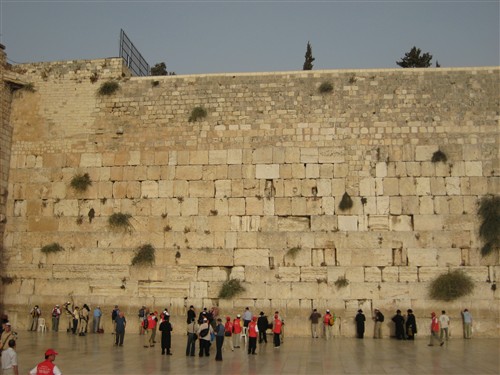 Nestled on the western border of the infamous West Bank and simultaneously claimed as Holy Land by Muslims, Jews and Christians who live there in a segregated togetherness, Jerusalem can most accurately be described as “intense”. We stayed at the Jaffa Gate Hostel, inside the Old City, near the Tower of David. The hostel was friendly enough, tucked back in a small nook amid the old stone walls, but it left a lot to be desired in the way of cleanliness. We have come to realize that paying to rent a room, even in an establishment that is in the business of renting rooms, does not guarantee you a clean room. The linens, though tattered and worn, seemed relatively fresh but the shower, if you could even call it that, was filthy. It appeared as though it hadn’t had a good (or even a bad) scrubbing in quite some time. Also, as with many old buildings with old plumbing, you couldn’t flush ANY paper products down the toilet – I will never get used to that as long as I live! To compound the issue, there was no daily maid service to empty the trash. Suffice it to say that this girl was ready to either vomit or move on at the end of our three night stay.
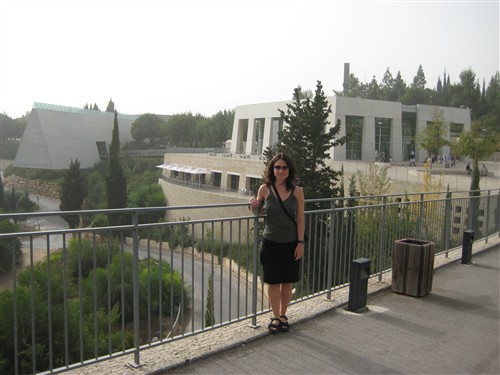 Yad Vashem, the Holocaust Museum, was high on our list of sites, partly because we had been lazy about doing any research in advance on the Christian sites and partly because our combined Bible knowledge is borderline heathen, so we hopped on the morning bus to educate ourselves on one of the most powerful and haunting events in human history. There is no real way to mentally prepare yourself for the experience of walking through the most comprehensive collection of Holocaust artifacts and personal accounts of the survivors. The museum is in a nondescript location about two hundred yards from the main road. The focal point as you enter the compound is a plain white building, which houses a reception desk, cafeteria, cloakroom, and gift shop. The museum itself is built underground. The large rectangular structure is brilliantly designed in such a way that you enter from one end, view each section chronologically through a zigzag formation, and finally emerge breathless, tearful and forever changed at the opposite end. The beginning of the exhibit focuses on answering the most pondered question regarding the Holocaust: How did humanity let such atrocities take place? How did a regime of hatred and unadulterated murder literally exterminate millions of innocent people while the world remained oblivious or turned a blind eye? The audio tour, stunning photographs, and descriptions of political, social, and economic conditions in post WWI Germany lay the foundation for understanding the people’s vulnerability to Hitler’s horrific brainwashing schemes. Why Hitler chose the Jews as his target still remains a mystery. It is, however, abundantly clear that he built his political strength on the desperation and despair of the people, providing them a scapegoat for their struggles. The German Jews were educated, cultured, affluent and hardworking. They could not fathom the hatred that was brewing around them, among their own countrymen. They had no way of predicting the horrific course of events that became their collective fate. Hitler preached fear into the hearts of the Germans – fear that the Jews were a threat to their very existence. He preyed on man’s inherent struggle to survive. Kill or be killed. History has repeatedly shown that we humans, created by God in his own image, can be manipulated like puppets on a string by governments and mass media.
 We had spent several hours at Yad Vashem, much longer than we had planned, and when we finally emerged in the early afternoon, I was emotionally exhausted. I would have preferred an afternoon of quiet contemplation but that was not in the cards. We took the bus back to the Old City and tried to walk to Dome of the Rock, which was built upon the rock which Abraham is believed to have bound Isaac in preparation for the sacrifice. It is a holy place for Muslims, many of whom go there to pray when they are called to prayer over the loudspeaker five times a day. The Ramadan breakfast seems to occur at a different time in every town and in the hour or two before breaking the fast that day, the narrow, enclosed stone road in the Muslim Quarter, leading to Dome of the Rock, was completely congested with shoulder-to-shoulder pedestrian traffic. We slowly shoved our way through the crowd but as we reached the entrance to the Dome, we were sternly turned away by armed Israeli guards; no gringos allowed. How they differentiated us from Muslims going to the mosque to pray is beyond me…just kidding.
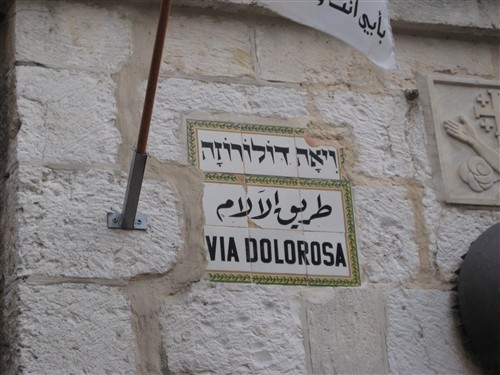
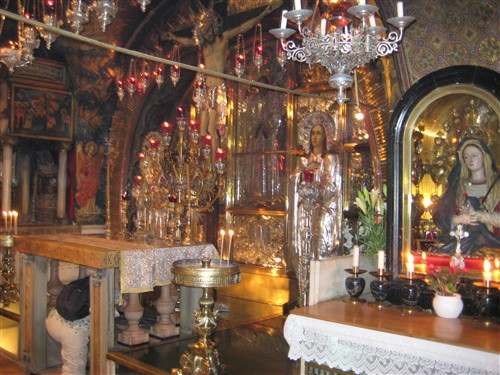 We pushed our way back through the crowd and turned down the Via Dolorosa, where an intimidated-looking group of European tourists were eagerly waiting for the Ramadan madness to run its course so that they could cross. We walked the Via Dolorosa from the Lions Gate to the Church of the Holy Sepulchre. This is the road on which Jesus carried the cross to the site of the Crucifixion. It was a narrow, stone road lined with stone and mortar buildings and, as we walked, we came upon the Prison of Christ, where he was held in captivity prior to his death. The prison was cavernous, claustrophobic and full of sweaty tourists. We descended a narrow, winding staircase to the lowest level and found a single cell: a deep hole carved out of the wall and rusted iron bars, sealing the fate of the captive. In ancient times, there would have been no light, no place to relieve oneself; nothing but hopelessness. We emerged stoic and thankful for the fresh air and daylight in the street. We continued along our path to the Church of the Holy Sepulchre, which contains the sites where Jesus was nailed to the cross, crucified, prepared for burial and buried. It all seemed surreal and we spent the afternoon in a state of weary disbelief. It didn’t hit us until later that we had stood in front of the most significant sites in the history of Christianity.
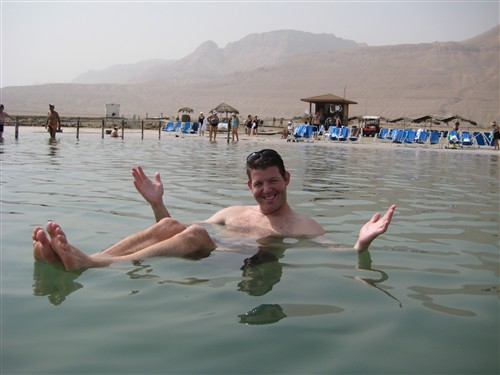 The earliest morning bus from Jerusalem dropped us off in the parking lot of our intended destination: the Ein Gedi Spa. The admission price was about $15, which included use of the spa facility, shuttle to the Dead Sea, a mineral mud bath and the spa pool. We changed into our swimsuits and decided to walk the path to the Dead Sea. It was a long, straight dirt road; with mountains behind us and the sea in front of us, we felt the desolation of our surroundings. The walk to the sea lasted about fifteen hot minutes and we arrived among the first sea-goers of the day. After dropping our things on a couple of sun chairs, we carefully waded in. The shore was made of solid, crystallized salt that created a glistening, wavy ground beneath our feet. The water felt oily and warm on our skin. When we were about waist deep, we sat down as if in a chair and the density of the water caused our feet to shoot up as though we were sitting in a Lazy Boy. In a swimming pool, you can float on your back, with your body straight, and rise and fall as you inhale and exhale. You control your buoyancy with your breath. In the Dead Sea, you are buoyant; you float, even at full exhalation. It is oddly relaxing, comfortable and effortless. You feel as though you are lying on a float in a swimming pool, only there is nothing beneath you but water. We floated and laughed away the beautiful, cloudless day. We were so happy.
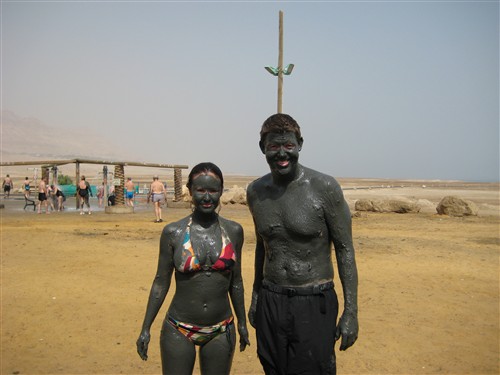 After frolicking in the water like schoolchildren, we rinsed off in the freshwater shower and rode the shuttle to the mineral mud bath area, where there was already a crowd of mud-covered, giddy tourists. We went right for it, digging our hands into the square wooden trough of slimy Dead Sea mineral mud and slathering it all over ourselves and each other. I liked the way it felt on my skin and the way it made our bodies sleek and dark. Playing in the mud put everyone in a playful mood and we were no exception. We let the mud work its mineral magic for the recommended twenty minutes and then followed the crowd to the sulphur shower. The water was unpleasantly hot and tasted awful. I hurriedly scrubbed the mud off my body and moved to the freshwater shower to rinse away the smell and taste of the sulphur. Satisfactorily rinsed, we headed to the spa to find some lunch. I had asked Aaron in the morning to give me one day without commenting on the price of anything and he humored me, even at the whopping $15 sticker price on the buffet, which reminded me of a lesser quality version of Bishops. We ended the Ein Gedi Spa day with a short dip in the spa pool and then caught the first afternoon bus back to Jerusalem.
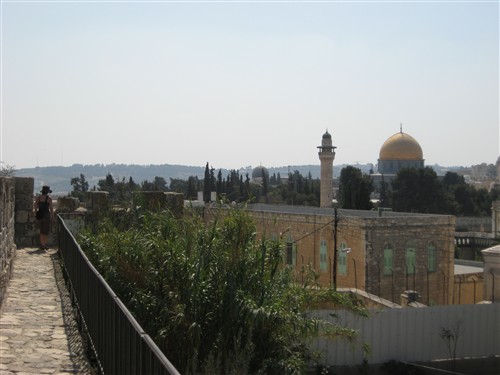 We spent our last day in Jerusalem catching a few last-minute sights. We saw the crypt where the Virgin Mary lived the remainder of her life after the Crucifixion and eventually died. The crypt was a cavernous vault on the lower level of a church. In the center was a carving of the Blessed Virgin lying in repose, encircled by benches on which you could kneel and pay your respects. A tour group entered shortly after we did and commenced to sing a beautiful hymn to Mary in Italian, the harmony reverberating off the ancient marble walls. Again, the experience was surreal. The story of Mary’s life is just that – a story to me; it was difficult to comprehend that this was the place where the flesh and blood Virgin actually lived and died. We also saw the room where the Last Supper supposedly took place and I felt the same way there – stoic. Part of the problem was that we viewed these Holy sites in the presence of a throng of tour groups, their trusty guides explaining the details in seemingly every language except English. The experience of walking inside those walls in quiet solitude would have been a more suitable environment for prayer, reflection and realization of where we were. We concluded Jerusalem with the Ramparts Walk – a walk along the top of the stone wall surrounding the Old City. From there, we got some excellent views of the Dome of the Rock and the Temple of Mary Magdalene, as well as a bird’s eye view of the Muslim Quarter, bustling with the usual Ramadan madness. The intensity of Jerusalem was overwhelming and the population of religious extremists created an atmosphere which I found to be stifling and ultra-conservative from every angle. While we believe that there is much more to Jerusalem than we have uncovered during our short stay, we are ready to move on.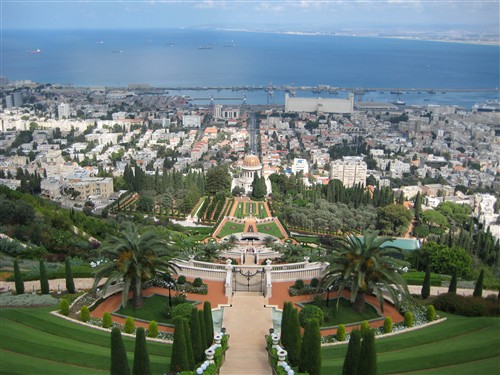
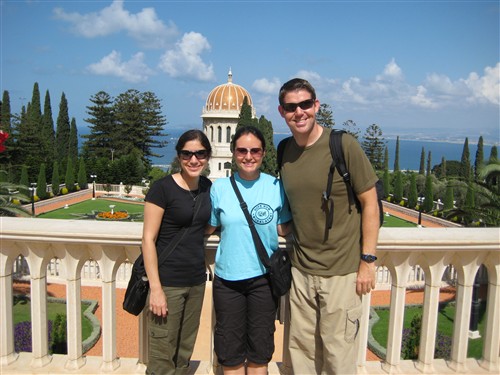 I can see why Saba is enjoying her volunteer work at the Baha’i World Center. It is a very serene, perfect setting for prayer and for walking, reading, thinking, or simply admiring the beauty of the gardens, which are meticulously manicured. I wanted to stay there – to spend more time wandering contemplatively through the terraces but there was no time for that. Instead, the three of us walked to Saba’s flat to change into our swimsuits, and then headed for the beach, where we relaxed and read all afternoon until the sun had set. The night breeze from the Red Sea had been warm in Egypt and we could comfortably sit by the water in short sleeves but the evening winds off the Mediterranean are cool and crisp. When the sun had sunken below the horizon, I quickly grew weary, covered in goose bumps and ready to hail the sherut to head for “home”. As I said goodbye to Saba, my old partner in crime, I didn’t feel sad because I know, with a strange certainty, that we will see each other again soon.