Posted under New Zealand
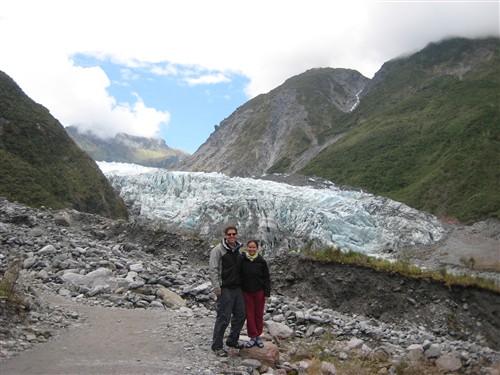
After extending our stay in Queenstown from three to five nights and loving every minute of it, we reluctantly left the room with the million-dollar view and headed north toward Greymouth where we’d booked a one-night stopover on our way to Abel Tasman National Park. The scenic drive up the west coast combined all of the usual elements of the thrilling landscapes that we’ve come to expect on the South Island – mountains, lakes, rivers, rolling hills dotted with grazing sheep – and enter into the collage the rolling waves of the Tasman Sea and raw, white sand beaches; it’s enough to leave you breathless. As we began to happily lament that our repertoire of exquisite landscapes had been vastly expanded in just a couple of weeks, we came upon the sign announcing the exit to Fox Glacier. Yes, I said GLACIER! As in gigantic ice formation of the same sort that, over millions of years, cut the fiords out of solid rock.
As we pulled into the car park, we caught a glimpse of the glacier in the distance. It was dirty white with shaded contours and looked as if it were once a rushing torrent that solidified instantaneously, its velocity frozen in time. The trail led to the base of the glacier and we followed it nearly as far, carefully crossing a narrow river that kept the less adventurous onlookers behind. We had previously discussed joining one of the guided glacier hikes but I had vetoed the idea because it sounded cold. As we skipped around on the river rocks and set up photos from various angles, we were surprised by the warmth of the air. We looked enviously at a few groups of hikers heading toward the base in shorts and parkas, half-wishing that we were among them. As we walked back to the car park, we shed a couple of layers down to our t-shirts and wondered again how the glacier could stay frozen in such a warm climate. Back on the road, it was only a short distance to another glacier called Franz Josef. We pulled in and walked down to the first viewpoint. The glacier itself looked almost identical to the Fox Glacier in both size and shape and it was a much longer bushwhack over river rock and sediment to get to the base so we mentally checked the box and headed back to the car.
We arrived in Greymouth around dinnertime and checked into a quiet backpacker hostel in the center of town. The largest city on the west coast, Greymouth is still a sleepy little town, with a long gold history, nestled at the mouth of the Grey River. At six o’clock, it seemed almost deserted but we managed to find a restaurant open and sat down for dinner. The food was average but we shared a nice bottle of wine and enjoyed the homey feel of the place and our smiling Julia Roberts lookalike waitress. Toward the end of our meal, two guys from a large party took out their guitar and banjo and serenaded the dining room with a medley of popular songs. This impromptu concert called for more wine, of course, and I ordered a luscious liquid dessert. Little did I know that in the tiny town of Greymouth, I would strike gold of my own in the form of New Zealand aromatics. With a flowery bouquet and a touch of fruit, the aromatic New Zealand Rieslings lack the syrupy sweetness of the California and German Rieslings, making them decidedly drinkable. In the States, we get a great selection of New Zealand Sauvignon Blancs and, as previously mentioned, the Marlboroughs are divine but the aromatics are a newly discovered treasure in our repertoire and we cannot wait to taste more of them!
The serenade continued through two Heavenly glasses of Montana Riesling and, thankfully, ended while we were still able to walk out of there. Greymouth was a lovely town for a stopover. We could easily have spent one more day walking along the river and admiring the old European architecture but Abel Tasman was calling us from the north to come hike its trails and kayak through its calm waters. Who were we to argue?
Comments Off on Glaciers to Greymouth
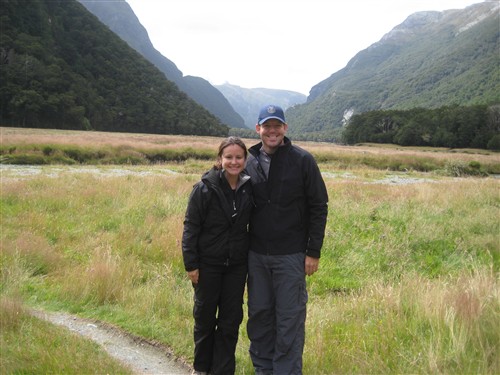 The Flats Hut was an impressively built and maintained complex of basic cabins with modern restroom facilities and a lovely picnic area edging an expanse of golden valley with a lazy river ambling through its straw-colored grasses. We stopped to eat our sandwiches at a picnic table near the river, admiring the views of craggy snow-covered peaks and lush green forest.
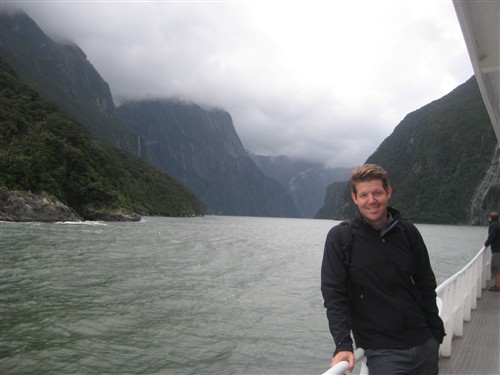 Fiordland National Park is inclusive of 3 million acres in the southwest region of the South Island. This region is covered in dense, mountainous rainforest and meets the Tasman Sea on its western coast. The fiords were created during the ice ages when glaciers repeatedly advanced and regressed, cutting narrow and steep-sided valleys through the rock, which then became flooded by the sea. The national park is one of the wettest places in the world with some areas collecting almost 7 meters of rainfall per year. Not surprisingly, it was raining as we drove into the park on a day trip from Queenstown. The 4.5 hour drive was a series of picture-perfect landscapes and as we neared the fiordlands, we began to see the rainwater cascading down the sheer granite rock faces of the surrounding mountains.
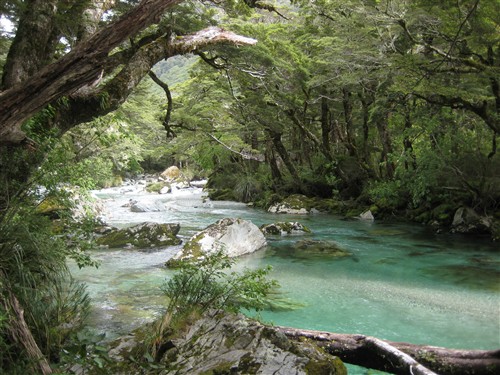
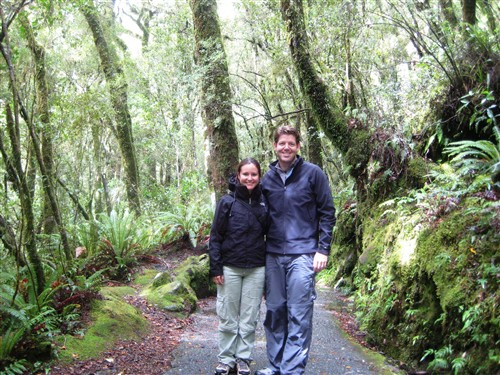 On our way out of the national park, we stopped briefly for a nature walk on one of the shorter trails, called The Chasm. The rain and long drive ahead precluded us from endeavoring to hike further in but we wanted a glimpse of the trails. The path cut through dense green forest, curving around granite boulders and crossing over rocky, meandering streams. There were tiny, hidden waterfalls, abundant ferns and mosses in red, green and gold. Water trickled down moss-covered rocks, dripping from the glistening pointed tips of ferns. Everything looked so alive! During a twenty-minute hike, we crossed at least three bodies of water – all feats of sublime natural artistry; strewn with contoured boulders and fallen trees. The canopy of entwined trees overhead sheltered us from the rain and we could have walked longer were it not for two compelling forces: the narrow, tortuous road beckoning us to begin the long journey home and the hot meal and bottle of wine at the end of the road.
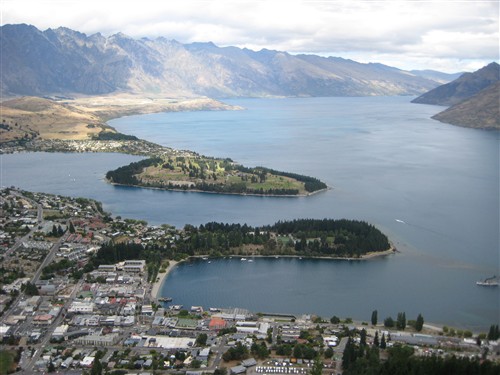 We checked into Scallywag’s Travelers Guesthouse and were awestruck by the million-dollar view of the lake and surrounding mountains from our bedroom window. We drove into town to pick up some groceries for the next few days – after two months of eating every meal out in India and Thailand, we’re back to self-catering – and then stopped at the charming Vudu Café in town for an appetizer, a couple of microbrews and some great people-watching. From our perch at a sidewalk table, we hypothesized that the tourist population in Queenstown was comprised of the following groups in almost equal parts: Australians and North Island Kiwis on holiday, Japanese tourists, Europeans (spending their soaring Euros and towering Pounds) and Americans (spending their sadly deflating dollars) on family vacations, and thrifty globetrotters (most of whom fall into the European category) like ourselves, monopolizing every camper van and backpacker hostel available for miles. Back at Scallywag’s, we finished the evening with some local wine and cheese and good conversation around the dinner table with some other interesting couples at the hostel.
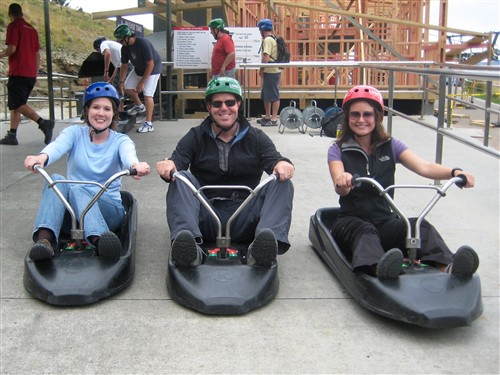 Needless to say, this activity was Aaron’s pick and he was, inarguably, the most antagonistic and enthusiastic racer. We moved onto the advanced track after our introductory run and Aaron tried to coax us into racing each other on the next five runs. I think the spirit of friendly competition overcame him as he took turns on two wheels, sticking his leg out the side to keep from flipping sideways, and flew over long drops with one hand in the air. On one run, he was so intent on keeping me in his sights as I threatened to pass him that he almost crashed into the side of the tunnel wall. He was like a teenager breaking all of the track safety rules and I was the scolding mother hen, flashing forward to the gruesome scene of having my thirty-year-old husband air-lifted from the mountain to the nearest hospital to set broken bones from flying off the luge track. Incorrigible! But it was fun to witness such youthful exuberance. Adulthood and its corresponding worries and responsibilities seem to suffocate the frolicsome, free-spirited nature of many people but I have a sneaking suspicion that it won’t happen to us. As I flash back to that cheeky, insolent, mischievous grin in sunglasses and Speed Racer helmet, in fact, I am certain of it.
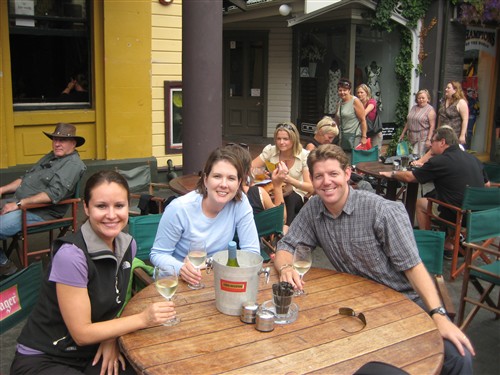 Six action-packed runs down the luge track left the three of us weary and ready for a grown-up’s beverage. We hopped back onto the gondola for the picturesque descent and then walked into town. Queenstown has so many tempting venues for afternoon (après adrenaline rush) cocktails and we didn’t walk long before settling into a patio table with a bottle of Oyster Bay Sauvignon Blanc from the Marlborough region in the north. The Central Otago wine region, just outside of Queenstown, is known for its Pinot Noirs; however, I would argue that there is scarcely a better wine to have on a sunny afternoon than a well-chilled Marlborough Sauvignon Blanc. Interestingly, it is more expensive to drink NZ wines in NZ than in the States.
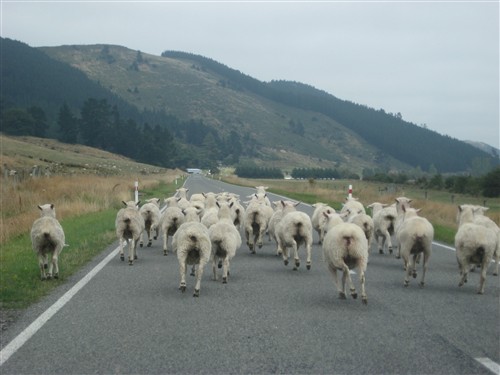 G’day! Welcome to New Zealand! Population: 4 million humans; 40 million sheep. The locals are called Kiwis, gentlemen are blokes, friends are mates, and vowels are consistently butchered in the endearing Kiwi-accented English. The most common fast food is fish and chips or “fush ‘n’ chups” and, not surprisingly, lamb is a staple entrée on Kiwi dinner tables. New Zealand’s two islands, the North and South Islands, are together about the size of Colorado and rival its stunning alpine landscapes. The Lord of the Rings films were shot against New Zealand’s fairytale backdrops. The remote islands attract almost 3 million foreign tourists each year who are drawn to the postcard-perfect views, outdoor activities, beaches, lakes, mountains, wineries and lack of terrorism. The weather in NZ is gorgeous right now – sunny, breezy and 70s during the days and cool enough for a light jacket in the evenings. The sun doesn’t set until sometime between eight and nine o’clock so each day is long and full of possibility.