Posted under Italy
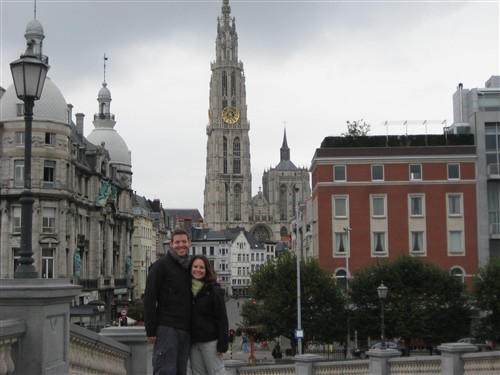
If you own a diamond, there is a greater than 80% chance that it was cut in Antwerp. Nicknamed Diamond City, Antwerp has 300 diamond-cutting workshops, 1500 diamond traders, and 4 of the world’s 25 diamond banks. But all of these are packed into an area of less than one square kilometer. The rest of Antwerp is a beautiful medieval city and vibrant university town. We liked it immediately.
Our hotel – one of the most comfortable of our trip and (unfortunately) priced accordingly – was located in the beautiful town square across from Antwerp’s magnificent gothic Cathedral of Our Lady. Its pretty church bells enchanted us throughout the day. Yes, we only had one day to explore Antwerp and were wishing we had more but that has been the recurring sentiment throughout our travels: there’s never enough time.
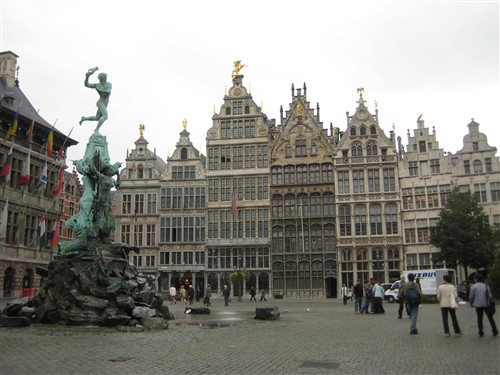
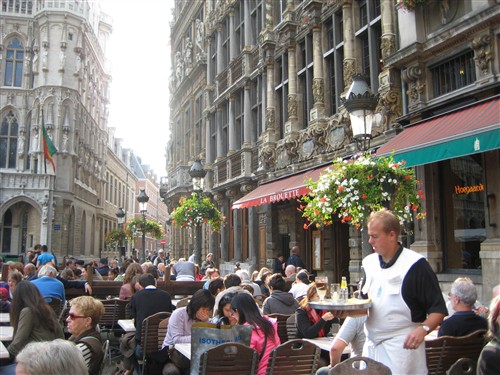
 Since we overdosed on museums in Italy, we decided to do less museums and more aimless wandering in Belgium. The cool autumn air invigorated us to roam the streets, with their quaint, colorful 16th-century Guild Houses; stopping at leisure for frites, waffles and cold Belgian beers served in stemmed glasses. We are unapologetic winos on average but there is something so appealing about sitting on a sunny patio, bundled in jackets and scarves, sipping cold beers on a chilly afternoon. If we make it to 4:00 before happily indulging in our first cold one, we applaud our enormous restraint. That said, we must escape Belgium before our daily unadulterated gluttony expands our waistlines beyond the confines of our pants.
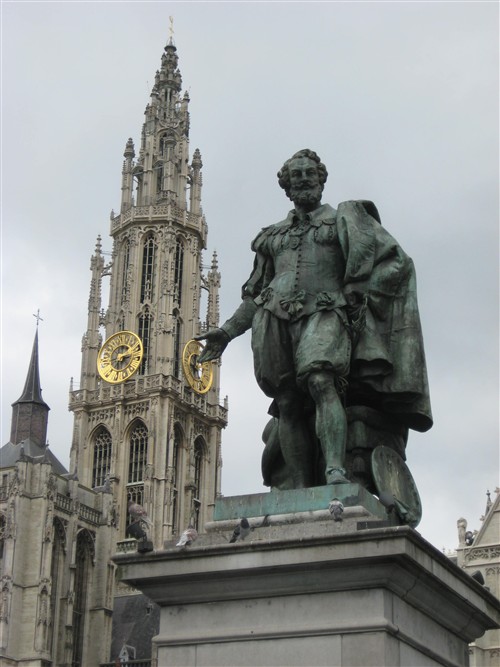
Antwerp’s most celebrated citizen is famed artist Peter Paul Rubens (1577-1640). Rubens and his wife, Isabella, bought a house in Antwerp in 1610 and Rubens spent the following years enlarging and embellishing it, making it the most impressive early 17th-century home in Antwerp. Rubens’ house, with its diverse collection of art, is open to the public and we spent the better part of an hour wandering through the lavishly decorated living rooms, the artist’s studio, the portico, the pantheon of classical sculptures, and the ornamental garden. Rubens filled his home with works that he admired and from which he drew inspiration, including many still life paintings, portraits, and sculptures. Several of Rubens’ own work was displayed in the studio.
I have always loved seeing people’s homes. Regardless of size or decadence, a person’s home tells a lot about him. A home is a mini-museum of someone’s personality, full of trinkets and treasures with which that person has chosen to surround himself during the most private moments of his life. When I imagine our inevitable reintegration into American life, without a Big Texas house full of pretty things to come home to, I am warmed by the thought that whatever little place we find to call home in the near future will be filled with all of our special things: our sweet little dog; our warm, cozy bed (which we will NEVER take for granted again), our soft blankets, our kitchen stuff, and a LOT of travel photos! While we will surely welcome the return of our old, familiar things – which have hopefully fared well in their climate controlled storage unit in Texas – we take comfort in knowing that we can live happily with only the bare essentials. I have said many times throughout this journey that we feel quite at home on the road and I have meant it wholeheartedly. Our prolonged backpacking adventure has helped us to emotionally detach ourselves from our material possessions (excluding the dog). Home is where the heart is. We carry it with us and can unfold it anywhere with just a little love and creativity.
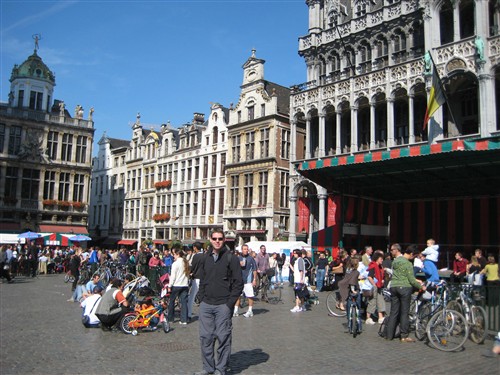
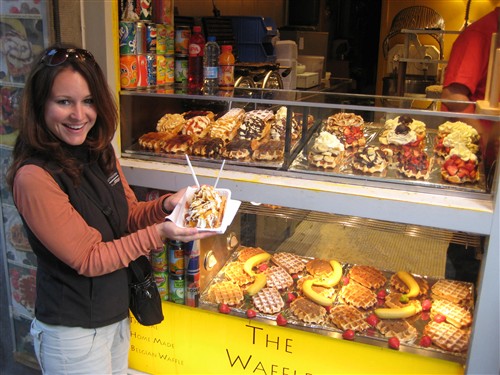 When we finally reemerged, Car Free Sunday in Brussels was in full swing. Bicycles and pedestrians owned the cobblestone streets. Families pushed baby strollers and everyone from kids to senior citizens glided through town on two wheels. The whole multicultural, multilingual population of Brussels seemed to be outside, enjoying a sunny day in their pedestrian friendly city. It was a beautiful sight.
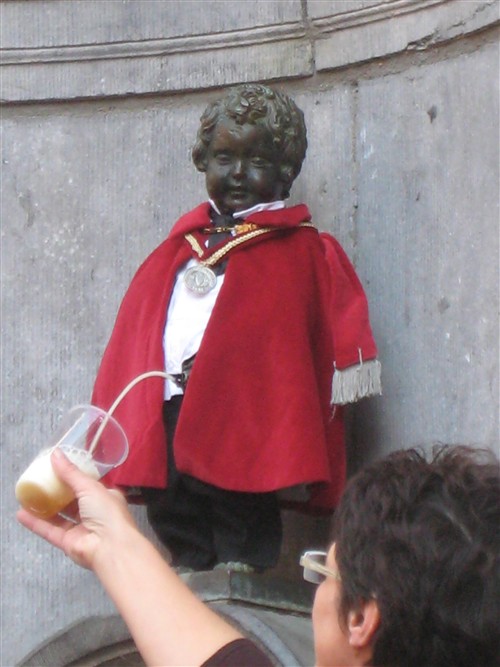 Our next stop was at a small bronze statue – Brussels’ beloved city mascot named Manneken Pis, a.k.a “the Piss Boy”. His likeness is everywhere – on postcards and replicas lining every souvenir shop window. Following the signs for Manneken Pis, we came upon a small square full of commotion. As it turns out, Piss boy has a wardrobe and it was time to change his clothes. A crowd had gathered around his fountain, including a group of cheery old men, dressed in garments identical to the Piss Boy’s, drinking beer, singing songs and pushing around a replica of the statue on a cart, making it “piss” on the shrieking onlookers and laughing all the way. While this was going on, one man was gingerly changing the Piss Boy’s clothes with the utmost love and affection, ruffling his bronze hair and pinching his nose. When the little statue was decked out in his new duds, he was hooked up to a beer keg and cheered on as his stream filled cup after cup with the local grain. What a spectacle!
 On our way back to the hotel, with happy hearts and even happier round bellies, we suddenly heard classical music – loud classical music. Rounding the corner, we looked up to discover a man with a full DJ setup, spinning lively classical tunes from the top floor balcony of a vacant building in the middle of the city. A crowd had gathered on the street below, mesmerized by the melodies that filled the cool night air and resonated through the streets. Naturally we wondered, Is this guy going to get arrested for disturbing the peace? This can’t be legal. Then we read on a flyer that this performance was part of a free concert series – Le Concert Invisible – that this guy puts on at random locations around the city. Everyone loved it.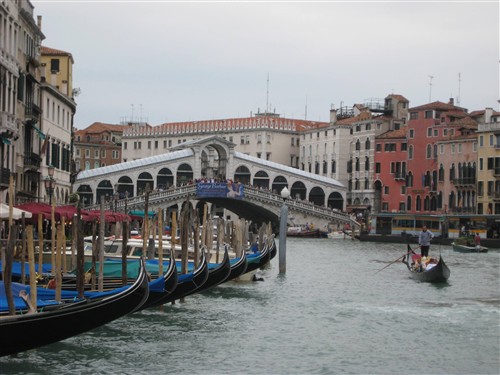
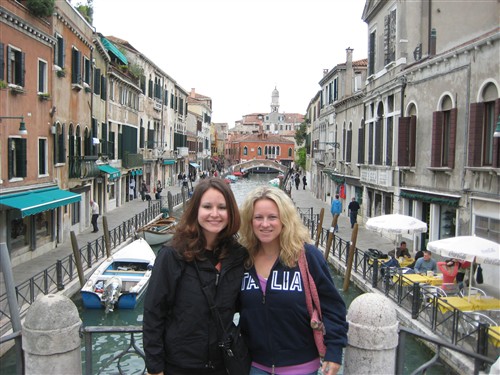 Walk through Venice at lunchtime, getting lost in the senseless maze as you follow your nose toward the tantalizing aromas of fresh baked pizzas, pastas and bread wafting through the lanes while trying not to succumb to the temptation of the gelato shops before lunch. The tranquility of morning has been trampled by a parade of tourists, moving through the narrow alleys like ants on a wall. Water taxis, ferries, and the quintessential Venetian gondolas maneuvered by burly, tattooed gondoliers in striped shirts navigate the canals. Almost everyone you pass is holding either a slice of pizza or a gelato cone. The outdoor cafes and fine restaurants are full of holidaymakers, indulging in three-course lunches and bottles of wine. Around every bend in Venice is a beautiful photo opportunity, especially the bridges where pretty painted buildings and the sparkling canals form stunning backdrops.
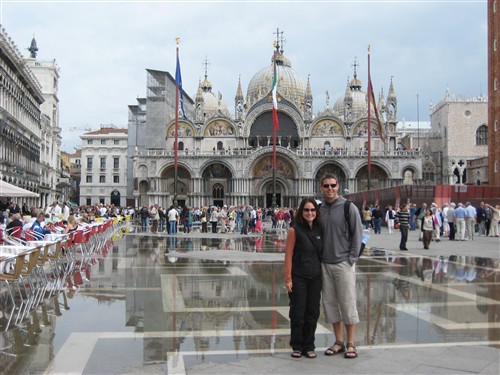 If the Grand Canal is Venice’s lifeblood, then the Piazza San Marco is its heart. Step into the vast, crowded, pigeon-infested square and your gaze will immediately center on the magnificent Basilica di San Marco. Venice’s cathedral – built on the plan of a Greek cross – showcases the Byzantine style in all of its glory with five bulbous domes and dazzling gold mosaics both inside and out. The dim, cavernous interior and the marble floor that has rippled over the centuries together create a dizzying effect. Across from the basilica, the top of the campanile affords a bird’s eye view of the piazza and the best panoramas of the city.
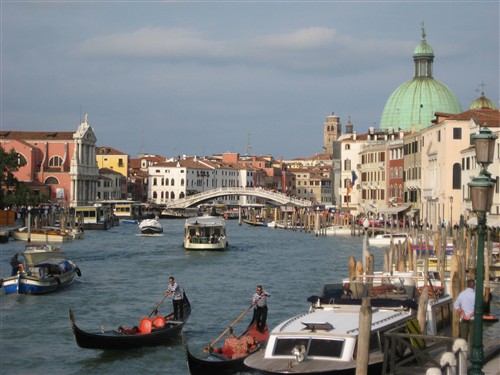 On our last night in Venice, my beautiful and gainfully employed little sister treated us to dinner at one of the expensive and pretentious restaurants on the Grand Canal in view of the Rialto Bridge. With the moonlight sparkling on the water, we savored juicy Chianti over courses of meat, seafood and pasta. It was the perfect exclamation point to Venice, where we indulged in more gastronomic tourism than any other kind.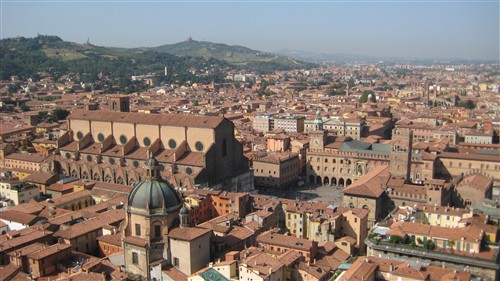
 By ten p.m., we had made up our beds, showered and settled in. A brisk fall chill had swept through the whole building and, as I opened the wardrobe doors to look for heavy blankets, I discovered a pile of possessions behind door number two: leather jacket, white collared shirt, camouflage dob kit, some miscellaneous articles of clothing, and a large metal wrench! The items clearly belonged to a man and our heads began spinning with paranoid ideas of a crazy wrench murder with a key to our room. Why would a backpacker need a wrench?
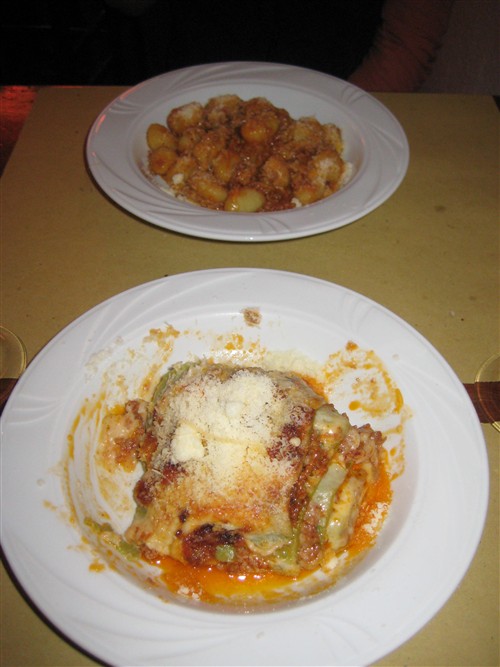 We met Aaron in the hallway at the designated time, loaded the car, and laughed over breakfast at our crazy night in the hostel dorm. Natty has been officially initiated into the hostel world.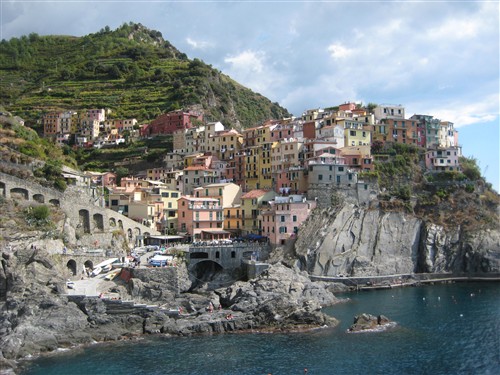
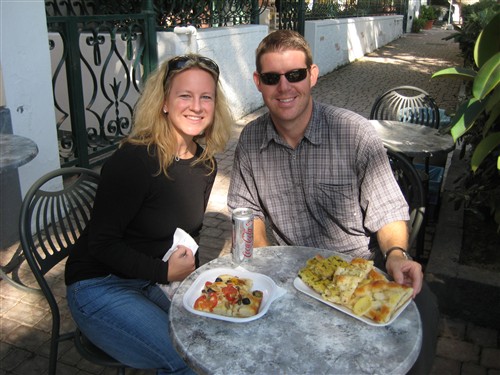 Next, we walked a scenic, one-kilometer trail, called Lovers Lane, between Manarola and the easternmost village of Riomaggiore, browsed around town for a while at the focaccerias and ceramic shops, and snapped countless shots of the photogenic villagescape before hopping a train to the westernmost village of Monterosso. Monterosso has the longest stretch of beach of all five villages and the ocean was beckoning us for a swim. Of the utmost importance, however, was finding Focacceria Enoteca Antonia which reportedly served fifteen kinds of focaccia from scratch. Our stomachs were rumbling and our mouths watering before we reached the doorway just across from the beach. All four varieties of piping hot, generously topped focaccia were unbelievably delicious, making it hard to refrain from stuffing ourselves silly. After that, I felt wholeheartedly that my Cinque Terre experience was complete.
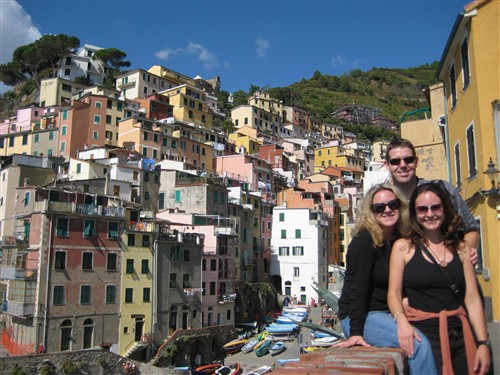 Leaving Cinque Terre was like losing touch with a good friend. You find happiness in other things but every now and then, when your mind stops spinning with the day’s distractions, your friend’s face flashes through your mind and warms you with fond memories. I hope someday to return to Cinque Terre, to wander the colorful streets of Manarola, to swim in the sea at Monterosso, and to explore the villages that we missed this time. In the meantime, I’ll rejoice in the quiet moments when my mind is free to swim with happy memories of a very special place.