Warning: Use of undefined constant ‘wppa_setup’ - assumed '‘wppa_setup’' (this will throw an Error in a future version of PHP) in /home/youngs/public_html/wp-content/plugins/wp-photo-album/wppa.php on line 28
Youngs Around the World
November 22nd 2007 by Tina
Zambia Part II: “The Smoke That Thunders” & The Mighty Zambezi

Posted under Africa & Zambia

The transfer from Kabwe to Livingstone was surprisingly smooth and we settled into Fawlty Towers Hostel around 6 o’clock. The hostel was centrally located in the tiny town and we walked down the road about five minutes to a restaurant called Funky Munky and shared a pizza. The food was decent and the sodas ice cold, but the place itself was a hot box with only an industrial fan battling the heat waves from the sun and the pizza oven. We decided to use the next day to relax and regroup so we stayed around the hostel and spent time making plans.

Livingstone is your basic underdeveloped African shanty town with a big international attraction: Victoria Falls. The Falls were officially discovered by a British explorer named David Livingstone, who named the incredible natural wonder after Queen Victoria. The enormous waterfall flows through the Zambezi River which divides Zambia and Zimbabwe, and is one of the world’s premier locations for extreme sports. Just a few of the adventures that adrenaline junkies can sink their teeth into include bungee jumping, skydiving, rides on zip lines and gorge swings, abseiling, microlight and helicopter rides, and world class white water rafting on the Zambezi river. On Zanzibar, we had spoken to a few people who had personally experienced the rafting on the Zambezi. Their descriptions were all the same: it was the scariest thing they’d ever done and someone had perished in the violent rapids during or around the time that they were there. In Lusaka, we happened to walk by a display window in which a television was showing highlights of the Zambezi rafting. Every raft flipped like a pancake, throwing all of the helpless riders into the white, rushing water.

All of these data points lead us to swear off the rafting even before we arrived in Livingstone but we eagerly browsed the menu of activities and booked a few others: the sunset booze cruise, a day of unlimited gorge swing/abseiling/zip line/flying fox, and a visit to Livingstone Island in the middle of the Zambezi, at the edge of the falls. We also booked flights to Cape Town, South Africa after determining that overland travel would have involved forty hours on sweaty African buses. We’ve become greedy with our time lately and relished the idea of a full month in South Africa.

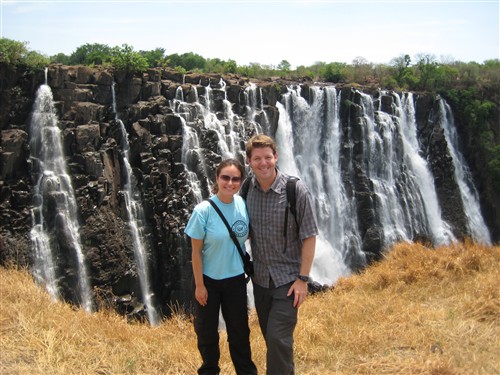
We woke the next morning with vigor and vitality, energized by the excitement of our upcoming adventures. The hostel offered a free shuttle to the Falls at ten a.m. so we decided to check it out. We entered the park and walked along the scenic, winding path with lush greenery and sweeping tree branches creating an arbor above. Victoria Falls is known as Mosi-oa-Tunya in the Kololo language, meaning “The Smoke That Thunders” and, as we rounded a curve into a clearing, we discovered why. From the park entrance, you can hear a low, thunderous roar of rushing water. Just as the Falls come into view, you begin to feel a cool mist on your skin from across the wide ravine. The velocity of the water is so high that a thick cloud of mist rises above the edge and hovers in the air, and this was at the end of the dry season when the Falls’ water levels are lowest. An almost constant rainbow glitters above the pool at the bottom as mist and sunlight collide.

We walked the length of the path, pausing at each vista to marvel at its unique view. It was a romantic, leisurely stroll and our moods reflected the peace of our surroundings and the perfection of the day. As we rounded the path, we met the Zambezi for the first time and caught sight of some rafters floating along the green river which snaked through the picturesque Batoka gorge and under the Victoria Falls Bridge. We watched silently as the three rafts bounced through a rapid and then looked at each other with reciprocal devilish grins. “Are you thinking what I’m thinking?” he asked. “Yep!” I replied. And that was that. Gorge swing was out. Rafting was in.

The best views of the Falls are supposedly from the Zimbabwe side but that view would have cost us two Zimbabwe visas, two more park fees on the other side, plus a new visa to re-enter Zambia since our initial $100 visa fee (extortion!) only bought us a single entry. Needless to say, we decided that a view from Zambia would suffice.

The Victoria Falls Bridge is an orange bridge which spans across the canyon from Zambia to Zimbabwe – bungee jumpers cast off from the center of it – and we thought we might be able to walk onto it without leaving Zambia. The walkway ended near the end the bridge but the entrance was fenced off. We learned that there was a separate entrance which was controlled by Immigration. As we were turning back, a young man on the other side of the fence beckoned us across, offering to guide us onto the bridge while avoiding Immigration…for a small fee, of course. We considered it for a brief moment and then decided that, since we’d already been busted by Immigration once, we would be best not to push our luck. We opted to head back to Fawlty Towers to rest up for the booze cruise.

Around four-thirty, we were picked up from our hostel and shuttled to the Waterfront Hotel for the cruise. Our ride had arrived almost thirty minutes late so we were the last ones on the ship and the bar was already rocking! We climbed to the upper deck, ordered some cocktails, and melted easily into the crowd, some of whom were already “three sheets to the wind”. Most everyone was going for fruity vodka cocktails, which slipped down a little too easily. My target intoxication level lay on the border between “just drunk enough to calm my nerves about our newly scheduled whitewater rafting trip the next morning” and sober enough so as not to have a hangover.

As our ship slowly cruised along, we admired the tree-lined river banks, spotted a few elusive hippos, munched on some pretty sad but sufficiently salty appetizers, and unwittingly slid over the target level of intoxication as the vodka kept flowing and conversations became increasingly animated. Dinner was served buffet-style on the lower deck just as the sky began to change to a foreboding shade of gray. Some of the crewmembers distributed plastic ponchos, which we good-humoredly donned during dinner. A heavy shower poured down as we continued our silly antics on the lower deck. The bars were upstairs so we were only exposed to the elements as we refreshed our drinks. The cruise came to an early conclusion due to the weather, which was probably for the best.

In my muddled state of mind, I somehow convinced my only-slightly-less-intoxicated husband that we needed a night cap at Hippos, the bar conveniently adjoined to our hostel. After a quick round of cold, local beers, we stumbled to our room and fell into our terribly uncomfortable hostel bed with the big dip in the middle. As I lay there, my head slightly spinning, I could already feel the beginnings of a hangover. Damn! But it was too late to do anything about it at that point. A wave of nerves suddenly washed over me and I began to have paranoid delusions of getting eaten by crocodiles, swallowed by the Zambezi or smashing face-first into a jagged river rock. I tried to imagine what it would feel like to drown. Would it be painful? How long would I suffer before losing consciousness? All of these crazy thoughts swirled around in my brain, working my nerves into an anxious frenzy. I tossed and turned for hours, marinating in my own apprehension and sweating like a pig on account of my racing heart, the hot breath of a Zambian summer panting upon us, and my peacefully sleeping husband absorbing every whisper of the fan. As I gradually breathed through the panic and calmed myself down, the fear gave way to guilt over the prospect of dying and leaving my puppy motherless. What kind of a mother was I to take such extreme risks?

Yes, I realize that some of the thoughts that pass through my mind are vividly imaginative and borderline crazy but if you plant thoughts of death inside anyone’s head – anyone who truly loves life – and take away his inner monologue, I suspect that you will discover another ticket holder for the crazy train. In any case, I must have eventually dozed off because I woke to the alarm on Aaron’s watch, heavy-eyed and dehydrated, a shadow of my former self. Half-dazed, I pulled my clothes on, brushed my teeth, and staggered into the kitchen for a steaming cup of instant coffee – the only kind you get in Africa. Without my morning caffeine fix, it would walk through life in a zombie-like state. The older I get, the stronger the addiction becomes. Caffeine: the means of producing twice as much on half the sleep!

I never thought I’d hear myself say this but I think that having a hangover actually worked to my advantage. Throughout the shuttle ride to the rafting office, breakfast, safety briefing and subsequent shuttle to the ravine, I was too busy feeling like shit to feel nervous. In my deflated state of being, I simply followed the crowd and did what I was told.

The safety briefing was humorous and informative; we all signed the waiver form, acknowledging that we were well-informed of the probable risk of injury or death and promising not to sue in either case. Blah, blah, blah…you have to sign it or you can’t go. What struck me about the form was the bold-faced definition of Class 5 rapids: White Water Rafting on the Zambezi River in Victoria Falls has been classified by the British Canoe Union as Grade 5 – “extremely difficult, long and violent rapids, steep gradients, big drops and pressure areas”. Translation: Pretty F—ing Scary!

After the briefing, we selected our gear – helmet, paddle, life vest – and hopped into the shuttle. As our vehicle neared the park entrance, I began to notice a transformation from Hangover Hell to adrenaline-fueled excitement! We were dropped off at the edge of the cliff and had to hike down to the river – a steep, slick, and jagged descent – which left us breathless and perspiring in the morning sun. The inflated rafts were waiting for us at the bottom and, before we knew it, we were climbing aboard – seven rafters and our captain, Sanka Man.

In a low, raspy smoker’s voice (though we never saw him smoke), Sanka Man familiarized us with the various commands and guided us through some preliminary drills, including one in which we all jumped into the water. The water temperature was refreshingly cool and, despite the crocodile thoughts in the back of my mind, I thought that it might be okay if I fell out of the boat a few times.

Of the twenty-three rapids on the Zambezi, three are Class 5 and the first half of the course is comprised of Class 4 and 5 rapids. After faring well through our first patch of whitewater, Sanka Man said, “Okay, guys, you can go for a swim if you want.” We all looked at each other, trying to discern whether he was joking, but Sanka Man ran through the center of the boat and dove off the front end. A second later, we were all in the water, floating along the current, all smiles as we enjoyed the beauty of the canyon.

There were about five rafts on the water along with ours as well as a first aid team and several rescue kayakers if you washed up too far from the raft. We’d been told during the safety briefing that, if we fall out of the boat, we should try like Hell to keep hold of the “Oh Shit rope” along the perimeter. That was one piece of advice that I intended to heed.

We braved the first few rapids with wild excitement and surprising ease. Between the rapids was a lovely calm during which we could regroup, reposition ourselves, and enjoy the sunlight sparking off the canyon rocks. Our team worked well together and, by the third rapid, we had begun to paddle to an unspoken cadence. From the moment that Aaron and I had stepped into the raft, we loved everything about it and kept exchanging ecstatic looks. We couldn’t believe that we’d even considered skipping it!

As we paddled into a Class 5 rapid, called Gulliver’s Travels, the longest and most technical rapid on the course, the right side of the raft sailed upward, holding the raft almost vertically, and flipping me, heels over head, into the drink. I managed to keep a one-handed grip on the “Oh Shit rope” and held on for dear life as the rushing water pounded my face. I’d barely had a chance to get my bearings before Sanka Man valiantly pulled me back onto the relative safety of the raft. It was my first spill and it was exhilarating! We reached the calm between rapids 7 and 8 and our captain called us in for a huddle. “Okay, guys, the next rapid is called ‘Midnight Diner’ because you have a menu of choices. The right side is called the ‘Chicken Run’ – it’s a Class 3 and it’s for the chickens. The middle run is the salad; with that one, you have a fifty-fifty chance of making it through.” Then he paused and smiled mischievously. “The left side is called Star Trek – it’s the steak. If you choose the steak, you have an eighty-five percent chance that the raft will capsize and dump everyone into the drink. Now you need to decide among yourselves which way you’re going to take me today.”

We hesitated for a moment, gauging the courage on each other’s faces. Four of us almost immediately called for the steak while the other three more timidly expressed their preference for the chicken. After a brief discussion, we called for a vote. One of the chickens swayed to the steak side to impress her carnivorous boyfriend so it was decided by a 5-2 vote to bring on the beef! I did feel a bit sorry for the two chickens on board for it was plainly obvious that they were uncomfortable with the group’s decision. On the other hand, one probably shouldn’t endeavor to raft a river known for its Class 5 rapids if he has left his steak knife in the drawer. That said, we paddled toward the steak with racing hearts until we heard the captain’s command to “Get down! Hold on!” The raft flipped so fast that none of us even knew what happened until we watched it on video at the end of the day. All I remember is holding onto the “Oh shit rope” with one claw like the hungry hawk that stole my sandwich and suddenly being submerged in a rush of whitewater. Even with a hold on the raft, it was difficult to breathe with the water thrashing on all sides and I coughed and choked a bit. Suddenly, Aaron surfaced beside me, grabbed my life vest and lifted me above the rush and I knew that everything was fine. Sanka Man had already recovered his position atop the raft and was pulling us up, one by one. The adrenaline rush from the spill was truly spectacular and Aaron and I later discussed that we definitely see how serious injuries and deaths can occur from such rapids as these – some of them are intensely violent and you have no control over which way the water throws you once you are in its clutches. However, it is that exact powerlessness, that total surrender to the will of nature, that makes it so thrilling!
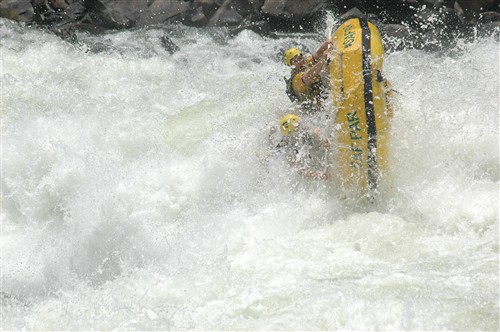
 

The ninth rapid, Commercial Suicide, is a Class 6 rapid so they don’t raft it. After recovering from our spill, we docked just before #9 and walked across the rock ledge to the right of it. The rapid was a narrow passage between jagged rocks and had a huge drop in the beginning – it looked positively fierce! We rode #10, an easy run in comparison with the first nine and took a break for lunch.

The second half of the day was a series of Class 3 and 4 rapids but no fives. They were fun but a bit like riding the kiddie coaster at the amusement park after you’ve spent the morning riding the scariest ones. By the twenty-third rapid, we were ready to conclude the adventure. We disembarked and climbed a third of the way back up the steep ravine wall, where a cable car lifted us over the remaining distance. We had drifted twenty-four kilometers along the river and an open-air bus drove us back to the lodge with a cooler full of ice cold beer, water and sodas.

The company that organized the trip, Safari Par Excellence, did an impeccable job – we were so impressed with every aspect of the experience from the expertise and professionalism of the staff to the precise coordination of events. Their operation is top notch and we highly recommend them. And, for that matter, we seriously recommend Livingstone, Zambia as a destination for the adventure traveler. The Zambian people are easy-going and friendly and Livingstone offers enough action-packed adventure sports to entice even the most experienced adrenaline junkie. We didn’t stay long enough to quench our thirst for action and we will undoubtedly leave wanting more!
1 Comment

November 17th 2007 by Aaron & Tina
Zambia Part I: Charitable Cheese

Posted under Africa & Zambia

Fate is a funny thing. At times in my life, I have fought shamelessly to change mine – often chasing adventures of the rather “unconventional” sort – while at other times, I have faithfully relented to the will of the wind. I have been rewarded, slapped, blessed, and cursed. I have risen and I have fallen. I believe in fate but I believe in my ability to change it.
Life is like one of those “choose your own adventure” books that I used to read in elementary school. At the end of each chapter, there is a choice to make, an adventure to be chosen, each with its own path and its own ending. Naturally, after reading through to one ending, I would have to begin again to find out the “What if?” of the other choices. Unfortunately, or perhaps fortunately, in real life, we do not have the luxury of turning back time. Some of the choices that I’ve made in my life have been downright idiotic but they have been my choices and I cannot regret them for they have eventually brought me here, to this time and place, to this crazy dream coming true before my eyes. My favorite poem is one by Robert Frost, written in 1920:

THE ROAD NOT TAKEN
Two roads diverged in a yellow wood,
And sorry I could not travel both
And be one traveler, long I stood
And looked down one as far as I could
To where it bent in the undergrowth;
Then took the other, as just as fair,
And having perhaps the better claim,
Because it was grassy and wanted wear;
Though as for that the passing there
Had worn them really about the same,
And both that morning equally lay
In leaves no step had trodden black.
Oh, I kept the first for another day!
Yet knowing how way leads on to way,
I doubted if I should ever come back.
I shall be telling this with a sigh
Somewhere ages and ages hence:
Two roads diverged in a wood, and I-
I took the one less traveled by,
And that has made all the difference.

As it turns out, fate has stuck her nose into our plans and called us home for a wedding at Christmas. Our original itinerary would have put us in Asia around then but we decided instead to take the opportunity to spend more time in Southern Africa. While the extra expense of this unintended trip home falls far outside the sanity border of our budget, it has bought us two very positive perks: Christmas in Iowa, which is on par with the best experiences that life has to offer, and a more thorough exploration of Africa.

On Zanzibar, the hands of fate pushed two lovely New Zealanders into our path, Jerry and Hayley Field whom we met while swimming with dolphins. They help to run a farm and cheese-making operation as a mission project in Kabwe, Zambia, and they invited us to be their guests for a couple of nights.

We had planned to take the fast ferry from Zanzibar to Dar es Salaam and make arrangements from there to take the two-day train to Zambia. However, due to such motivating factors as insufficient information online (a chronic problem in Africa), lack of reasonable access to a travel agent, our negative first impression of Dar (from the one oppressively hot night we spent there in a seedy neighborhood with no A/C), the rumored unreliability of the train (supposed to take two days – could take up to four!), and that peaceful, easy island feeling, my dear husband suggested air travel instead and I enthusiastically concurred, mostly because it bought us two extra nights on Zanzibar! Coincidentally, we met Jerry and Hayley at the Zanzibar airport. They were on both legs of our flight to Zambia so the four of us traveled on together, spent a night in Lusaka, and then caught a bus to Kabwe.

As I’ve mentioned before, bus rides in Africa are always interesting, particularly at the “bus stations”, and Lusaka was no different. The four of us had shared a taxi to the bus station and, before it had come to a complete stop, the car was surrounded by young men, shouting and shoving each other to try to sell us bus tickets. It is an uncomfortable feeling to be swarmed by such vocal locals but we have grown accustomed to it. What still bothers us, however, is the physical nature of it. They tend to grab you by the arm, push you in one direction, or try to pull your bags out of your hand. The swarming I can deal with – the grabbing is unacceptable!

As our taxi rolled into the parking lot, one of the men reached through the open window, grabbed my arm, and started pulling on it. Instinctively, I shrieked, “Don’t touch me!” and yanked my arm away. This seemed to get everyone’s attention and the three leaches crowding my door apologetically retreated to let me out of the car. We collected our bags from the trunk in a hailstorm of flailing arms and simultaneous shouting and let Jerry make the bus arrangements.

With our packs stowed in the luggage compartment under the bus cabin, we grabbed four seats in the back. Most of the buses in Africa do not leave according to a schedule but rather when they are full, meaning every narrow seat is filled and the aisles are clogged with overflow passengers and parcels. In Lusaka, we waited in the sweaty bus for a record two hours before embarking on our ninety-minute journey. While we waited, I kept an eye on the luggage compartment. There are always many men standing around the buses with no apparent function or purpose and you feel compelled to keep one eye cocked whenever your bags are out of your immediate possession to ensure that the bags don’t depart before the bus does.

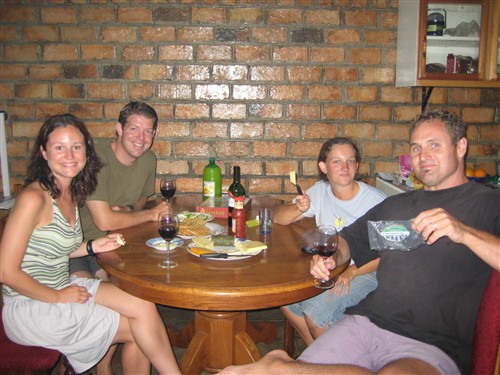
We arrived at the farm around six p.m. and easily settled into Jerry and Hayley’s spacious two-bedroom house with cozy loft above. They were the most gracious hosts and we immediately felt at home. Hayley has an herb garden in front of the house and there is a lovely patio and a large backyard. On her first night home, after a ten-day island vacation, Hayley put together a delicious lasagna, made with Swiss cheese produced in the cheese factory. A bottle of South African red wine complemented the meal perfectly and we talked late into the night.

The Fields have been on the farm for a year and are more immersed in the local culture than we could ever hope to be so we enjoyed hearing their perspectives on some of our observations thus far. We’ve noted on several occasions that the children seem incredibly well-behaved in Africa. On long bus rides, babies hardly cry. A girl of about six years sat on the floor of one bus – she didn’t have a seat – and didn’t make a peep for ten hours! This is without a single material item to keep her attention – not a book, a toy, or a crayon; she didn’t sleep but just sat, idle and quiet, the entire time! It seems unbelievable but this is a phenomenon that begins in Africa at a very young age. Because of the culture and/or the poverty, babies are not stimulated. There are no toys and no books. Children are left to their own devices at an early age because their mothers live hard lives and cannot be bothered with them. We’ve often seen young children sitting in groups in the dirt or being tended by other children who are not much older themselves. Jerry shared his observation that even the local school curriculums are devoid of creative and cognitive thinking exercises and gave the following example: If you give a group of Western children each a toy truck, they will play and collaborate with each other. If you give the same-aged group of Zambian children each the same toy trucks, they will look awkwardly at them for a few seconds then hide them under their shirts. They seem less inclined to play or to imagine.

We have observed the direct, long-term results of this unfortunate phenomenon in all of the African towns that we’ve visited, where streets are literally lined with young men sitting on ledges and benches for hours at a time, just staring, with nowhere to be and nothing to do. We’ve seen village women with the same blank stares and idle tendencies. As business-minded Americans, we immediately see opportunities that are not being exploited while hundreds of able-bodied men and women sit idle, with neither the foresight nor education to capitalize on them. It does not surprise us then that a culture such as this remains saddled with the sort of hard labor, low-wage jobs that will unlikely bring a nation out of poverty. This is Africa.

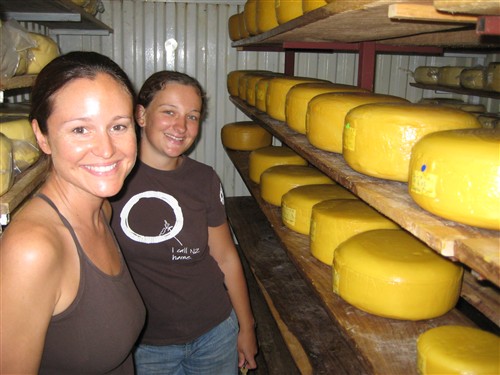
Bright Hope International bought the farm and pre-established cheese-making operation in 2005 with the goal of teaching local Zambians how to support themselves while maintaining a self-sustaining, profitable business. The farm is run by a group of volunteer Kiwi missionaries in conjunction with a local Zambian foreman. The operation employs 25-30 local citizens and supplies cheese to local businesses. They produce cheddar, emental, Gouda, Swiss, parmesan, feta, gruyere and mozzarella, and cream cheese, just to name a few. They currently have about 200 freesian cows. We enjoyed the privilege of touring the farm and cheese operation and learning about the cheese production process.

Cheese 101: I have always naively assumed that all cows produce milk, all the time. Not so. Only females produce milk and only while they’re pregnant, which makes perfect sense, of course. On many dairy farms, such as this one, the farmers employ methods of artificial insemination to keep the female cows as perpetually pregnant as possible. Twice daily, at four a.m. and four p.m., the cows are milked using a milking apparatus, which channels the milk fresh from the udder to a canister in the milk room. Next, most of the fat is siphoned off into a separate bucket and is later used to make butter and cream cheese. The skimmed milk is taken directly to a large vat in the cheese room, where it is mixed with cultures (which acidify the milk) and rennet (which coagulates the milk into curds and whey). The proportions of these two ingredients determine the texture, density and flavor of the cheese. When the milk has curded into lumps and the whey has fallen away, the lumps are wrapped in cheesecloth and pressed into molds, where they sit overnight in the cheese room. The cheese is then removed from the mold and moved to a refrigerated room to age at least three months with the exception of mozzarella, which matures in only three days! Inside the refrigerated room, the cheeses must be rotated at least once per day, throughout the aging process. Certain cheeses, such as feta, must spend time in a bucket of brine. When the cheese reaches maturity, it is cut and packaged for distribution.
The operation employs a small local sales force to solicit the orders, mostly from businesses catering to tourists, and the deliveries are made in the farm’s cheese truck. The volunteer administrators manage every facet of day-to-day operations, including accounting and reporting, product quality control, personnel, developing and repairing infrastructure on the property, and fixing the vehicles when they break down. The missionaries work pro bono, bless their hearts, so any monetary donations benefit the local operation directly. The project requires a group of multi-talented and uniquely skilled individuals but, even with all of the required resources, running a business in Africa still has its own set of challenges.

As the four of us visited, Jerry quoted Leonardo DiCaprio’s character Danny Archer in the movie Blood Diamond. “T.I.A. This is Africa.” It is a blanket response to the many nuances of Africa that seem bizarrely backwards and for which there is no logical explanation. Whether you have to wait at the petrol station for 40 minutes while a shift change takes place or you walk another kilometer to the fourth ATM that you’ve tried because the first three were broken, Africa has a way of slapping you in the face, constantly reminding you where you are and by whose rules you are playing. African commerce requires unlimited patience, especially from Western-minded individuals. Tasks are completed at a snail’s pace; what would take twenty minutes to accomplish in the States can take weeks in Africa. Something as seemingly simple as opening a bank account can entail four or five trips to the bank, submitting redundant forms and resubmitting previously submitted forms which were inconveniently (or incompetently) misplaced. This is Africa.

In the resorts on Zanzibar, we observed the frustrating pace of the African service employee. We would walk up to an empty bar and order a drink from the bartender. Twenty minutes later, we would look up at the still dormant bartender, who hadn’t even begun to make our drink and he would meet our eyes with a look of realization that he was supposed to be doing something and “What was it that you ordered again?” When we tried to order an item in a restaurant with a slight variation from the standard preparation or ask a clarifying question about a menu item, we were met with blank stares. It is partly due to the language barrier but there is definitely a larger disconnect there. Customer service and overachievement seem foreign ideas to these men and women. Aaron compounds the frustration by asking detailed questions about menu items and, when it is clear to everyone at the table (usually just me) that he’s not going to get an answer, he tries harder to clarify his question, thereby intensifying the look of total confusion on the face of the server. Just order the damn burger! But this is Africa and Africa requires patience.

An estimated thirty-five percent of urban Zambians are infected with the HIV/AIDS virus – a maddening statistic that has lowered the average life expectancy of a Zambian to only thirty-three years! In the local culture, however, the subject is still very taboo. When someone dies of the virus, people say that he died of Tuberculosis or malaria, but NEVER AIDS. There are local clinics which dispense free medication to infected persons. In towns where the clinics reside, locals will go to another town, often much further away, to collect their meds so as not to be seen by anyone they know. The meds work to fight the symptoms of the virus so the patient starts to feel mentally and physically better at which time he starts having sex again and spreading the disease. We wonder whether the Western-sponsored drugs are doing more to help or hurt the pandemic which has left thousands of Zambian children orphaned or living with grandparents who are too elderly to support them. This is Africa.

What impresses us most about the farm project is that it is teaching the local people valuable skills as well as providing jobs. There is a Chinese proverb that says, “Give a man a fish and he will eat for a day. Teach a man to fish and he will eat for a lifetime.” This kind of hands-on educational gift empowers and teaches self-reliance, initiating positive change. An educated and skilled population will thrive.

On our last night with Jerry and Hayley, we were treated to a cheese tasting! We tasted about five varieties, of which my favorite was the Swiss and Aaron’s the emental; they were all delicious! After that, it was steaks, more wine and a rowdy game of Settlers of Catan, a board game which we will be sure to purchase in about sixteen months. Our stay on the farm was short and sweet but definitely one of the highlights of our adventure. We are so appreciative of the Fields’ hospitality…especially the use of their washing machine! They are doing remarkable work and we admire them for their commitment. We are fortunate for the twist of fate that crossed our path with theirs. Fate is a funny thing. Sometimes you just have to go with it.

1 Comment

November 10th 2007 by Tina
Kendwa by Daladala

Posted under Africa & Tanzania

After three incredible nights in Paje, we decided to move to Kendwa Beach on the northern tip of Zanzibar. There are essentially three modes of transportation available for getting around on Zanzibar: private taxi (most expensive), private minibus, and daladala (dirt cheap). We had taken a taxi from Stone Town to Paje but, in the interest of curbing transportation costs and for the sheer adventure of it, we wanted to take the daladala from Paje to Kendwa, passing through Stone Town. As fate would have it, a private minibus driver at Cristal made us an offer we couldn’t refuse on a ride to Stone Town and dropped us off at the local spice market from which the daladalas departed. We paid the mzungu price of two thousand Tanzanian shillings each (still dirt cheap) for an hour long ride from Stone Town to Kendwa. We hoisted our packs onto the roof of the open-air truck bed where they were piled on top of sacks of food and construction supplies. We then climbed into the back with about fifteen locals sitting shoulder-to-shoulder on the bench seats. When the daladala was satisfactorily stuffed with patrons, a barefoot conductor hopped onto the back and signaled the driver to pull away by clanking on the metal frame of the roof structure with a stack of coins.
Despite Aaron’s suggestion otherwise, I was wearing shorts and a sleeveless shirt – I was going from one beach resort to another for goodness sake! – which drew the usual stares from the Muslim locals, though the offenders at least tried to be discreet. It is interesting how you can always feel a stare upon you, especially the penetrating eyes of disapproval or contempt, even when you purposely avoid making eye contact. I notice it to a greater degree as a minority in race and religion and as a foreigner in this conservative, tribal culture. In my opinion, we would have exacted the same stares if I’d worn a berka, just for being mzungus. In fact, we stopped briefly near a group of schoolgirls and one of them shouted, “Ay, Mzungus!”, and pointed at us as if we were monkeys in the zoo. We smiled and waved, laughing at the spectacle of giggling schoolgirls as the daladala drove away.

I had made a conscious choice of attire that morning, knowing full well that we planned to ride the daladala with the locals. There were a number of reasons for my choice. First, the Tanzanians, particularly the Zanzibaris, are nothing like the Egyptians – my fleshy exhibition was not going to put us in danger of being drawn into a street brawl. Second, though I have grown increasingly more traditional in my thirties about the domestic role that I want to play in my family dynamic, I am a bull-headed, outspoken, unapologetic American feminist on the subject of women’s rights and equality. I don’t like to be told what to wear. Aaron suggested that I was being culturally insensitive and he was probably right on many levels. While I admit that it tickles my personal fancy to stir the proverbial pot, my motivation in this scenario lay in setting a flesh and blood example of a liberated woman who can stand proudly on her own or by her loving husband’s side, wearing whatever she wants (and nothing she doesn’t), with the poise, confidence and dignity of a queen. I am not so naïve, however, as to presume that this is always how I am perceived. A woman sitting across from me on the daladala had a ten minute conversation with the young man next to her while repeatedly gesturing toward my bare legs. She spoke Kiswahili so we’ll never know what she said but her expression suggested disapproval. This sort of thing never bothers me and I responded with friendly smiles.

Between Stone Town and Kendwa, the daladala stopped periodically, letting passengers off and taking on others; all of these exchanges were orchestrated by the barefoot conductor with his clanking coins, who stood on the bumper for most of the ride because the vehicle was consistently filled beyond capacity. Aaron captured the daladala experience most accurately when he said that if the vehicle, comfortably but snugly, fits fifteen, they’ll pack in twenty and, if there are five more people along the way, they’ll squeeze them in too. It doesn’t seem to be as much about maximizing profits, however, as simply giving a ride to someone in need of one. They won’t leave a man behind in the interest of personal space for the existing passengers. There is no concept of personal space in Africa. There is always room for one more.

We stopped once for a young mother and baby alongside the road. The truck was already packed so tightly that my hips were beginning to go numb from being squeezed from both sides but the barefoot conductor nonetheless grabbed hold of the baby while the mother climbed over about twenty pairs of tangled legs to a narrow corner in the back. The big-eyed baby girl was then passed, without the slightest whine of protest, through an assembly line of arms until she landed safely on her mother’s lap. It was at once strange and beautiful.

The daladala dropped us off at a roundabout two kilometers from Kendwa. With two sets of bruised (from the hard, wooden plank seats) suburban buns, we were happy to hump the final distance down the dirt road.

We are constantly fascinated by our experiences on African public transportation.
It would be wishful thinking to suggest that we commune with the locals when we ride their uncomfortable, sweaty buses rather than travel by plane like the majority of the mzungus. The race disparity is much more pronounced here than it is in the States. In my observation, almost without exception in both Kenya and Tanzania, the white people are here either as tourists or in a business or philanthropic capacity. The locals are black tribal peoples who didn’t grow up with white people living down the street or going to the same schools. We are foreign to each other though we can speak the same language. I recently read The Poisonwood Bible, by Barbara Kingsolver, about a tyrannical Southern Baptist minister who drags his American wife and four young daughters to the Congo to impose his religious beliefs on the local tribal villagers. I see many similarities between the cultural barriers that we have experienced and those described by the wife and daughters in the book. We can sit shoulder-to-shoulder with the locals on their daladalas, shop in their markets, solicit their businesses, exchange smiles and pleasantries, but we cannot begin to penetrate the tribal barriers which have been solidified over generations. Certainly not in the two to four weeks that we have allocated to each African country on our itinerary and, in reality, probably not in a lifetime.

On countless occasions, we have driven through rural villages where the villagers chase after the bus, feverishly shoving fresh vegetables or some other local product up to the windows. On those same streets, I always see women of about my age sitting idly on the ground, leaning against a storefront or house. They all seem to have the same distant look on their faces. I search my own catalog of womanly emotions and experiences for some semblance of insight into the thoughts behind those vacant expressions and, invariably, I come up empty. These women have lived lives in a world that I cannot begin to understand from my passing bus window. I want to reach inside their souls and look at the colors, to study their faces and hear their stories, but for selfish reasons, for my own collection box of memories. This desire does not seem to be reciprocated by the people here, least of all by the women who seem to want the least to do with us. Perhaps it is a trivial and indulgent desire, afforded to a silly American woman who has never known hunger, struggle or pain in comparison. I am from a world that is unfathomable to these women, a world of luxuries and excesses that seem so vain from this dirt road in the middle of rural Tanzania.

Speaking of vain luxuries, Amaan Beach Resort in Kendwa has not disappointed! The beach is every bit as beautiful as Paje. The sand is peppered with seashells but the tide is higher so we can swim at all hours of the day. The resort atmosphere is livelier than the sleepy bungalow setting that we enjoyed in Paje but there are also more services. Our garden view room is perfect and we have reached the point of true relaxation. The grounds, particularly the lush, manicured garden courtyard, are nothing short of a spectacular botanical paradise. Because Kendwa is on the western side of the northern tip of the island, we also get brilliant sunsets over the water.

We are staying three nights here and there are no excursions tempting enough to lure us out of our zone of relaxation. Truth be told, we know that nothing can top the dolphins and we are still glowing in the aftermath. After two incredible nights, we still haven’t ventured out of the resort with the exception of a morning walk along the beach. We swim with our scuba masks during the day and have seen starfish, sea urchins, several varieties of crabs and two kinds of jellyfish, which have been kind enough not to sting us yet.

On one of our walks, we found a starfish that had washed up onto the shore but was still weakly hanging onto life. Aaron picked it up with his flip flop and gently flung it into the water. At first, it just lay on the ocean floor, upside down, too weak to turn itself over. Then, by a stroke of luck, a gentle current swept through the water, turning the starfish halfway over; slowly but surely, as we cheered from the sidelines, it began to right itself, one long leg at a time. It was our good deed for the day and we celebrated by lounging like beached whales for the next eight hours.

At sunset, the water is almost dead calm, rippling just enough to glisten in the waning sunlight. Last night, we were sitting at a table on the beach listening contentedly to the Eagles, as the big orange ball sank slowly toward the horizon. The water looked irresistibly calm and inviting so we peeled off our clothes and swam furiously toward the sun. When we reached a good distance from shore, we lay on our backs, splashing, giggling and working to stay afloat. I would have believed that time stopped for those precious few moments were it not for the natural clock on the horizon. When the sun had just sunken low enough that the sky was illuminated by a dull iridescent glow, we began swimming toward the shore in a slow elementary backstroke, which naturally evolved into a furiously competitive backstroke race to the shore.

While we could easily conceive of staying longer on Zanzibar, we both feel so completely rejuvenated that the excitement of our upcoming African destinations is beginning to pull at us with a magnetic force. Concluding a tropical beach vacation is so much more satisfying when you don’t have to return to a hundred emails and a stack of files at work. So tomorrow we’re off on the fast ferry back to Dar and, if the stars are in alignment, Zambia here we come!

5 Comments

November 7th 2007 by Tina
Paradise Found

Posted under Africa & Tanzania


After two nights spent wandering around Stone Town, we headed for the beach. Stone Town encompasses the west side of the island while the many white sand beaches, peppered with resorts and bungalows, lie along the north and east sides. We chose to start at Paje, on the eastern shore, because of its reputation for beautiful beaches, turquoise water, and sleepy bungalow atmosphere. It is everything we dreamed and more!

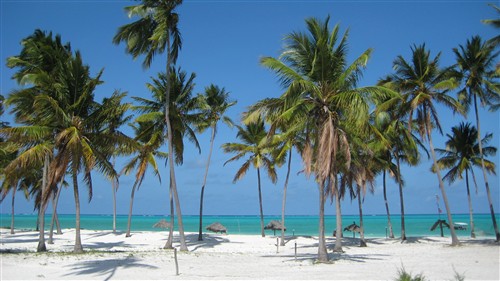
The fine, white sand is so soft that you feel like you’re walking in baby powder. The water is a glistening turquoise for almost as far as the eye can see and then gives way to a deeper shade of blue. The resorts are small and personal with thatch-roofed bungalows, hammocks swaying between palm trees, beachside cabanas, and cozy outdoor lounges with lots of cushioned seating and mellow tunes playing softly day and night. A gentle breeze from the east blows constantly over the beach, making even the hottest afternoon hours pleasant and the evenings comfortably cool. The beaches and resorts are only sparsely populated at this time of year so we have the place almost entirely to ourselves. Swahili women, draped in colorful island fabrics, walk along the beach in the mornings, at low tide, collecting seaweed in hand-woven baskets. The tide is so low that they can walk a half mile out and, from the shore, they appear to be walking on water.

We spent our first night at a quiet resort on the south end of Paje. The room was adorned with African lamps and tribal accents surrounding a rustic king-size bed. The beach there had more dense concentrations of seaweed, making it less desirable for swimming, but the indoor lounge featured cozy nooks and conversation areas, a pool table, and a great selection of board games. After placing our dinner order, we engaged in fiercely competitive games of pool, chess and Rummikub while our hosts busied themselves preparing the meal for us, as well as the other six guests of the evening. We all sat down together at beachside tables and feasted on fresh seafood prepared with local spices. Aaron’s crab pasta in cream sauce and my prawns in rich coconut sauce over spiced rice were both superb. It was a quiet, relaxing meal and a perfect start to the perfect beach vacation. In Zanzibar, you exhale every worry, every tension and twinge of anxiety while inhaling the peaceful, happy island breeze. Hakuna Matata.

After breakfast and a game of chess the next morning, we moved up the beach to our newly beloved Cristal Resort. The beach is pristine – the swimming is heavenly – and the outdoor lounge is a self-contained oasis of relaxation. The thatch-roofed bungalow has an “island minimalist” theme with open spaces, clean lines and wood trim. I could stay here for a month without batting an eye but my darling husband, with his undiagnosed Attention Deficit Disorder, could never endure it. He’d have to start a business or something to keep himself stimulated. Aaron and I are polar opposites in this regard. Give me a stack of books, a pen and a journal, and I can spend endless hours of uninterrupted bliss on a picture-perfect beach. For Aaron, what constitutes paradise for five days could quickly become excruciating without enough activities to hold his attention. On this trip, we strive to maintain a healthy balance between his desire to sail on and my need to drop anchor every now and then. Zanzibar is my island paradise. I smile as I watch Aaron lying across from me on a plush outdoor sofa with book in hand and wonder how long he can last.

Our daily activities consist of eating, reading, swimming, sunning, walking, and just hanging out in the lounge at Cristal. There are a handful of potential excursions such as snorkeling, scuba diving, boat trips called Blue Safaris, and SWIMMING WITH DOLPHINS! OK, we agreed to be anti-excursion this week – to spend an entire week just relaxing – but who could resist the opportunity to swim with dolphins? Not us!

The driver picked us up this morning at 6:00 sharp, along with seven other guests, and drove about twenty minutes to the south coast of Zanzibar, a village called Kizimkazi. After selecting a mask, snorkel and fins, we waded about fifty yards through shallow water to our vessel, the Jumbo, a long wooden boat like a dhow but with motor instead of sail. We quickly set out on the gentle morning waves and, almost immediately, saw dolphins surfacing in the distance!

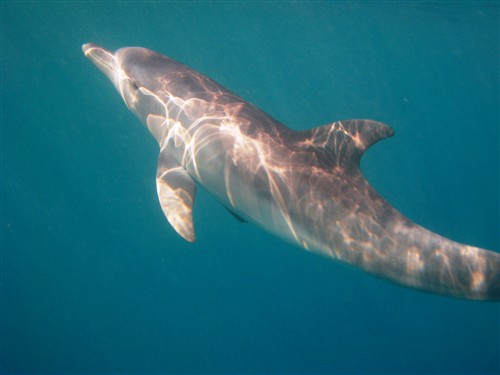
We cruised a bit further from the shore until we could see several groups of them around our boat. We excitedly pulled on our snorkel gear and rolled off the sides of the boat. Almost as soon as I put my mask into the water, I saw them – sleek gray dolphins gliding through the water below us and on all sides. They were beautiful and they were everywhere! On several occasions, we would see nine or ten of them swimming about twenty feet below us while we floated above with our masks in the water. Then the dolphins would start rising toward the surface, gliding slowly and sometimes only an arms length away! They would stay with us for five to ten minutes at a time and, when the dolphins would swim away, we’d patiently wait for them to resurface, then frantically swim to catch up to them. When they were too far away, we would swim back to the boat and go looking for more. There were so many dolphins around us that we were hardly in the boat at all! No sooner would we all climb back into the boat than a new group of them would surface just a short distance away and we’d flop back into the water and kick furiously after them.
When we finally headed for shore, we were all fatigued from an hour long rush of adrenaline-fueled dolphin pursuits. We were overwhelmed by the intensity of the most amazing aquatic experience of our lives. We had envisioned seeing a few pairs of dolphins that would swim away from us as quickly as we hit the water but the dolphins delivered and delivered big! We estimate that we saw about thirty of them in all and they lingered and played around us as if we were dolphins too. The sensation of floating effortlessly along the surface of the warm ocean water, staring in amazement and awe at those marvelous creatures, was pure magic! Though not even a full day has passed since our incredible swim, it already feels like it was a dream…but it wasn’t! Today we swam with dolphins!

2 Comments

November 6th 2007 by Tina
Zanzibar: Busted by Immigration & Paying the Mzungu Price

Posted under Africa & Tanzania

At the ferry dock in Dar es Salaam, there are several classes of ferry tickets listed on the board but foreigners may only purchase the most expensive VIP tickets at $20 each…and that’s for the slow ferry. Additionally, the Tanzanians have a currency scam going on from Arusha to Zanzibar. They quote all prices in U.S. dollars but when you actually pay in their local currency (the Tanzanian shilling), they use an outrageous conversion rate, which inevitably adds a couple of dollars to the original price. It is so infuriating, especially when they do it with a smug grin that says “yes, I know I’m screwing you but there’s nothing you can do about it”, but we’re dealing with it begrudgingly…for now anyway.
We departed Dar es Salaam for Zanzibar in the relatively plush VIP section of the most wobbly ferry vessel that I’ve ever experienced. If not for the powers of meditation, I might well have lost my breakfast in the middle of the cabin. After three and a half long hours, we arrived at the port in Zanzibar Town, the main commercial hub on the west side of the island.

Because Zanzibar is an independent city-state, joined to Tanzania by a declaration of unity, we had to clear immigration. As we had feared, our transit visas came into question and we were shown to a separate immigration office where an agent lectured Aaron on the meaning and limitations of the transit visa. The sole purpose of your visit must actually be transit (i.e. passing through Tanzania directly from one country to another within fourteen days), which apparently doesn’t make allowances for a five-day pass through the island paradise of Zanzibar. The agent informed us that we would have to pay the full price of $100 each for new visas. However, after twenty minutes of savvy negotiation by Aaron, we paid only $70 each – the difference between the full visa price and the price of the transit visa that we already had. We cursed the additional $140 but we couldn’t be too upset; we’d tried to beat the system and gotten busted with no real harm done. Anyway, now that we have the regular visas, we are in no rush to leave Zanzibar, which is picturesque perfection!

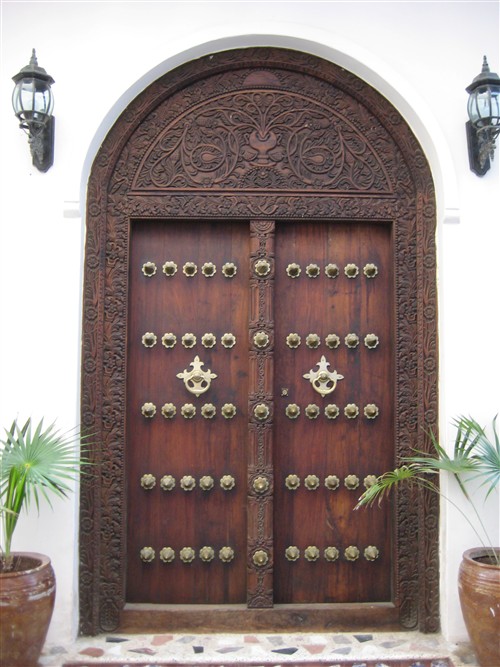
We spent two nights in old Stone Town, getting lost in the narrow, zigzagging streets, perusing the island shops and local spice markets, and admiring the historic town known for its slave trade history, Swahili Muslim culture, and old stone buildings with exquisitely carved wooden doors. On our first evening, we watched a gorgeous sunset from the terrace bar of the posh Afrika House while sipping deliciously overpriced cocktails. With mild island intoxication, we wandered through the darkening streets to a late-night outdoor market along the shore, where Masai tribesmen sold their colorful, beaded wares and street vendors served up fresh grilled seafood skewers, fruit and Zanzibar pizzas, all by lantern light.

We ordered two pizzas from the vendor who seemed to be getting all of the local business and watched curiously as he generously layered ground beef, diced tomatoes, a mix of chopped onions, peppers and spices, one raw egg, a dab of mayonnaise and a dab of soft, white cheese in the center of a round flat disk of dough; he then mixed it all together, turned the corners up, and tossed it onto a makeshift skillet. After browning both sides, he served it sliced with salad, ketchup, and chili sauce on top. We noticed that the local patrons were paying 1000 shillings for each pizza so, when ours came up, we tossed 2000 shillings into the money bowl. “One more thousand,” said the vendor. Oh yes, the mzungu price! We endure this sort of discrimination a lot in Africa, for transportation, food and lodging: one price for locals and one price for the mzungus, or white people. Guess which one is higher. While the individual instances of discrimination are certainly more minor than, say, job discrimination for example, they are unapologetically blatant and equally infuriating. In the case of the pizzas, it was about $1.50 versus $1.00 each so we laughed it off and tossed in the extra bill. Anyway, the pizzas were scrumptious and we finished off the meal with a chocolate-banana pizza from another vendor who didn’t charge us the mzungu price. We enjoyed our evening so much that we did exactly the same thing the next night: Afrika House for the sunset and the street market for dinner. The second night, however, we paid the local price for our pizzas from the hospitable vendor but only after stopping by the first discriminating vendor’s stand to tell him that we were taking our business down the way, “where mzungus are treated as equals!”

1 Comment

« Prev - Next »