Posted under Philippines
On our last day in the Philippines, we embarked on a day tour of Bohol. We had chartered a car and driver for the day and were on the road by 7:30. As we rode through the interior of Panglao Island on our way to the land bridge, I regretted not renting a moped and spending a day exploring the lush, tropical forest community. There were so many opportunities to ask the driver to stop for photos of the homes – so beautiful in their sad state of dilapidation – but I let them slip away. I hope that the picture in my mind will always be as vivid as it is today.
The tour began with some diverse yet decidedly forgettable stops: an historic bronze statue of a blood pact between a Spanish conquistador and a Boholano chieftain; a centuries-old coral stone church (probably a gift from the Spanish Catholic crusaders, funded with resources plundered from the islands); and an enormous captive python weighing in at 225 kilos. It was a beautiful day on Bohol and we were happy to be on land. Despite our driver’s breakneck speed, the ride was lovely with fantastic buffered views of Filipino life. We drove through expansive rice fields with straw-hatted farmers wielding man-powered ploughs, immersed shin-deep in the sopping muck. The fields were framed by palm trees and banana plants against a backdrop of low, tree-covered mountains.
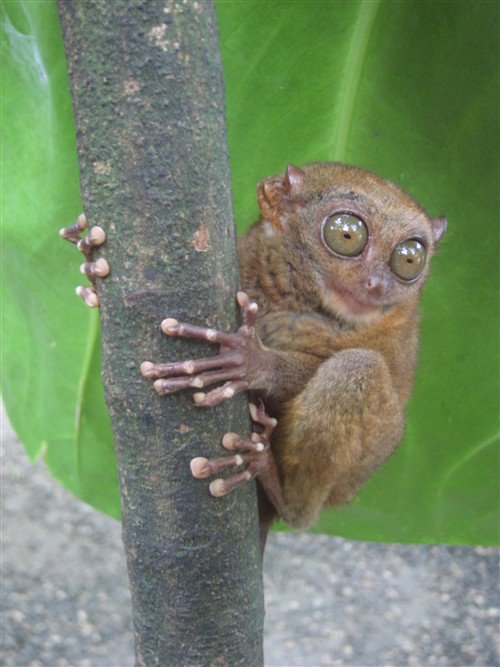 We arrived at the Tarsier Visitor Center with no expectations. We had seen the island’s mascot – the tarsier – immortalized in postcards, key chains, stuffed animals and t-shirts in the many gift shops along the beach. As we entered the rectangular fenced area of the conservatory and spied a pair of the tiny monkeys clinging to a narrow tree branch, it was love at first sight. The tarsier is the world’s smallest primate. It can literally fit in the palm of your hand. Tarsiers are indigenous to the Philippines and are currently endangered. The two tiny monkeys clung to their tree branch while we cooed and photographed them (without flash because their proportionately large eyes are nocturnal and would be damaged by the bright lights). We were each given a wooden skewer with a black bug on the tip to feed them. It was adorable to watch them grab hold of the skewer with their tiny, soft hands and lick every last trace of insect guts from tip of the stick. On our way out, I dropped some coins into the donation box. I hope that someone is working hard to save the tarsiers. If the little angels ever made it to the States, every kid would have to have one.
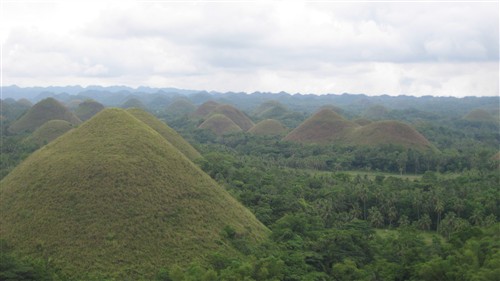
After the tarsiers, we drove on to the highlight of our tour: the Chocolate Hills. If the tarsier is Bohol’s mascot, then the Chocolate Hills are like the Taj Mahal of the island. They are the premier tourist attraction. There are 1,268 hills in the middle of the island, covered with vegetation that takes on a rich brown tone in the hot summer months. The hill formations are thought to have resulted from rising coral reefs, centuries ago when much of the island was underwater. The main viewing point is located at the top of the highest hill, offering panoramas of the brown hills rising up from a thicket of dense tropical forest and stretching as far as the eye can see in all directions. The viewpoint is naturally thronged with tourists but, as you stare mesmerized across miles of chocolate vistas, you subconsciously tune out all but their awe-inspiring magnificence.
The grand finale of our tour was lunch on one of the many floating restaurants that cruise the lazy Lomboc River. Heavy rains over the last few days had stirred up the silt from the river bottom, changing the river’s usual emerald green hue to a murky greenish-brown. Rain had poured down just a few minutes earlier, stopping in time for our lunch cruise, and we were happily surprised to find the floating restaurant packed as we climbed aboard. We took seats at our assigned table, which we shared with a Filipino family. Tables were set around the perimeter of the boat with a long buffet set up in the center. When everyone was seated, the hostess announced that we could begin the buffet line, which incited a mad, disorganized rush from all directions to the center table. With our plates full of fresh fruit and piled high with traditional cuisine, we began our leisurely cruise down the river. A solo guitar and vocalist provided live entertainment, consisting of a decidedly cheesy mix of American soft rock covers. Aaron quite accurately compared the two-man band to Adam Sandler’s character in The Wedding Singer. As the floating restaurant glided merrily along, we attempted to tune out the music but ended up singing quietly along to songs like The Love Boat.
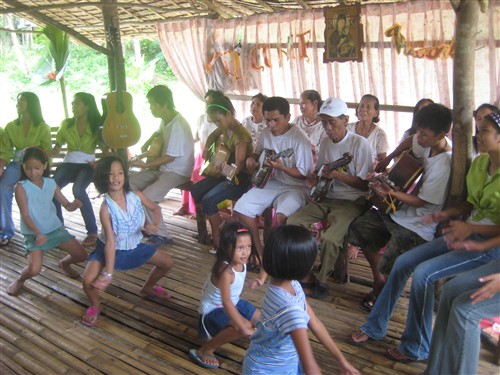 The river bank on both sides was thick jungle with simple homes built on the water’s edge. There were many locals outside, sitting on their riverside patios and waving to the boats going by. At several spots along the banks, large groups of local people, spanning three generations, sat on floating pavilions made of bamboo and thatch. As we neared them, the band stopped mid-song and one of the men tethered our boat to the pavilion. The group immediately commenced the first of several high-energy music and traditional dance performances. The young girls danced first; then the young boys and the mothers and grandmothers. Those who weren’t dancing strummed guitars, sang and clapped along. Everyone participated with faces exhibiting true joy. There were donation boxes attached to the posts on the pavilions and we were happy to contribute to such an inspiring and energetic display of local culture. Each group performed for about twenty minutes and then untied our boat and waved goodbye as we cruised away. It was a very moving experience that really epitomized the heart and soul of the Filipino people. We were continually inspired to see people with so little material wealth express such joy and love of life.
As we rode to the Cebu airport, our final stop in the Philippines, we felt the usual twinge of sadness that seems to come with leaving a place that we have truly enjoyed. The coral reefs were pristine. The locals were friendly. The beer was cheap and the mangos perfectly sweet. With white sand beaches and plenty of upscale resorts, it is easy to stay isolated from anything resembling real Filipino life but the Philippines is a long way to come for just another pretty beach. The real treasures of the islands are the people – living, loving and always smiling.
Comments Off on Chocolate Hills and The World’s Smallest Primate
 We arrived back in Manila by bus and with great ambitions. We had booked a flight from manila to Tagbilaran on the southern island of Bohol where we planned to do more diving and hopefully get some beach time but, before that, we were going to attempt a shotgun trip – a nine-hour bus ride each way – to Banaue in north Luzon to see the famous rice terraces of the Cordillera. The logistics were exhausting to think about but the photos of the rice terraces were breathtaking and we’d certainly endured worse travel in the not-so-distant past. By now, our backs are strong and our patience is long.
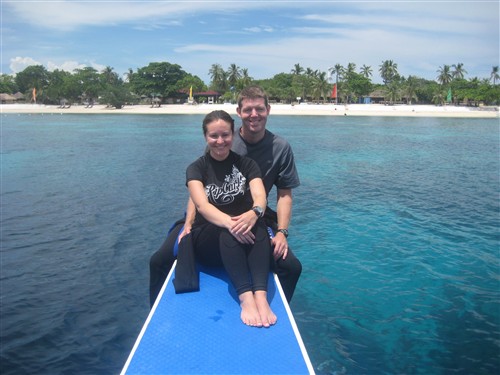
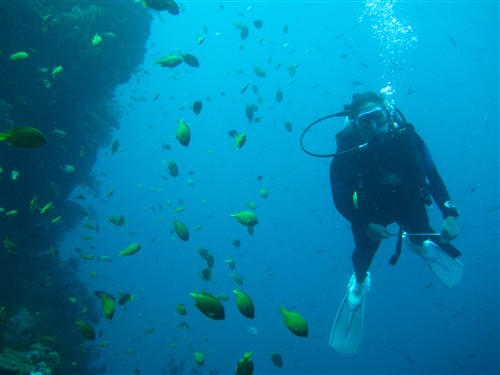 We had come to Alona Beach to dive and dive we did – ten times over the course of five days, dividing our time among Panglao, Balicasag and Cabilao Islands. The islands are known for their spectacular reef walls – tall underwater cliffs covered with colorful hard and soft corals. The water was clear and the marine life vibrant. There were daily, two-dive boat trips around the islands, which afforded us plenty of much-coveted boat time and an early afternoon return leaving hours to linger over a post-dive beer and hot shower before pondering the day’s most pressing decision: where among the beautiful candlelit seaside restaurants to have dinner.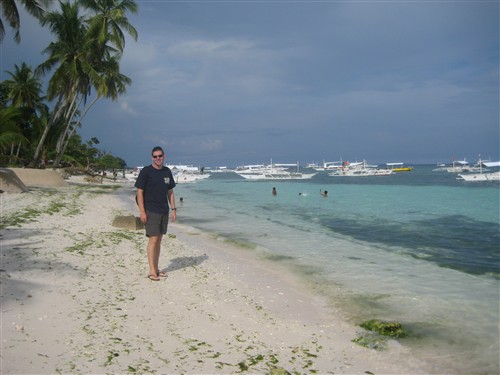
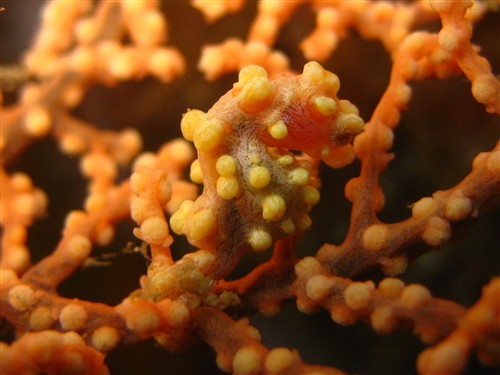
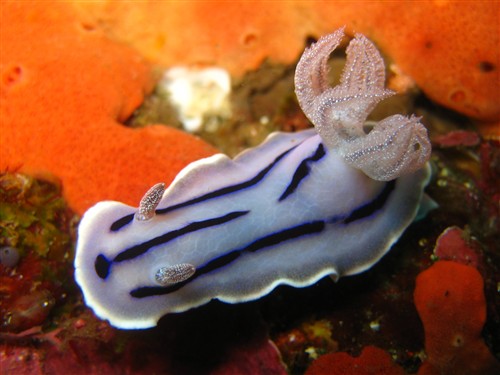
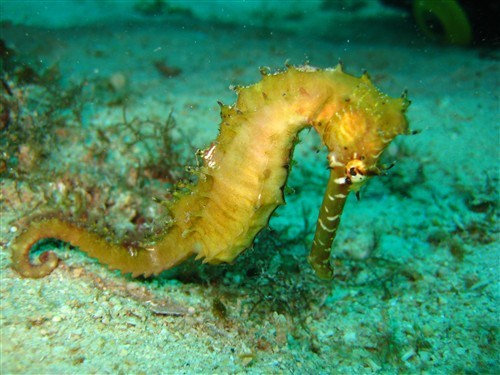 The rest of our diving in Sabang was easy and enjoyable. Other “muck dives” yielded much-coveted seahorses – both pygmy seahorses, which are about the length of a fingernail and difficult to spot since they blend seamlessly into the coral and also thorny seahorses, which are three-to-four inches long, delicate and fascinating. I have always been intrigued by seahorses: they are one of the world’s few creatures whose males carry their offspring. I have always wanted to see one but they are as difficult to find as they are beautiful. Imagine my elation at seeing more than five on a single dive!
 As we loaded our bags and ourselves onto the pumpboat for Batangas, the young boys climbed aboard again looking for coins to be tossed. Their youthful exuberance was refreshing and I handed a few pesos to one of the boys but he kept it for himself rather than tossing it into the sea. Smart kid. As the boat motored slowly away from the shore, I felt a twinge of sadness. Sabang is a sleepy little divers’ town with no beach to speak of, which doesn’t stop the natives from wading in on a hot day. There is little to do besides dive, drink beer and wait for the spectacular tropical sunsets. Life is slow and simple. The locals are friendly. The diving in Sabang is excellent for its diverse underwater world of captivating shipwrecks, gorgeous hard and soft corals and treasure chest of fascinating, unusual sea creatures. Seahorses…check!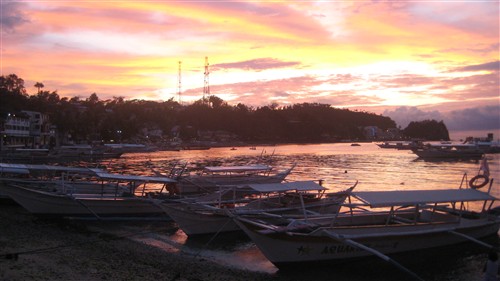
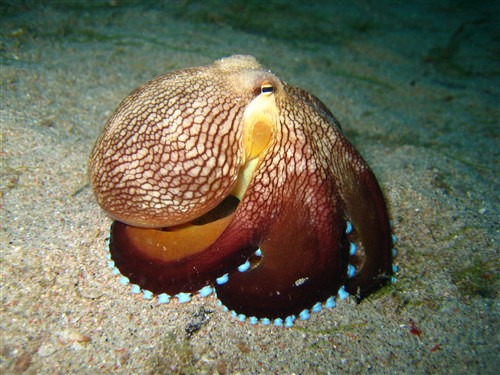 We checked into the Sabang Inn Dive Resort, a Spanish-inspired villa with spacious sea view rooms, and purchased a diving and accommodation package for four nights. Less than two hours later, we were underwater at a dive site just one hundred meters from the oceanfront resort. The site was impressive for its diversity. Aaron found an octopus hiding in a pipe on the sandy ocean floor and we watched as it changed color from a camouflaging shade of gray to dark red. The Philippines is known for its macro diving, or “muck diving” – scavenger hunts through the otherwise unimpressive sandy sea floor looking for tiny, unusual sea creatures. I prefer pretty coral reefs to sandy bottoms but I had to admit that the octopus was amazing. We explored a beautiful wooden wreck covered in multi-colored algae and teeming with schools of small shimmering fish. It was a great first dive and we were excited about the prospects of the next three days.
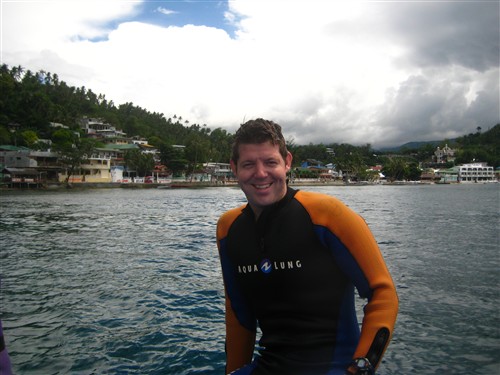 During the last forty minutes of the dive, I stuck to Aaron like glue, despite his repeated assurances that he was okay. I would spend three seconds looking at coral and the next three watching Aaron, making sure that he was breathing and staying within two kicks of my clutches. He was still visibly frustrated with his equipment setup, but everything seemed to be fully functional. I could not relax and enjoy the dive site because all that I could think about was getting Aaron back safely to the surface. I know that I drive him a little crazy when I go into Mother Hen mode and, in a beautiful underwater paradise, stare worriedly at him while ignoring the spectacular coral and fascinating variety of fish. I love scuba diving – it has become a true passion and a significant funnel of our fun money – but the reality is that when it comes to guarding the safety of my family, that magical underwater paradise disappears outside the figurative walls of my tunnel vision. For me, there are simply no other fish in the sea.
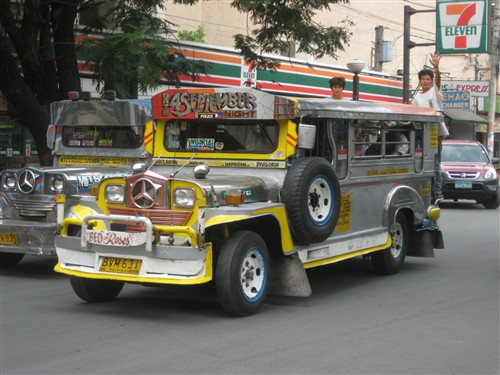 We are back in the Third World and startlingly so. As we rode into Manila in the dark of night, tacky neon signs illuminated long rows of night clubs, restaurants and hotels. At a stoplight, a young, filthy girl, holding an infant, knocked on my window, begging for money. After two-and-a-half months of living in the Western world (New Zealand, Australia, Japan), I was not mentally prepared for India-caliber poverty and the wretchedness of her appearance gave me a start. I quickly switched to Third World mode.
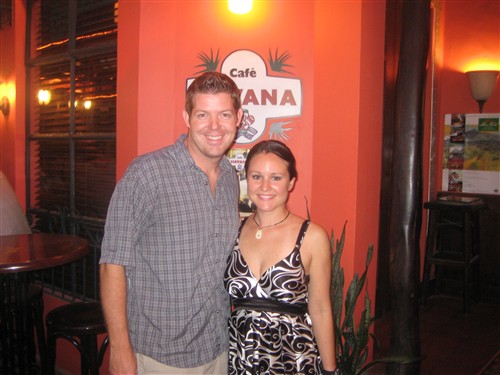 On a brighter note, we regrouped in our room after a long day of intense observation and gussied ourselves up for a night out in Malate. I had bought an inexpensive little silk dress in Thailand, thinking that I’d wear it once and mail it home after it had fallen victim to the cramped conditions of my backpack. After donning it in Thailand, I folded it into a large Ziploc bag and carried it like that for over a month in my pack before pulling it out again in Australia. Miraculously, it came out virtually wrinkle-free as if it had been hanging in my closet. I pulled it out several weeks later in Manila with the same fabulous result. I’m shocked at the resilience of this little dress and tickled by the pleasure of having something delicate, pretty and feminine to throw on once in a while as a reprieve from my t-shirts and cargo pants.