Posted under India
Udaipur. We were taking the overnight bus to Jodhpur that evening. A couple whom we’d met in our cooking class warned us that the sleeper berths get really cold at night so we decided to leave early to try to buy a blanket on the way to the bus station. We visited so long after dinner, however, that by the time we left, all of the shops were closed. We walked back to the hotel where we had stashed our bags for the day and layered on as many warm clothes as we could comfortably bear: two pairs of pants, three shirts, jackets and scarves. We were bundled to capacity and beyond.
We boarded the sleeper bus, which had both chairs and fully enclosed two-person sleeper compartments. Our berth was on the upper level, right behind the driver’s seat. It seemed cozy and we were as excited as two kids at their first slumber party. The bus departed around ten p.m. At twelve-thirty, we stopped for an hour-and-a-half at the Indian version of a truck stop: a dirty squat toilet with no sink, soap or toilet paper; a man cooking something under a tent and a few random locals standing around selling refreshments and baked goods. At this particular stop, we were treated to a chorus of Bollywood show tunes blasting out over an old school loudspeaker. Just about that time, as we huddled in our compartment, we began to notice that it was starting to get cold outside…and also inside. The chilly night air seeped in through the sliding glass window that wouldn’t stay closed and seemed to circulate through crevices in the sliding door to the main cabin. As bundled as we were, we could not get warm all night long and spent most of the night not sleeping but shivering. After trying countless heat-sharing cuddle positions, we arrived in a quiet, dimly lit parking lot in Jodhpur around seven a.m. – two hours late!
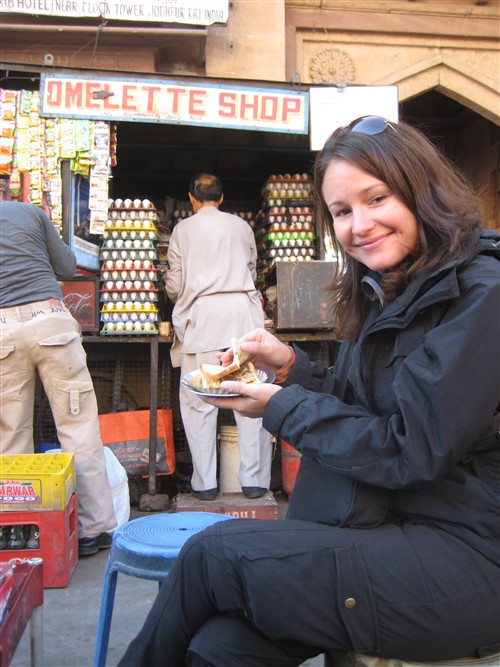 Our hostel in Jodhpur had supposedly sent someone to collect us from the bus stop but he was nowhere to be found so we took a rickshaw to the hostel. Having slept in short, intermittent segments, we collapsed onto the bed and slept late into the day. Because of our restless journey, we both woke at an odd hour, groggy and irritable, and craving a hot, greasy breakfast. The day began on a sweet note. We walked just a few short steps to the main market entrance to the legendary Omelette Shop, which was more like an omelette cart. We sat on plastic patio stools while devouring two of the house specialty – the masala cheese omelette. I never would have guessed that the world’s only orgasmic omelette was being served daily from a little cart in Jodhpur, Rajasthan. Aaron tried to get the omelette man to divulge his secret ingredient but the man just threw his head back and laughed a laugh that said “I’m taking this one to the grave, son.” Little did we know that our taste buds were in for another colossal treat. Sushma, our cooking class chef, had told us to try a makhania lassi – a yogurt drink made with green cardamom and saffron – when we went to Jodhpur and as we entered the market with happy bellies full of greasy omelettes, a big sign advertising makhania lassis suddenly appeared before us. We sat down and ordered one to share…and then another one. Makhania lassi is absolute Heaven on the palate! My addiction was immediate.
You wouldn’t think that a day with such a delicious start could turn sour but somehow, after the lassi, things started to go south. Likely, in part, because of our attitudes, we found the people on the streets of Jodhpur collectively disagreeable. So many of the children begged and the streets felt cold and unwelcoming. We decided to tour Meherangarh, meaning Majestic Fort, which was built on top of a steep hill at the edge of the city. The fort, once the residence of generations of rulers and now a museum – was interesting and the audio tour was well done. From the highest levels, we took in the best views of the blue city of Jodhpur. The houses are painted with indigo, which gives them a cool, pale blue hue.
From the fort, we walked about fifteen minutes down the road to a grand white marble cenotaph (tomb monument), called Jaswant Thada, which was commissioned by the wife of Maharaja Jaswant Singh II in his memory. The marble used to construct the memorial is so fine as to be almost translucent. Inside were photographs or drawings of all of the past maharajas of Jodhpur in silhouette. A small altar in the center with a photograph of the honored maharaja was adorned with colorful flowers, pictures of Hindu gods and burning incense. What strikes me as odd is that, while pedestrians are required to remove their shoes before entering the monument, the dome is covered with pigeons that “bless” the marble steps and terraces all day long. While I respect the cultural custom of removing shoes before entering a holy place, I’ll always remember leaving with pigeon poo all over the bottom of my last pair of clean socks.
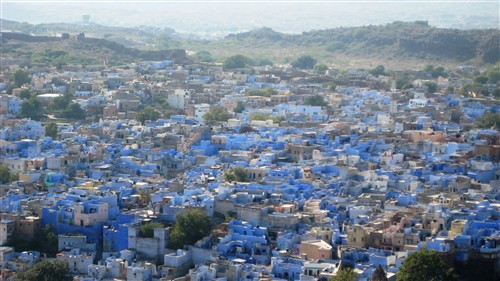
By the time we left the cenotaph, I was beginning to fade, both physically and emotionally; I think we both were. I wanted to take a rickshaw back to the hotel but Aaron thought that it would be fun to walk the medium-length distance through a different part of town. I humored him, mostly because, as a woman of thirty-two, my back side can use all the exercise it can get, especially after many weeks of paneer butter masala. So we walked down a long, curving road and down some steep steps into the heart of the blue city. Before long we were joined by three young schoolgirls who begged us for school pens and rupees. In a normal state of mind, I have more patience with the kiddos but, in this case, we just tried the very scientific and strategic method of ignoring them. Just when we thought they had finally given up, one of the little scamps slapped me square on the back with all of her pre-pubescent might and then took off running down the narrow alley, followed by her two friends. My first instinct was to chase them down, just to scare them and teach them a lesson but I chose instead the much more mature and classy alternative of shouting profanity in a show of raised fists. The incident catalyzed my impatience to its apex and we stormed back to the hotel while completely ignoring everyone who spoke to us along the way. By way of unanimous consent, we sought out the most direct route to a rooftop restaurant that served wine. On the rooftop of Indique, our spirits gradually improved as we worked our way through two half-bottles of Rajasthani red wine while watching the sun set in a pink, blue and purple sky, then headed downstairs to an enclosed restaurant with glass walls overlooking a beautiful city fountain. With full bellies and a mellow wine buzz, we retired early but not before making arrangements to leave Jodhpur the next morning – a day earlier than we’d originally planned. We hired a rickshaw-wallah to pick us up the next morning, drive us to one last palace and wait with our bags while we took a brief tour, and then drop us off at the train station.
We woke early the next morning and walked into the market in search of a warm blanket – for future sleeper buses and trains – and haggled over a heavy green-and-white flowered one that is an absolute albatross to tote around. Our master plan was to grab one more makhania lassi and masala cheese omelette before we headed out of town. We found a lassi shop and inhaled one each before making our way to the Omelette Shop only to find it dark and closed! No! Heartbroken, we walked back to the hostel to meet the rickshaw driver and, in a sudden stroke of genius, decided to skip the palace and instead wait for the Omelette Shop to open! No regrets…the omelettes were amazing! Jodhpur was easily our least favorite stop in Rajasthan. Abused by schoolgirls and hassled by a host of other beggars, we felt a very chilly reception there and, with the exception of the unequaled omelettes and addictive makhania lassis, we were happy to watch Jodhpur fade into the distance.
Comments Off on Masala Cheese Omelettes & Makhania Lassi
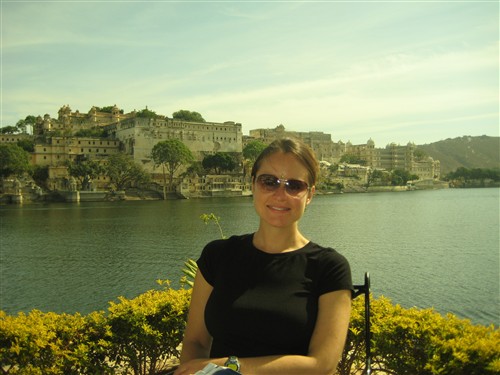 Set on the edge of a sparkling lake and nearly surrounded by mountains, the whimsical, romantic city of Udaipur has a distinctly European feel. From the sunny lakeside patio of Ambrai Restaurant, where we enjoyed our best meal in India, the afternoon sunlight glitters on the tiny ripples of the lake. Local men, women and children bathe and wash clothes at the sun-soaked ghats along the water’s edge. The sound of the women beating the wet clothes clean echoes across the town.
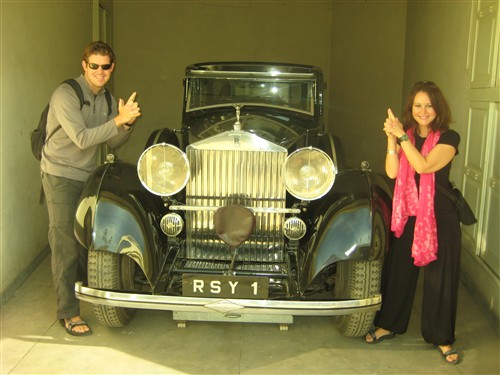 Our next two days in Udaipur were lovely. We lingered longer on sunny terraces, checked out a few shops, and kept our activities to a minimum. On day two, we took a rickshaw to see the maharaja’s vintage and classic car collection. Each of the twenty-two splendid automobiles had its own garage and an extraordinarily personable guard opened them, one by one, speaking of each car with pride and affection. Neither Aaron nor I are car buffs but we were awed by the beautifully restored historic vehicles nonetheless. Most impressive was the 1934 Phantom Rolls Royce used in the James Bond film Octopussy, which was partly filmed in Udaipur.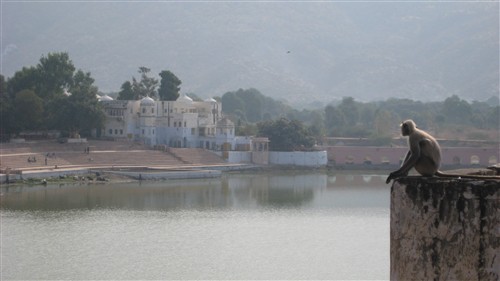
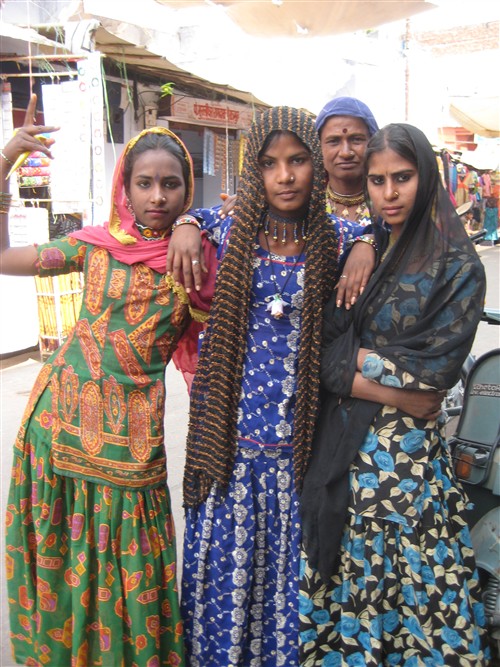 The people of Pushkar, and our ability to interact closely with so many of them, were by far the highlight of our visit. They are vibrant and charming and clad in even brighter and more vivid garments than those we have seen thus far in India. We could literally spend hours photographing each and every fascinating person and many people – especially the elderly panhandlers carrying their shiny collection buckets – are happy to be snapped for a few rupees. Now that we know the game, we always carry small change in our pockets and hand it out like Halloween candy. The elderly panhandlers are docile and entertaining but there are also the nasty little child beggars who are persistent and ruthless. One little girl was begging with a baby in her arms. When we tried to shoo her away, she lifted the baby’s garment to display its back full of red sores. Another boy tried, with average success, to engage us in a whole debate about the value of taking our money to the grave versus giving it all to him. The next day, the same boy followed us again. I told him that he should go to school. He replied, “If I go to school, who will get my Mama chapati?” That made me sad because it was probably true. So young to have such worries.
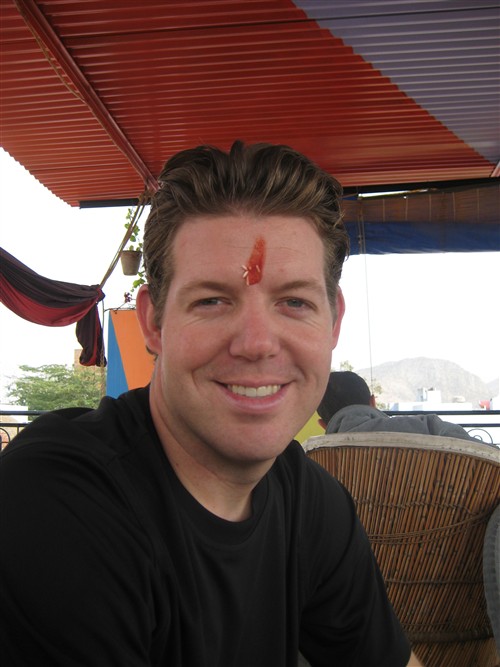 The priest led me through a series of prayers, alternating in heavily accented English and Hindi, with me repeating after him. I dutifully followed his instructions to wash my hands in the holy water, then place my wet fingers on my forehead, eyes, shoulders, heart and stomach, blessing each with my touch. I prayed for peace and love and good health and a long life and the same for those in my immediate family. At the conclusion of these prayers he dipped his wet thumb in the red powder on my plate, creating a red paste, and gently smeared it on my forehead between the eyes. I was finally allowed to walk to the water’s edge and pour the contents of my plate into the lake. I returned to the mat and the priest informed me that in order for the Gods to answer my prayers, I must make a donation to the poor, solemnly promising to feed no fewer that one thousand of India’s impoverished citizens. He spoke quickly, implying a minimum commitment of “One Food”, or one thousand rupees, about $25. Handing me a coconut and slowly dripping holy water onto it, he asked me repeatedly how many people I intended to feed. “One Food? Two Food? Three Food?” I initially balked at the promise, knowing that I had no intention of donating his asking price, but he would not let me complete my prayers without commitment. He again submerged his hand in the holy water, removing it and once again he let it drip methodically onto the outstretched coconut. “How many food?” His words clamped down like a vise on my conscience. I agreed to “One Food” and moments later, with my prayers official, I was ushered to a small table at the top of the steps where a man waited with an official receipt book.
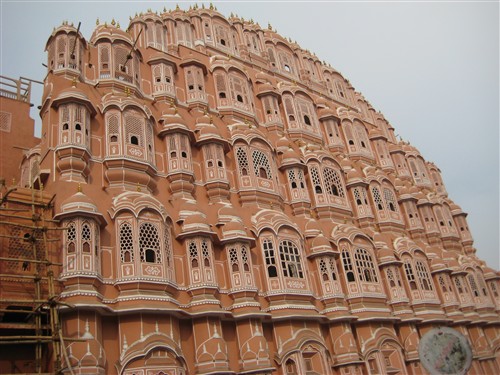 We flew from Mumbai to Jaipur, which is the capital of the Indian state of Rajasthan, and took a taxi to the Hotel Pearl Palace, near the city-center. Our room was not quite ready so we ventured up to the rooftop for a drink. Our room was tastefully decorated with local textiles and modern amenities. After settling in, we set out for a walk to the train station to purchase train tickets to our next few destinations. We only made it a half-block from the hotel before an autorickshaw-wallah convinced us to let him drive us around. Rickshaws are two or four-seater cabs or carts with a single driver’s seat in front. Autorickshaws have motors and can maneuver through traffic like a motorcycle. Bicycle rickshaws are slightly cheaper and good for short distances. We arrived at the train station and booked tickets to Ajmer, Udaipur and Jaisalmer. Our driver, Munna, was so friendly that we took him up on his offer to take us sightseeing around town for the rest of the day.
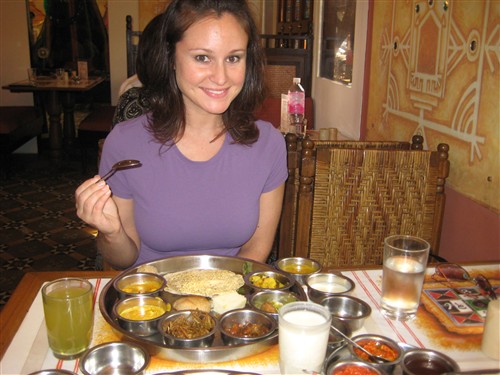
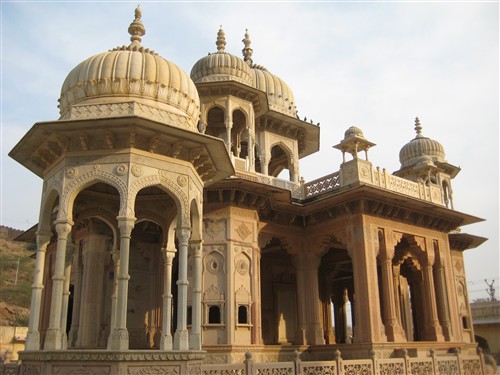 Munna recommended a good place for thali and we made a quick lunch stop before moving on. We were the only tourists inside the dim restaurant, which is a good sign. The thali was great, though much less elaborate than Chetana, and it energized us for our next stop: the Royal Gaitor. The royal cenotaphs, or tombs of the Maharajas of Jaipur, were set against dry, rocky mountains. They are beautifully carved monuments with intricate details, carved out of marble from Italy, India and many parts of Asia.
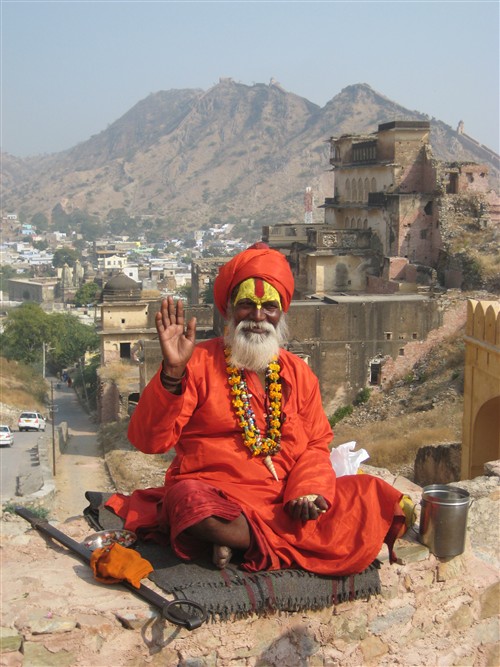 Next stop: Amber Fort. Set on a mountain top about 11km north of Jaipur, the pale pink looks vast enough to encapsulate a small city. We declined offers of jeep and painted elephant transport to traverse the road leading to the fort entrance on foot. The courtyard of the fort was full of activity and, while Aaron waited in line to buy tickets, I was accosted by every variety of trinket-seller. Luckily, my pest-evasion skills are sharp these days and I was able to escape them with minimal effort. As we wandered through the fort’s many buildings, courtyards and labyrinthine hallways (the Maharaja’s passageways to his various wives and concubines), we admired the traditional Rajasthani architecture: elaborate entryways, beautiful city views from corner towers, and the intricate designs in the Hall of Victory and Hall of Pleasure. We could easily envision the Maharaja attending to his amorous desires between royal responsibilities.
 After waiting almost two hours on the tarmac at O’Hare for our plane to be de-iced, we were off on a rather uneventful eighteen-hour journey to Mumbai (formerly Bombay). We enjoyed the spiciest and most delicious Indian airplane food; in one meal, I ate a pepper (which looked like a green bean) that set off a four alarm fire in my mouth. As the plane touched down at Mumbai International Airport, two friendly Indian women gave us homemade chapati (Indian flatbread, similar to a tortilla) after Aaron helped them with their bags. Before we had even set foot on Indian soil, we felt warmly welcomed.