Posted under New Zealand
When I first met Aaron, he had a large world map in his home office with little red pushpins stuck into each of the places he’d been. I remember looking at that map, with the majority of the pins stuck into places in Central and South America, and thinking to myself “this man is going places”. A few months later, when we traveled together to Hong Kong with Aaron’s MBA class (coincidentally, the same week that the U.S. declared war on Iraq and the deadly SARS outbreak in Hong Kong reached near-epidemic proportions), we shared a twinge of excitement as we pushed the new pin into the map. That experience was pivotal in the early stages of our relationship because we realized that we shared an intense passion for seeing the world.
The first several days on the North Island unraveled as a mad dash toward Auckland. Having stolen a day here and there from our North Island itinerary to spend extra time in the South, we now find ourselves racing against the clock to fit in as much as possible before New Zealand becomes just another pin on the world map.
Wellington
Land ho! We glimpsed the North Island through the window of the ferry. From a distance, it looked much like the South Island – pretty forest-covered mountains separating the sky from water on the horizon – but the ship turned parallel to the coast and glided along until it found Wellington Bay with the quaint capital city curving around the bay in the shape of a crescent moon. We arrived around 5pm and checked into what felt more like a backpacker factory than a hostel. After being “processed” by a robot-like receptionist, we were handed a key to a bland, impersonal box of a room, which shared two dirty bathrooms with an entire floor of what seemed to be mostly twentysomethings. Hostels are like a box of chocolates…thankfully, we were only staying one night.
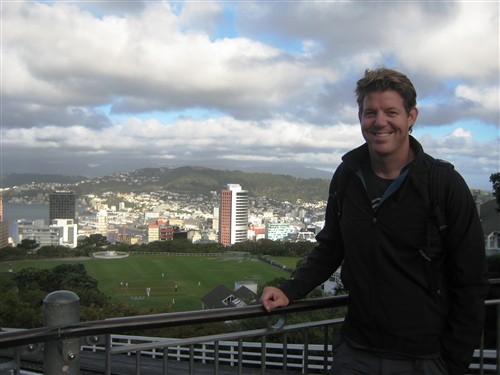 We drove about five minutes into downtown and set out on a walk to explore the city. I was immediately impressed by the number of theatres, restaurants and bars. It was Saturday night and the sidewalks were dotted with diners and drinkers at patio tables, enjoying the music that gave each venue its own personality. New Zealand seems to have a very young population and the larger cities have a small-scale cosmopolitan feel. We took a ride on the Wellington Cable Car up the side of the mountain to look out over the city. A sprawling botanical garden is designed into the mountainside, offering an alternative route back down to town but we opted for the return trip on the cable track and stopped for a quick dinner at a kebab place on the way back to the hostel. The next morning we were on the road early, ready to continue our journey north. Wellington is a great example of a city that grew smartly without losing its small town charm.
Lake Taupo
The town of Taupo, nestled alongside the biggest body of water in New Zealand, was another one night stand. The town has seemingly been built on the edge of the lake to cater to tourists stopping over on their way north or south. Still, it is a lovely small town. After walking along the lake for a while to stretch our legs, we strolled through the public park on our way back to the hostel. The park was swarmed with families – children climbing, swinging, squealing with delight over every piece of playground equipment; young couples lying under shady trees – enjoying the sunny Sunday afternoon. It reminded me of the slow-motion scenes in the movies of children on an idyllic day at the park while the threat of the end of the world looms overhead.
Rotorua
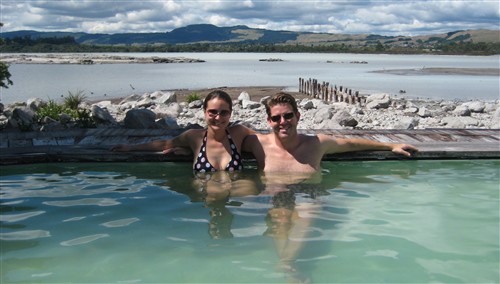
As we drove into Rotorua, another lake town, the smell of sulphur infiltrated our nasal passages. We know this scent well; after our Dead Sea mineral mud bath, we took hot sulphur showers and the earthy stench never quite came out of our bathing suits. We arrived around lunchtime and, after surprisingly little coaxing, Aaron acquiesced to spending the day at the Polynesian Spa. We set out on foot through the quaint little town of Rotorua, stopping into a shop here and there and eventually turning into the Government Gardens. The English-inspired grounds include a mock-Tudor museum, a bowling green, croquet lawn, an historic Spanish Mission-style bath house and the Polynesian Spa. We spent the afternoon soaking in a series of thermal pools overlooking the lake.
The next day was for Aaron’s chosen activity – the Zorb – which is a large plastic ball that you can climb into and get rolled down a long hill. As we walked out to our car, parked along the street, Aaron immediately noticed that it had been side-swiped during the night so we began our day at the police station filing a report. Thankfully, the minor dents and paint chipping didn’t affect the car’s drivability but the prospect of dealing with the rental company and filing an insurance claim still took the wind out of our sails and we decided to spend the day eating ice cream, playing online, and going to our first movie on the road – The Bucket List. Despite the morning’s early mishap, it turned out to be another great day.
Waitomo Caves
There is only one reason to take the 2.5 hour detour from Rotorua to the Waitomo Caves – Black Water Rafting! We had booked the activity in advance of our arrival at the Long Black Café in Waitomo and showed up early for coffee and a sweet before our adventure. It began with a lengthy process of armor assembly: wetsuit and jacket, over-shorts, neoprene booties, helmets, and white rubber galoshes. Hideously appareled, we hopped into a mini-bus for the eight-minute ride to the Ruakuri Cave. We selected rubber inner tubes from a huge stack on the edge of a clearing and practiced a few maneuvers on the ground. Then we walked to a nearby dock on the edge of a shallow river and took one practice jump off the dock into the water. The jumping form is as follows: standing on the edge of the dock with your back to the water and your buns stuck into the hole of your tube; on the count of three, you jump backwards, ideally landing in the reclining position in your tube. In our group of twelve, which included one grandmother, I was the only one to fail my practice jump and flip backwards into the river. (Aaron: Hmmm.)
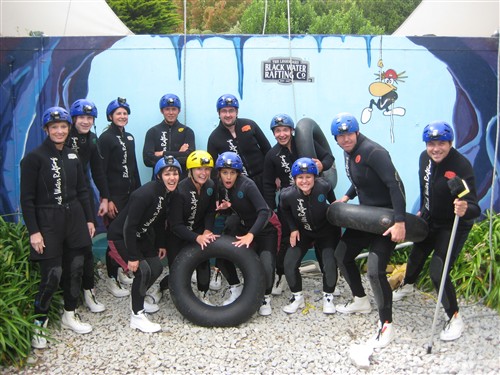 We walked a short way to the cave entrance – a tiny, inconspicuous crevice in the rock, which I immediately envisioned as the vagina of the earth. One at a time, we crouched through the crevice and regrouped just inside the cavernous underground to let our eyes adjust to the darkness. The caves were created over thousands of years as the river slowly eroded solid limestone and the river still flows through them. With our lights on, we walked further inside, careful not to disturb the stalactites overhead, and climbed into our tubes. Keeping our bodies as straight as possible, we “limboed” through a passage with only about two feet between the surface of the water and the wall of rock above. We paddled for a while, admiring the rock formations inside the cave. The water was frigid (about 50F degrees) but our suits kept us reasonably warm. Only when I stuck my bare hands in the water to paddle did I really feel the chill.
We had two opportunities to jump in the manner we’d practiced, including one leap backwards off a six-foot waterfall. The jumps were my least favorite part of the trip but I managed to land them both with only minor aches and pains from the body-wrenching jolt as tube slapped water. Shortly after the big jump, though, came the most rewarding part of the journey. We formed a long “eel” by lining up single-file and grabbing onto each others ankles, turned off our lights and floated slowly through the damp darkness while overhead thousands of tiny lights twinkled like green-hued stars. These were the glow-worms. “Glow-worms are the larvae of the fungus gnat, which looks much like a large mosquito without mouth parts. The larva glow-worms have luminescent organs that produce a soft, greenish light. Living in a sort of hammock suspended from an overhang, they weave sticky threads that trail down and catch unwary insects attracted by their lights. When an insect flies towards the light, it gets stuck in the threads and becomes paralysed – the glow-worm reels in the thread and eats the insect.” (Lonely Planet, New Zealand, 2006)
We spent just over an hour underground and, though I enjoyed the experience for its uniqueness, I must admit that I was happy to see light at the end of the tunnel. Back at the café, we were treated to hot soup and bagels before heading off to check into our farmhouse hostel just down the road. Black Water Rafting: Check. I wouldn’t do it again but I’m glad that I did it once.
Comments Off on Lakes, Hot Springs and Glow-Worms
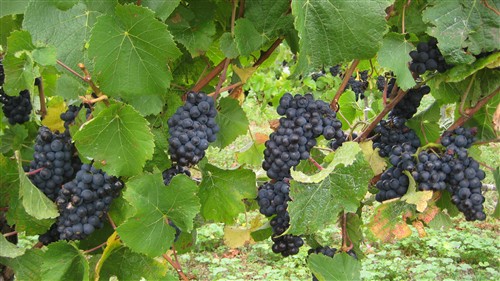
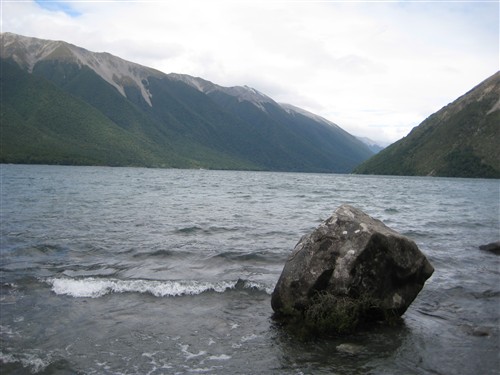 During the days, Aaron and I ventured out – once to Nelson Lakes National Park and once into charming (with hanging flower baskets everywhere) downtown Nelson – while Jerry worked and Hayley relaxed around the house in her wonderfully round, uncomplaining eighth month of pregnancy. In the evenings, we dined together and drank local wine (well…three of us). The Nelson region is wine country and, while lesser known than the neighboring Marlborough region, it has some impressive wineries.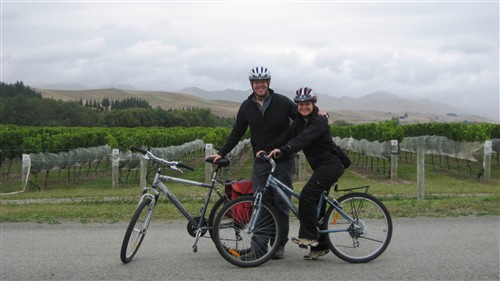
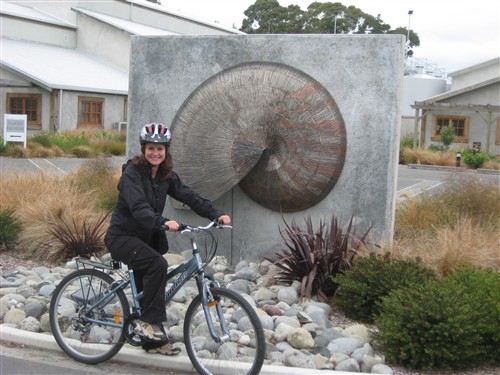 I’ve been especially looking forward to the Nautilus Winery since, many years ago, as my first-ever taste of Marlborough Sauvignon Blanc, it catalyzed a preference shift from California Chardonnays to Marlborough Sauv Blancs lasting through the present day. When a shift like that occurs, a wine lover remembers the details. First tasted at Bistro Zin in Tucson sometime around 2002, I ordered a bottle at every subsequent visit (which, in those glory days, was frequent) until it somehow slipped off their wine list. I have not come across it since, though many others have tickled my palate from the roundish depths of polished glasses. It was a pleasure to taste it again at Nautilus after all these years and it was as delicious as I remembered.
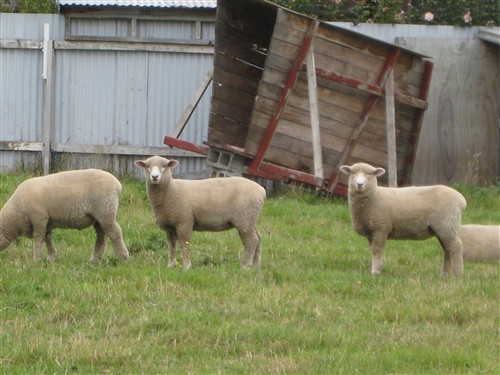 Our week in the wine country concluded our travels in the South Island. The next morning, after ambitiously swinging the rackets again, we packed up the car and drove north to Picton to catch the ferry across the Cook Strait to Wellington in the North Island. We’ve enjoyed the outdoor adventures, the arresting beauty of the landscapes, the glaciers, the wine country and especially the sheep, but we’re ready to see what the North has in store.
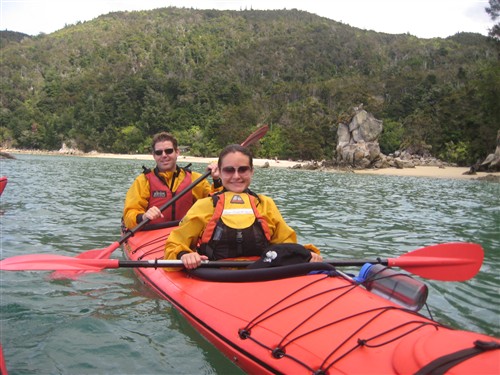 The tiny town of Marahau is the gateway to Abel Tasman National Park. The smallest of New Zealand’s national parks, it is also one of the most visited. We stopped off in Motueka, just 18 km south of Marahau, to buy groceries for three nights in the woods and made our way over winding forest roads to our small family-run lodge, Kanuka Ridge. The cabins were small and basic, with communal restrooms a good thirty yards down the hill, but the common lodge area was cozy and we made ourselves at home. We booked a guided half-day kayak trip for the next morning and settled in to make dinner as well as a picnic lunch for the kayak trip.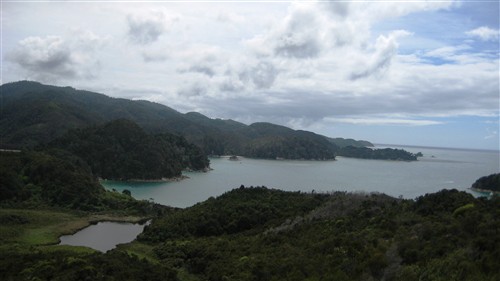
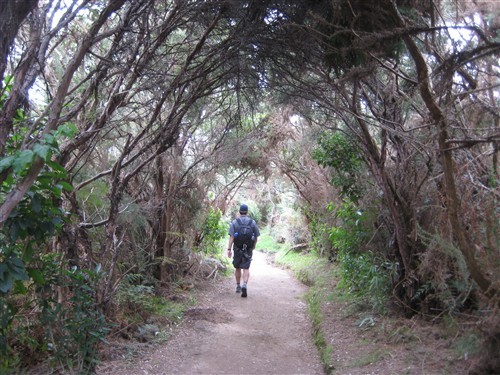 As the years go by and our lives get busier while our bodies get older, I hope that we will always make time for long walks together. In addition to the exercise, fresh air, and beautiful scenery, I love it because of the bond that it fosters, the free flow of ideas that play off one another and entwine into ever more dreams.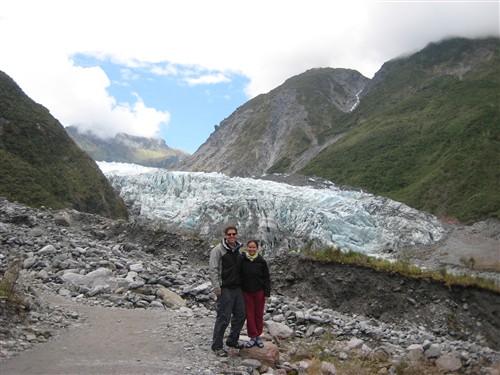
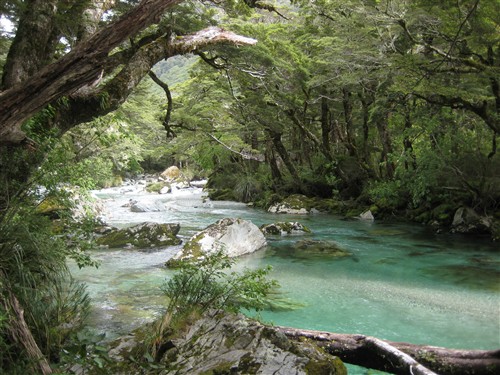
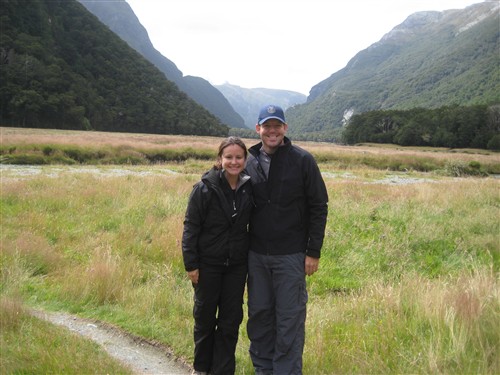 The Flats Hut was an impressively built and maintained complex of basic cabins with modern restroom facilities and a lovely picnic area edging an expanse of golden valley with a lazy river ambling through its straw-colored grasses. We stopped to eat our sandwiches at a picnic table near the river, admiring the views of craggy snow-covered peaks and lush green forest.