Posted under Japan
 On our final morning in Kyoto, we humped our packs for twenty minutes through the pouring rain to the train station for our connection. The three-hour journey to Hiroshima was once again made easy by our shinkansen (bullet train). The world-famous trains traverse the country; regularly cruising at speeds in excess of 150 km/hr, making riding the train faster and easier than flying. We’ve taken them all over Japan – they are definitely the best way to get around.
We arrived just before lunch, giving us the afternoon and evening to explore Hiroshima. Our hostel was in the middle of downtown, within walking distance of all that we wanted to see. Our first stop was Peace Memorial Park, a sprawling oasis in the middle of the city, built as a post-war gathering place to comfort the victims of the atomic bombing and to pray for world peace. The park contains numerous memorials including the Cenotaph for the A-bomb victims (housing a list of all known victims), the Flame of Peace (which will only be extinguished once the last nuclear weapon on earth is destroyed) and the Hiroshima Peace Memorial Museum. We wandered around the park, filled with tour groups snapping pictures, suited workers on lunch breaks, and others just enjoying the sunny Friday afternoon.
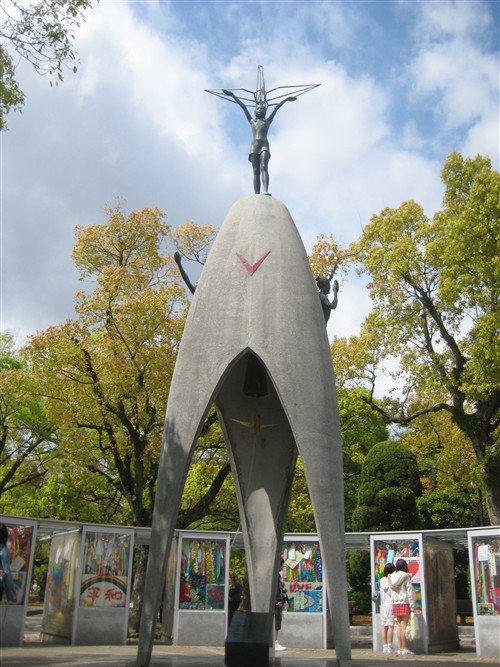 Adjacent to the park is the Children’s Peace Monument, inspired by Sadako Sasaki, a ten year old girl who survived the bombing at the age of two, but later developed leukemia caused by post-bomb radiation. She decided to fold 1,000 paper cranes, a Japanese custom through which a wish will come true, believing that it could help her overcome the disease. She died before reaching her goal but her classmates finished folding the rest, sparking national interest in her story. Each year thousands of students around Japan remember Sadako’s story and fold paper cranes which are sent to Hiroshima and placed in this monument.
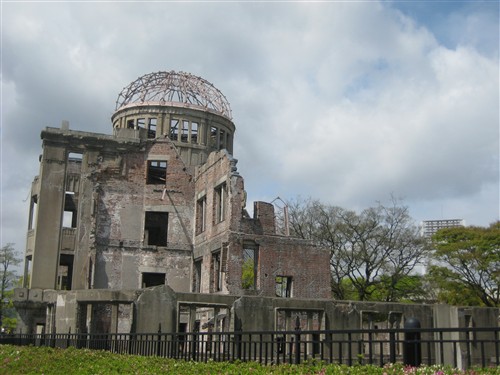
We continued across the river to the A-bomb dome, a symbol of the devastation inflicted upon Hiroshima. On August 6, 1945 at 8:15am the world’s first atomic bomb exploded approximately 600 meters above the city, almost directly overhead the Industrial Promotion Hall. The heat rays and blast burned and crushed nearly all buildings within a two kilometer radius of the hypocenter. Though the city was completely destroyed, a single recognizable landmark remained. The dome of the Hall. Today, the dome and skeleton structure of the Hall remain and have been fortified to perpetually appear exactly as they did more than sixty years ago. In the now-thriving metropolis of Hiroshima, the ruins are a stark reminder of her tragic past.
Retracing our steps, we made our way to the Hiroshima Peace Memorial Museum, or A-bomb museum. The two-story building contains pictures, video, scale models, and government documents narrating the events leading up to and after the atomic bombing. An estimated 140,000 people perished, including Japanese civilians, Korean forced laborers, and POWs as a result of the bombing. Some died instantaneously from the blast, others suffered for days or weeks before finally succumbing to their wounds, while still others died months or years later from the effects of residual radiation released during the nuclear reaction. The museum contained many tragic stories and first-person accounts of the pain inflicted on that August day so many years ago and, as Americans, it’s hard not to feel a twinge of guilt for the actions of our government. So we look for justifications, reasons to explain the horror of Hiroshima. Why did the United States drop the atomic bomb on Hiroshima? The simplified, two-part answer provided was uninspiring. First, the U.S. bombed Hiroshima in a final effort to end the war with a weakened Japan while limiting the Soviet Union’s world influence. The second reason was to justify the tremendous development costs of the Manhattan project which developed the atomic bomb. As we studied the surprisingly unbiased exhibits of the museum, learning more than any textbook or website could teach, it became more apparent to us that there is no justifiable reason to use nuclear weapons. But more than that, it reinforced the idiocy of war, nuclear or otherwise. It was an emotionally intense three hours that left us desperate for a distraction, something lighthearted and fun.
Introduced in Japan in 1873 and played continuously even during WWII, the sport of baseball is hugely popular. Although we’re both half-hearted baseball fans in the States, we’re always eager to attend live sporting events, especially in other parts of the world. The Hiroshima Carp play in a downtown stadium right across the street from the A-bomb dome and they were hosting Japan’s most celebrated team, the Tokyo Giants. The night had grown considerably colder so we bundled up, bought a couple of cheap tickets and made our way to the outfield bleachers. Arriving on time, but still missing the first pitch (the Japanese are annoyingly punctual sometimes), we found our general admission section and looked for a couple of seats. Amid thousands of Carp fans we admired the amazing spectacle created by red-and-white (Carp colors) plastic noise makers. A makeshift band casually assembled behind the crowd belted out tune after tune, while the enthusiastic crowd chimed in on queue. There were four or five drums, a few horns, two guys waving huge team flags, and a conductor orchestrating it all. The fans formed a sea of red and white; many donned the pinstriped jersey of their favorite player. We ordered two draught beers from a passing vendor with a keg strapped to his back and began furiously cheering for the mighty Carp.
 Despite being dressed like a couple of backpackers, unable to speak the language, and clearly foreign, we felt right at home. This was baseball, America’s game, why wouldn’t we? After a couple of innings, we decided to brave the food court. We’d seen plenty of noodles and rice and fish walk by so we knew what to expect. After some deliberation, we settled on a “French Dog” (corn dog), some chicken tenders, and French fries. Not exactly traditional Japanese fare. We immediately regretted not ordering noodles, but the menus were all in Japanese and it just seemed like too much work. With the home team down by four runs, we stayed until the bottom of the sixth inning when we lost our waning motivation as the Carp squandered a chance to score with the bases loaded and no outs. Chilled to the bone, we decided to call it a night. Walking back to the hostel, I recalled the comment of a British guy in our hostel. He said that it was interesting how symbols of America’s two greatest influences on Japan are right across the street from one another, the A-bomb dome and Hiroshima’s baseball stadium. For better or worse, I guess it’s true.
Comments Off on Hiroshima
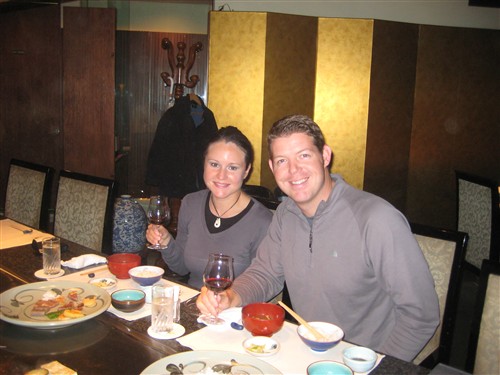
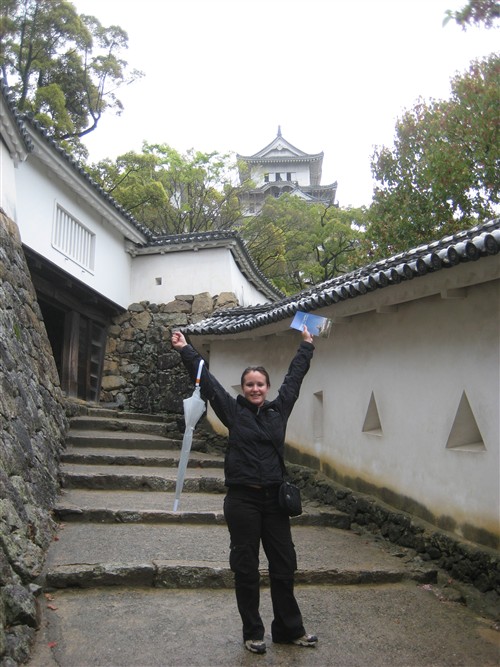 Our next and final stop was Himeji Castle in the city of…you guessed it – Himeji. Having lingered long over our Kobe lunch, the late afternoon was upon us. The castle was open until 5pm but the last admission was allowed at 4:00. The train spit us out at 3:45 about a kilometer from the castle, giving us exactly fifteen minutes to find the right station exit and sprint to the castle entrance. Painfully out of running shape and weighted down by rain jackets and our decadent Kobe feast, we made a mad dash up Otemae-dori in the rain. With burning lungs and heaving breath, we arrived at the outer perimeter of the grounds. We had the elevated castle in our sights but the ticket counter was still a good three hundred meters away. We had slowed our pace from all-out sprint to weary jog but when we heard the five-minute warning over the loudspeaker, we summoned our deepest reserves of energy and made a break for the gate. As we began the final one hundred meter uphill stretch, two male gatekeepers were standing with stopwatches, good-naturedly cheering us on until, at last, we steamed through the gate with mere seconds to spare, arms raised in triumph like the famous scene in the Rocky movies.
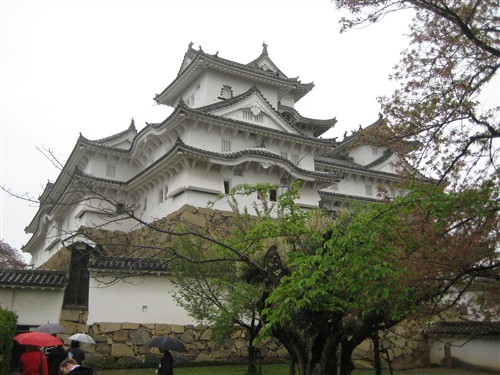 Built high up on a stone foundation, Himeji Castle is an impressive display of power and defensive ingenuity. The wooden structure is insulated by moats and high stone walls. Its fortifications include strategically placed openings for shooting arrows and guns or pouring boiling water onto unwelcome visitors. The interior of the castle is composed of heavy, dark-stained wood which held the dampness of the rainy day. From the sixth storey landing, a lord could look out over his vast lands in all directions. I could almost smell and feel the feudal history in the dark walls and heavy wooden beams; these walls held the restless spirit of battle. Himeji Castle was one of the most magnificent Japanese buildings that we have seen and one of the few castles that remain in their original wooden form. Although it took me an hour to fully recover from our race against the clock, the thrill of the chase enhanced the entire experience. In hindsight, I think that it was fate’s way of reminding us that it is important to maintain a good level of fitness. Many years ago, I wrote a short poem which has since served as a sort of credo: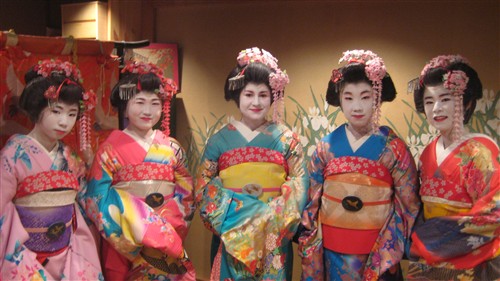
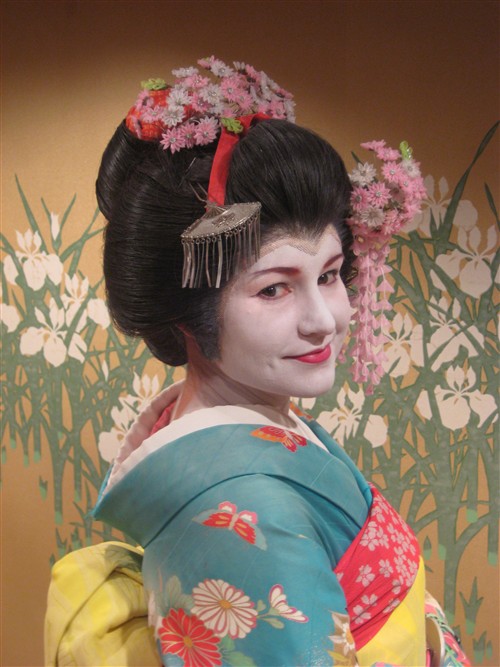 I walked down to the first floor to pose for the professional photo and then to be admired by my adoring husband. After the brief photo session, the photographer informed the receptionist that I was ready to receive Aaron but returned with the deflating news that he had not yet returned. Suddenly, I remembered how tight my kimono was, which reignited the panic. What to do? I had just spent the equivalent of two nights accommodation on this frivolous girly pleasure. I certainly wasn’t going to rip it off before Aaron got to see me. I inhaled the deepest constricted breath that I could muster and sat down on a bench in the receiving room, trying to remain calm, for what seemed like some of the longest minutes of my adult life. It was worth it. When Aaron returned, he dutifully fawned over me and played Hollywood photographer, posing me in different lights and angles and perfecting my little fantasy. On a sunny day, you can pay extra to stroll or ride a rickshaw on the city streets in costume. I would have loved that but my indoor photo session was great fun.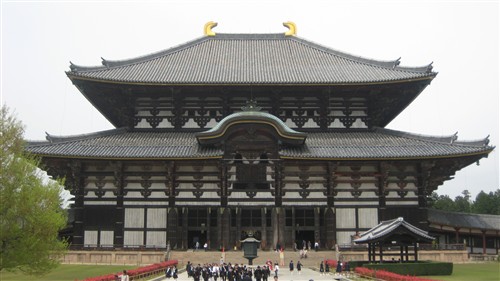
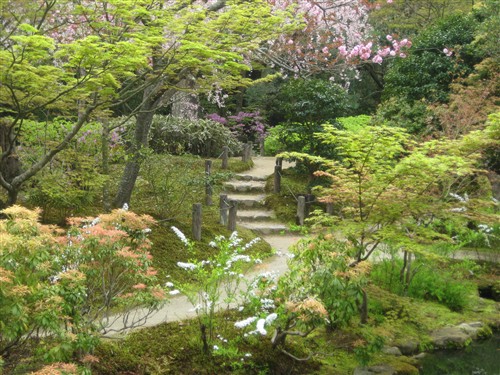 At my request, we stopped off at Issui-en, a magnificent secluded garden just a couple of blocks off the main road. Aaron opted to wait outside but urged me to take my time inside. Excited by the prospect of a rare moment of solitude, I slipped through the entrance and walked slowly around the grounds while all sensations of stress and urgency dissipated into the fragrant air. It was a garden scene from a fairy tale. As we have come to expect from Japanese gardens, Issui-en was meticulously kept and seemingly designed to coincide with the practice of Zen – “a school of Mahanya Buddhism notable for its emphasis on mindful acceptance of the present moment, spontaneous action, and letting go of self-conscious and judgmental thinking” (Wikipedia). Even a short stroll through one of these oases of serenity gently propels you into the remaining day’s embrace in a calm, cool and collected frame of mind. When I rejoined my husband, he could immediately discern by my peaceful expression that I had found my happy place.
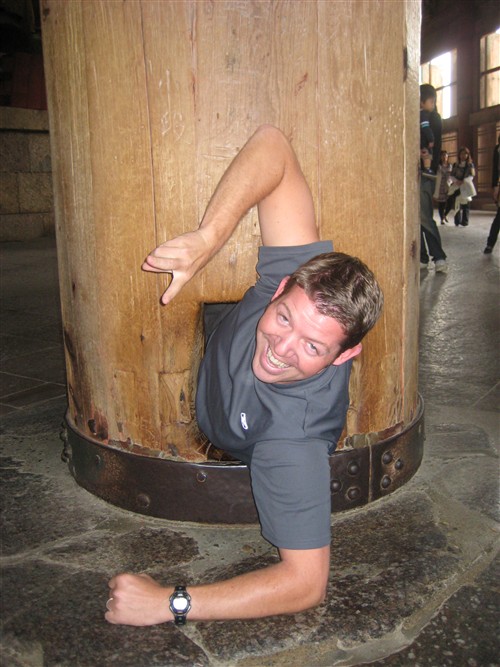 Behind the Buddha is a wooden support beam with a hole born into it, the size of which is identical to that of the Buddha’s nostril. Legend has it that those who can pass through the hole will achieve enlightenment. We watched in amusement as schoolchildren on a field trip passed through the hole with relative ease. Still, as the skinny, nimble pre-adolescents slipped through, there did not appear to be much excess wiggle room. Being naturally small-boned, I slipped through almost effortlessly, despite my newly-acquired travel chub. A group of European backpacker-types stood around the opening, sizing it up for a grand attempt. We walked away while they were still debating the possibilities but, as we neared the temple exit, Aaron decided that he wanted a chance at enlightenment too. We turned around and headed back for the beam, passing the Europeans who, having slightly narrower frames than Aaron, had shied away from the challenge. When we told them that Aaron was going to go for it, they too turned back to watch the big guy get stuck in the hole. After doing a few stretches to limber up, the brave Bear, who had by then attracted a good-sized audience, crouched down and inserted himself, arms first, into the opening. The outward appearance of the hole was deceiving because it was a bit smaller in the middle than it was on either side. Aaron managed to slide his arms through far enough for me to grab his hands and gently yank his shoulders and torso through. From there, he was able to pull the rest of his big bear body through, much to the amazement and applause of the crowd. Aaron was a hamming it up for his fans and I was relieved that my dear husband would not have to wallow in the depths of ignorant darkness while I basked in the bliss of enlightenment.