The idea for the interviews came to us during a hike in the Otways. That night, over a beer at “the pub” in Apollo Bay, we scribbled down a list of questions and then later answered them independently. It was fun to read each other’s answers for the first time. Even after spending every waking hour together for the last seven months, we still learned some things that we didn’t know.
What is the most prized possession in your backpack?
Tina: The laptop. It’s amazing how much free wireless internet there is in the world…even in Africa. It’s been essential for keeping the website up because we can type the long-winded posts and respond to emails offline rather than paying by the hour at a drab, characterless internet kiosk. Those places make me crazy! Also, we have all of our photos and our music collection, which I definitely enjoy browsing through when I’m homesick or craving some background music. We have a really elaborate trip planning spreadsheet that helps keep us organized and, since our itinerary is ever-changing and my short-term memory is ever-waning, the spreadsheet is crucial. Not a day goes by without opening the laptop. We have said numerous times that, if God forbid something happened to it, we would replace it immediately!
Aaron: Our laptop computer. It has been an invaluable resource for staying in touch with friends and family, researching future destinations, managing our trip expenses, and keeping my ADD brain occupied on rainy days.
What have been your top three destinations so far?
Tina: India (all of it, especially Pushkar and Jaisalmer in Rajasthan), Paris and Zanzibar, in that order. India is the craziest place in the world. I’ve never seen anything like it. We talk about India all the time. I miss the constant sensory overload, the shock factor of every scene, the erratic nature and volatility of the crowds, the bright colors and beautiful people. People say that you either love India or you hate it. I am totally enthralled!
Aaron: Our sun-kissed day biking around the Chateau in Versailles; walking around the streets of India – every day was an eye-popping experience; and sailing in the Bay of Islands
Name one thing that you’ve learned about yourself.
Tina: I’m a chameleon with an attitude.
Aaron: That I truly only have one speed – full throttle. When we were planning this trip, I thought that along the way I would find myself relaxing more and that we would travel whimsically, letting the wind blow us around the world. But I still wake up early most mornings (often waking my soundly sleeping wife in the process), ready to start the day and set our agenda of activities. Thankfully, Tina prefers a more leisurely approach to travel and she ensures a healthy dose of spontaneity in our adventure.
What do you miss most about home?
 Tina: Lena. I’ve lived away from home for more than ten years now so I’m used to only seeing my family once or twice a year. I miss my “pupperoni”, especially at bedtime. We look at pictures of her all the time and dream of having her again full-time. She’s such a sweet little furry bundle of joy!
Aaron: I definitely miss our little dog Lena and I miss having a place to call home. But most of all I miss my road bicycle. There is something so invigorating about going for a long solo bike ride.
If you could re-locate now to one city that you’ve visited thus far, which would you choose?
Tina: Paris. Aaron says that I would hate the weather in Paris and he’s probably right but I love the architecture, the parks, the language, the food, the Louvre, the fashion, the café culture and all of the crazy, rude Parisians. Maybe I’d hate it after a year but now I’m intrigued. I could probably spend every weekend for a year at the Louvre and still want more!
Aaron: Sydney
What has been one of your favorite activities?
Tina: Diving in the Red Sea. Aaron was right when he said that the Red Sea would forever skew my diving standards. We saw some amazing things there: pristine coral reefs with great visibility, Thistlegorm!!! Nothing else has compared so far and I have become a dive snob. Now I only want to dive in world class dive spots. Anything else is a waste of time.
Aaron: Swimming with dolphins on Zanzibar. They were so playful and they allowed us to snorkel with them for nearly an hour. It’s also where we met two great couples who quickly became friends: Jerry and Haley – the Kiwis who we visited in Zambia and again in New Zealand and Olaf and Nicole – the Germans who we’ll stay with when we visit in September.
Describe a really bad day on the road.
Tina: There hasn’t been a whole bad day on the road…only difficult moments like freezing our buns off in the sleeper car of an overnight bus in India, freezing our buns off at the top of Mt Sinai while waiting for the sun to rise, freezing our buns off in Rishikesh through a mountain of blankets. I really don’t like being cold. Also, the first day in a new country (especially a Third World country) can sometimes be a little tense when we don’t yet have a feel for how things work. You can’t really take a deep breath until you’ve checked into the first hostel. Aaron tends to stress more than I do on those days and snarling is contagious. It never lasts long though because the excitement of the new place always takes over.
Aaron: You are awakened by the chime from your stopwatch at “oh-my-God early” after five hours of sleep only to discover that the mosquito net covering your bed had a hole in it and you were attacked by a gang of probably-infected-with-malaria beasts in the night. After hurriedly packing you depart the hostel and, even before a cup of coffee, you encounter your first negotiation of the day – the taxi fare to the bus station. After threatening to board a matatu instead and walking away two times, you finally agree to pay the driver about fifty percent more than you thought that you should. You arrive without fanfare at the station, and with a cursory glance at your tickets, the conductor lets you board – after extorting a baggage handling fee for your two backpacks that are stowed below (you do want them to arrive, don’t you?). The seats are narrow, they don’t recline and it feels as if you’re sitting on a plywood bench. Thankfully, you remembered to pack a couple of snacks for the ride. Because your bus full of foul-smelling Africans, rambling over a narrow, two-laned potholed road for nine hours will only stop twice (and you don’t want to eat what the “rest stop” restaurant is serving anyway). After only an hour on the road, the ride is briefly interrupted by a massive accident which has managed to block both lanes of traffic and has halted traffic in both directions. After a 45-minute wait, a new off-road route has been created to circumvent the four or five vehicles involved in the accident, one of which is an overturned petrol-carrying tanker that is now engulfed in flames. You think to yourself, “Hmmm, this should be an interesting ride.”
You finally arrive at dusk (nerves a little frazzled but otherwise intact) without a place to stay and you step off the bus to brave the crowd of twenty taxi drivers all reaching to grab your bag and secure your fare. After verbally beating away the first fifteen, the remaining five convince you that the exorbitant price they quote is more than equitable. You begin walking to the randomly selected hostel from your trusty guidebook when you finally negotiate a deal with the only taxi driver who has continued to follow you. Your hostel has a room with a couple of twin beds overlooking a noisy intersection. It has one creaky fan to circulate the thick, humid air, a mosquito net with more holes than a brick of Swiss cheese, and a toilet with no seat. Perfect. What time does the first bus leave in the morning?
This was our journey from Nairobi to Mombasa and I’m ashamed to say that we repeated almost this exact itinerary the following day (but only a six-hour bus ride) over equally rough roads on our way to Lamu. The only redeeming fact about our horrific day trip to Mombasa is that after dropping our bags at the hostel (and paying another overpriced taxi driver), we treated ourselves to an upscale Indian food restaurant in town. We definitely needed it.
Where was the most uncomfortable bed that you’ve slept in?
Tina: Hmmm…lots to choose from. My twin bed in Petra had a dip so deep that I stuck my pillow in it and it was just about even. Our bed in Chiang Mai had so many springs sticking up through the mattress that I couldn’t sleep in any position. The bed in Swaziland had dips and springs poking through. I’m a stomach sleeper (a bad habit that I can’t seem to break) and the springs dig into my ribs. I never got used to sleeping with a mosquito net in Africa or in rooms with no cooling system in the heat of summer (Aaron is a human furnace, which doesn’t help). We’ve slept in so many awful beds that we’ve become more adaptable, learning to curl around the dips and contort our bodies to avoid the springs. It makes you so much more appreciative when you climb into a nice, soft, perfect bed with clean sheets and a duvet. It’s like Heaven!
Aaron: We stayed two nights at a hostel in Swaziland. It rained non-stop for two days, the entire hostel was damp and musty and smelled like the two big resident dogs. The double bed that we shared was at least twenty years old. Of course there was no box spring so the bed just sort of sat on the floor. It had absolutely no support, sagged in the middle and the springs poked us in the back as we tried to sleep.
A close second was the bed at our hostel in Johannesburg. It had the same affliction as the Swaziland bed – it was much too old and it sat on a quasi box spring that provided no additional support. It felt like fabric was draped haphazardly over some coil springs strategically designed to poke you in all of the wrong places. Here we endured three restless nights. After sleeping in nearly a hundred hostels we’ve become bed connoisseurs. Doubles or twins, bunk beds or futons, there is one universal truth: a bed that’s too hard is much better than one that’s too soft, especially if you’re a stomach sleeper.
What future destination are you most looking forward to?
Tina: All of Europe really. So many distinct cultures in such a small area. Spain and Italy have always been at the top of my list of dream destinations. They both seem so romantic!
Aaron: Nepal and trekking in the Himalayas. Do you know a good Sherpa?
Name one hard lesson that you’ve learned on the road.
Tina: Bad attitudes are contagious.
Aaron: In high season, book your accommodation in advance. It is always stressful trying to find a place to sleep when you arrive in a new city.
What experience do you most regret missing out on?
Tina: Kashmir. All of the books that we’ve read about India portray Kashmir as a magical, almost mythical mountain paradise.
Aaron: Climbing Mt. Kilimanjaro. It wasn’t something that was important to us at the time and it would have meant buying a lot of extra gear, but I wish that we would have done it.
What destination NOT on the itinerary do you most wish to go?
Tina: There are so many places that we’re NOT going! I wish we could spend more time on islands but they are always expensive to get to. I would love to dive in Palau and in the Galapagos Islands.
Aaron: Antarctica. It just seems like one of the last frontiers on earth.
What advice would you give to someone trying to plan a similar trip?
Tina: Just do it! Also, don’t buy the “around the world” plane tickets. They have too many restrictions and we have loved having the flexibility to change our itinerary at will.
Aaron: First of all, just do it. No amount of planning will prepare you for all of the inevitable surprises that you find on the road. Second, don’t try to see too much. After racing around Africa, we’ve slowed down considerably and we both prefer this pace. It’s a big world and it is impossible for us to see everything the first time around. Plus, our budget simply can’t support traveling as much or as quickly as we first planned. Our single greatest expense on this trip is our transportation costs, but it can be surprisingly inexpensive when you stay in one place for a while.
How do you envision life after traveling the world?
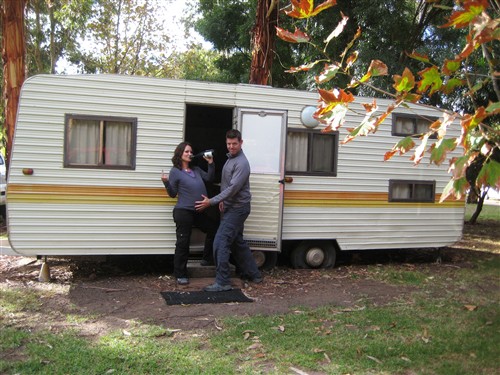
Tina: Barefoot, pregnant and unemployed. It will undoubtedly be a struggle to satisfy my champagne taste on a beer budget, especially because we will basically be starting over. The trip has, unfortunately, failed to curb my shallow materialism. A good friend once told me that he would live in a trailer if it meant that he or his wife could be home to raise their children and I totally agree. Besides, I kind of like trailers.
Aaron: Unless something compelling motivates us to stay abroad or start a business, I’ll probably go back to the corporate world for a while, hopefully securing a good relocation package to live where we want. God willing, we’ll start a family and have some babies running around before we know it…and we’ll need good medical insurance!
How have your experiences changed your views on religion?
Tina: As we’ve traveled through countries like India, Egypt, Jordan, and Thailand, in which Christianity is not the primary religion, we have learned a lot about other faiths. We have observed the worship of cartoon-like idols, listened to stories of multiple deities and prophets, and seen women oppressed in the most hideous ways. We have seen firsthand and read about the caste system in India and I have personally experienced the ultra-conservative, sexually-repressed, offensive expressions of Muslim men on the street and also observed the beauty of Ramadan. I think that the idea of religion is a good thing. People need incentive to be good or perhaps just enough fear to keep them from acting on their evil thoughts. It is the man-made element of organized religion that I find unsettling and the social aspects of some religions, as mentioned above, that I find utterly disturbing. Organized religion is big business and a powerful machine for manipulating the minds of masses. Suicide bombers are the perfect example of our day. Take a man from a poor mountain village with no prospects in life and convince him that he will be granted eternal paradise with seventy-one virgins if he blows up a shopping mall full of women and children (a.k.a. infidels) along with himself and you have a powerful (well-funded with Saudi oil money) weapon. I am appalled by the notion of religious war and religious persecution. We saw a great slogan on a camper van in New Zealand that read something like this: “Religious war is like two children fighting over who has the stronger imaginary friend.” I’m not renouncing Christianity or any other religion for that matter. I’m just skeptical of the thousands of years of hands skewing the words of the hand-me-down stories and, in many cases, of the real origin of the stories themselves.
Aaron: I think that religion is a good thing in so far as it creates peace, harmony and interdependence among people. But there are countless examples throughout history where men have distorted religion and religious teachings for their own advancement in wealth and power. And there are many examples in recent history where religious differences have led to war, not peace. No matter how just or virtuous our religious leaders’ intentions appear, there is always more than meets the eye. Whether you look at the Evangelical preachers on television every Sunday, the Pope delivering his Easter sermon, mullahs teaching at Madrasas, or Rabbis extolling the virtues of Judaism, all of these pundits are still human. And like all humans they have the potential to be influenced by earthly desires. Do they aspire to higher office? Do they have families to support? Are religious leaders immune to the consumer marketing campaigns which seduce millions of laypeople to overindulge each year?
Now more than ever, I believe that God exists. But I have become much more cynical and skeptical of organized religion. Did you know that Jews, Christians, and Muslims all believe in the Old Testament of the Bible? It’s the idea of prophets where they differ. The more places that we visit and the more religions that we learn about, it seems unlikely to me that only one group has it all figured out. But in my quest to find answers I dig deeper, and uncover only more questions. How many of us have read the Bible from cover to cover? The Koran? The Torah? What is the difference between Sunni and Shiite Muslims? Protestant and Catholic Christians? Orthodox and Reform Jews? Are these differences worth killing for? Dying for? How much of our own information on religion is spoon-fed through media outlets on television, in print, and online? Is our preferred media source truly unbiased? The same news story seen on Fox News, Al-Jazeera, and the BBC (British Broadcasting Corp) is never reported exactly the same.
For those of us who follow an organized religion, at some point most of us will question the teachings of our respective religious doctrines or the existence of our prophets. When the body of evidence presented fails to fully convince us, we are told to have faith. And even as an analytically-minded and scientifically-trained individual, I do. Because for all of its warts, organized religion creates cohesive communities, it strengthens families, and it compels individuals to be more charitable. For me, traveling has reinforced the idea that everyone should evaluate their own religious beliefs if for no other reason than it creates a greater understanding of our fellow man. My final point is this: If we spent less time arguing about the differences in our religions and spent more time discovering the similarities, could we live in harmony with mutual respect and greater understanding despite our different beliefs?
What is the most beautiful place you’ve seen so far?
Tina: The most beautiful landscapes were in Kenya, especially at Lake Nakuru. I don’t know if I realized it at the time but I look back at the photos now and my jaw still drops. The most beautiful beaches were on Zanzibar. The most beautiful cityscape is a tough one: either Paris or Udaipur.
Aaron: Just about anywhere on New Zealand’s South Island. The landscape is awe-inspiring and pictures cannot possibly do it justice.
Describe the most physically difficult experience?
Tina: That would have to be a three-way tie among three painfully steep ascents: Mt Sinai (because we were too stubborn to take one of the countless camels on offer along the way), our Chiang Mai trek, and the hike that we did on Aaron’s thirtieth b-day in Coffee Bay, South Africa. Brutal!
Aaron: Lamu, Kenya. After indulging in grilled white fish prepared Swahili style at a beach front restaurant, I spent the night and the next two days with the worst food poisoning that I’ve ever had. What’s worse is that we were in a sweltering, dirty, mosquito-infested hostel with a toilet that wouldn’t flush! I spent the night sweating, covered in DEET, lumbering to the bathroom every ten minutes. I couldn’t stomach a regular meal for a week and I didn’t eat fish for the next four months!
How do you feel the trip has changed you as a person?
Tina: The trip has transformed me into a person who will stop at nothing to follow my dreams. I am ashamed to say that I formerly pushed my greatest dreams aside in the interest of practicality and pragmatism, out of fear of failure and mediocrity. I want to spend my life doing things that make me happy.
Aaron: I’m more confident in my ability to solve problems. I’m still wound too tight and I don’t always handle adversity with the same grace as Tina, but I’m getting better.
What has been your biggest challenge on the trip thus far?
Tina: Keeping my weight down. You would think that all of the hiking, biking and pounding the pavement of cities would be enough to naturally keep us fit. The problem is that we love to eat, drink and be merry. Sampling the local cuisines of each place is an integral part of the overall experience. We eat out a lot and we love to cook so even our self-catered meals are often elaborate. If I left Aaron in charge of our diet, we would eat pizza and fried food for every meal with sweets in between. I credit my veto power for keeping us from ballooning beyond the capacity of our cargo pants. “I love sweets. I just looooove sweets!” said Aaron while alternating forkfuls of ice cream cone and caramel slice.
Aaron: Maintaining a healthy diet and not gaining weight. I thought that I would be skin and bones after spending months in Third World countries like Zambia and India, but everywhere that we’ve traveled we have eaten well. Sometimes too well.
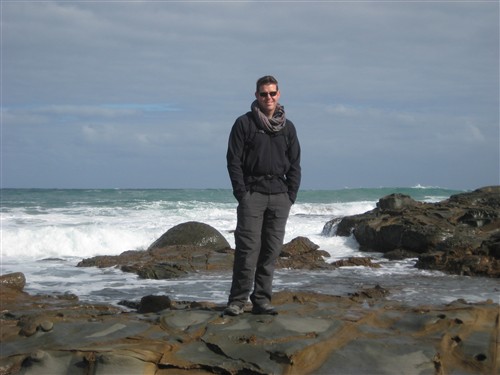 Our next stop (and, as it turns out, the last stop) along the Great Ocean Road was about 150 km down the coast to Apollo Bay. We found a place to stay just a stone’s throw from the beach, fixed some lunch, and went out for a long walk. Along the Great Ocean Road lies the Great Ocean Walk a beachside trail that takes about ten full days to walk from end to end. We picked up the trail just across the road from our hostel and began walking west, stopping often to marvel at the powerful waves. There were a few families enjoying the beach but swimming in this area is strongly discouraged due to riptides and currents. We stopped for a while at Shelly Beach where the shore was comprised of porous rock; the high tide was washing over the intricate designs on the surface, flooding pores and contours into streams and pools and leaving deposits of tiny shells. We spent about an hour sifting through the colorful shells and playing “chicken” with the incoming tide. It was a beautiful day and we were both playful and energetic. The beach walk was a nice change of terrain from the forest-covered mountains.
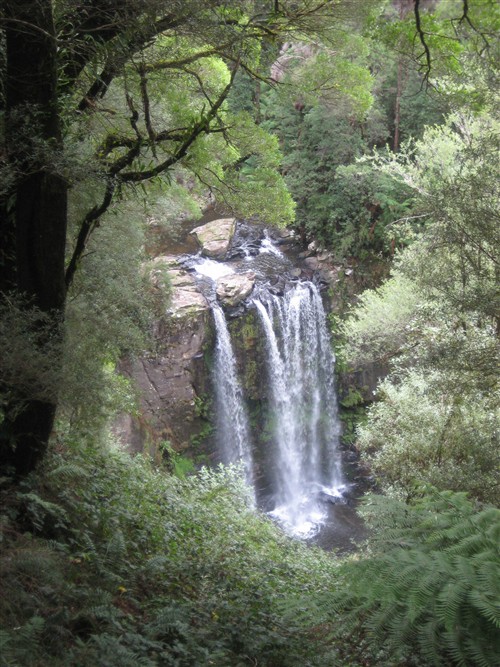 The next day was the most sunny and warm in the week’s forecast and we were determined to take full advantage of it. We packed some peanut butter sandwiches and apples and drove into Cape Otway National Park to do some hiking. Our reference materials listed several trails, most leading to a waterfall, with an average duration of an hour so we endeavored to walk one trail after another until our legs gave out on us. We walked to a couple of the waterfalls through lush rainforest trails with moss-covered trees, thick ferns and tiny waterfalls trickling down the mountainside into mossy rivulets. The growth overhead was sometimes so dense and healthy that it created a dim, cavernous ambience on the trail, even on a bright, sunny day.
 The Great Ocean Road has been a perfect contrast to our urban Aussie adventures. The coastal waterscapes and rainforest landscapes have been stunning and refreshing, the small towns quaint and relaxing. It is good to get away from the crowds, cigarette smoke, gridlock, noise, constant stimulation and endless distractions of cities to give yourself a little room to breathe and time to think once in a while. While it is a crucial element of maintaining balance, it is incredibly difficult to cut out a sliver of time from the rat race to accomplish it. As we continue to enjoy this rather colossal slice of time out from the race, we often think about how we want our future settled life to differ from the past. I hope to take more time away from the noise for prayer, quiet contemplation and solitude. I found this seemingly small task difficult to manage with a dog, a job, a husband, a social calendar, and a portfolio of memberships and philanthropic activities (it makes me dizzy and a little stressed just recalling it all!) I can only imagine the additional difficulty when you add children to the equation but I am convinced that it is a question of priorities.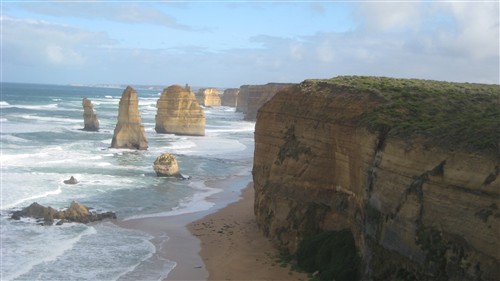
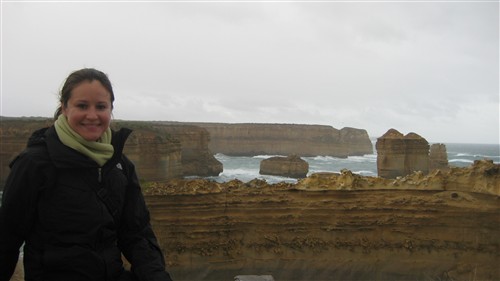 The coastal stretch between Port Fairy and Cape Otway, which includes the Port Campbell area, was a notoriously deadly area for sailing ships due to rough waters, hidden reefs and dense fog. The truculent stretch earned the name of Shipwreck Coast when its waters claimed more than 80 ships in a period of 40 years in the mid-to-late 1800s. The most famous of the wrecks was an English ship called the Loch Ard, which hit a reef on the final night of its three-month voyage in 1878. The vessel was so badly damaged that the crew were unable to assemble the life boats. Of the 55 people on board, only two survived. Much of the debris and cargo as well as one of the survivors from the wreck were washed into the gorge that now bears the name Loch Ard Gorge. Only four bodies were ever recovered and they are buried in a commemorative cemetery on the edge of a cliff. There is a great walking path along the gorge with signs telling the story of the shipwreck and ending at the cemetery. Shipwreck Coast is daunting for its ghostly tales, which are easy to believe as you stare out at the power and ambivalence of the waves.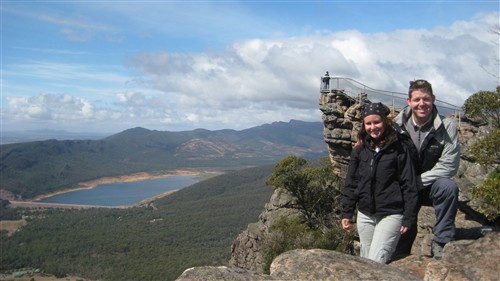
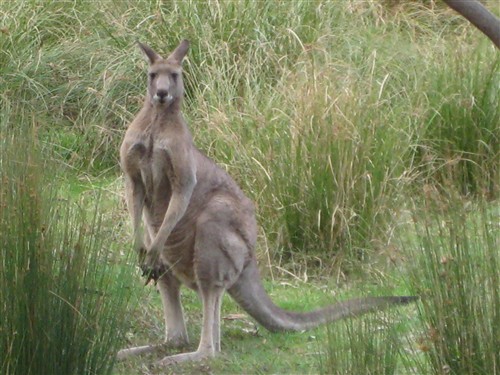
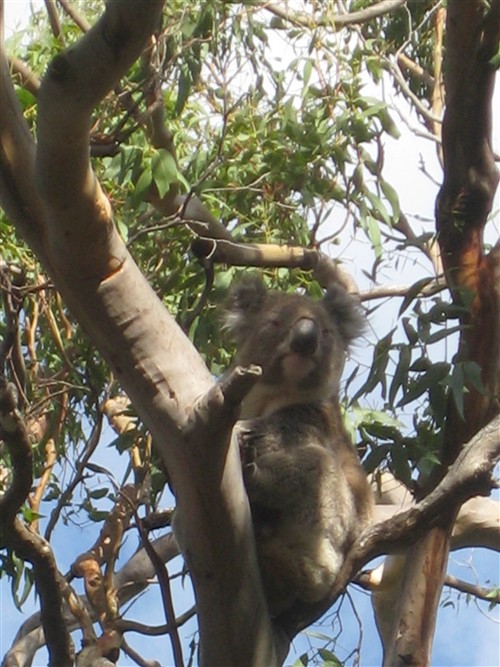
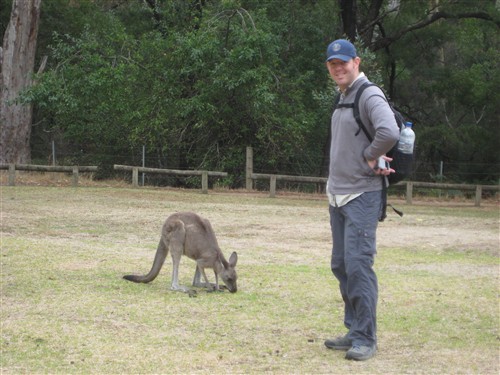 If the first trail energized us, the second one exhausted us and we trudged toward the car park with our earlier vigor spent. We reached the caravan park at the trailhead in the late afternoon to find a group of kangaroos nibbling on a grassy knoll. The roos were surrounded by several giddy observers, which they didn’t seem to mind. One father even sent his little boy into the mix with a fistful of grass to feed them. The kangaroos allowed the boy to approach and one even took a tug at his offering but then uncertainly retreated. They were beautiful – I never tire of watching them.