Warning: Use of undefined constant ‘wppa_setup’ - assumed '‘wppa_setup’' (this will throw an Error in a future version of PHP) in /home/youngs/public_html/wp-content/plugins/wp-photo-album/wppa.php on line 28
Youngs Around the World
December 19th 2007 by Tina
Jo’Burg

Posted under Africa & South Africa
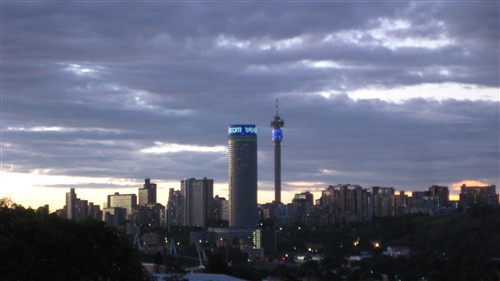
Johannesburg, our final South African destination, is reputed to be one of the most dangerous cities in the world. Our guide book warned “to be very careful of your personal safety in Johannesburg”. While we had already traveled to other notoriously dangerous cities, such as Nairobi, we were still apprehensive about visiting a city where the white minority confine themselves to suburban shopping malls and their homes which are so heavily guarded with tall walls, barbed wire, security bars and surveillance systems that you feel an eerie sense of criminality lurking about, whether real or imagined.

We had pre-arranged a ride from the bus station through our hostel and were picked up quite tardily by a young man in a white Mercedes van. During the ride back to the hostel, I asked the driver if Johannesburg really lives up to its dubious reputation. He replied that it is safe…as long as you stay within the areas that the hostel staff specifies. He then shared a story about two male travelers who had recently stayed at the hostel. The staff had warned them not to venture outside the “safe” areas but they chose to disregard that advice. The hostel manager received a phone call at 2:00am from the police department requesting that he come down to the station and pick up two young men in their underwear. The two had been mugged and the perpetrators took EVERYTHING but their skivvies! Thankfully, the two idiots escaped with their lives – some are less fortunate. Johannesburg records more deaths each year by murder than by car crashes.

As we rode through downtown Johannesburg in the safety of our vehicle, I couldn’t take my eyes off the streets. I recall thinking that it didn’t look that dangerous. My imagination had conjured up an entire Hollywood cast of unsavory-looking characters uninhibitedly toting guns, chains, brass knuckles and big knives, ready in a moment’s notice to wreak havoc on anyone foolish enough to present himself as a potential target. What I saw instead were poverty-stricken human beings living life in their own neighborhood. My first impression was of uneducated young men whose rough edges and disheveled appearance would likely preclude them from ever earning an honest living outside of the hard labor pool. But first impressions can be deceiving. Still, I wasn’t about to get out and ask them if they’ve accepted Jesus Christ as their Lord and personal Savior.

The hostel was nestled deep within a labyrinthine complex of heavily fortified houses. We entered the complex through a narrow alley separating two rows of modest homes behind walls and gates with barbed wire so jagged and extensive that it felt like we were entering a prison. Most of the walls also displayed signage of one or another armed response company – privately owned armed security companies that, judging by the number of similar signs around town, are making a killing! No pun intended. One thing was boldly apparent – these people are serious about their home security!

It was getting dark by the time we’d checked into our room and a heavy rain had begun to drench the city. We had spent over twelve hours traveling from Mozambique that day. Most people, me included, would relax, settle in, and go to bed early after an exhausting day like that. Not my husband! Instead, my never-do-tomorrow-what-you-can-do-today, can’t-sit-still-for-five-minutes, always-needs-a-project, sweet, adorable spouse gets this hare-brained idea in his head to walk to the grocery store. And worse…he puts on his best angel face to try to convince me to accompany him. I must admit that, after three years of marriage, I am still not immune to my husband’s charms. I strongly considered walking at least twenty minutes each way in the dark and pouring rain through the unfamiliar streets of Johannesburg! Granted, the store was supposedly in the “safe” zone but there was seriously nothing that we needed before morning. Thankfully, I came to my senses and tried desperately to bring Aaron to his. Perhaps it was my matted, greasy hair or my oily face from twelve hours of bus transit but my womanly guiles failed me. He was determined. I sent him off with a loving “Don’t call me to pick you up in your underwear at 2:00 in the morning from the police station. I’ll be asleep.”

He was gone for almost an hour and each minute of that hour felt like an eternity. I was sick with worry but tried to fill my head with positive thoughts as the rainfall crescendoed into an intense downpour. If absence makes the heart grow fonder, then fear for your lover’s safety transforms you into a love-crazed maniac! When he walked through the door, soaked from head to toe, I squeezed him harder than the day he proposed.

The next morning, we decided to spend the day doing touristy things, namely a township tour and a visit to the Apartheid Museum. We made the arrangements through the hostel and were collected shortly thereafter by our tour guide. He had a very thick accent and was difficult to understand but he conducted our township tour with educational commentary and endearing enthusiasm.

Townships were created during the Apartheid era when oppressive European settlers, mainly from the Netherlands and Britain, displaced hundreds of thousands of native Africans from their centrally located homes to shanty towns on the outskirts of the city. Black people were allowed to come into the cities to work in the goldmines, as day laborers or in a servant capacity but they had to live in one of the established ghettos, called townships. “Soweto”, which is an acronym for “South West Township”, is South Africa’s largest township community and one of the largest ghettos in the world. Though the scars of Apartheid have begun their arduous healing process, the ghettos are still painfully overcrowded and, with few employment opportunities, many township residents still find themselves living in squalid conditions.
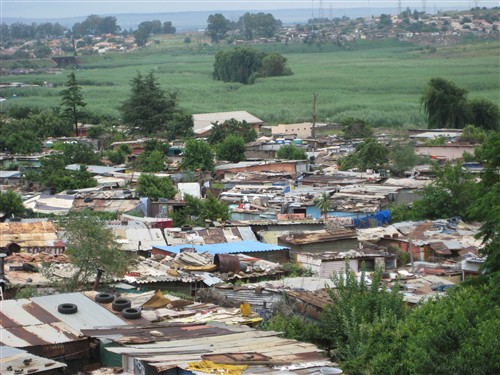
It was rainy that day and we spent the majority of the day viewing subdivisions of Soweto through the window of our van. Our guide was a resident of Soweto and provided valuable insight on the history, politics, education and living conditions related to township life. In one neighborhood, there had been a huge street party two nights prior and the residential streets were covered in jagged shards of shattered beer bottles. Scattered groups of men worked slowly to sweep up the glass but there was a good three block radius of unbelievable disaster zone. Our driver cringed as we listened to glass crackling under the tires.

As a part of the township tour, we also took a guided walk through one of the subdivisions of Soweto. Our driver stayed in the car while another local guide walked with us along a dirt road through rows of makeshift homes. Many had small vegetable gardens. One woman was sweeping diligently what might have been a front step but instead was the section of dirt road in front of her house. A group of little boys walked ahead of us, only mildly curious about two of what must be a parade of foreign tourists. Our guide explained that only about twenty percent of the township residents are employed due to poor education and lack of skills, proximity of the township to the city-center, lack of business opportunities within the township, etc.

We were also invited inside one of the houses and, for me, this is when things got a little awkward. Our guide led us into a one-room shack where three young men were sitting and said “Okay, you can ask them questions and take photos now.” First of all, we weren’t about to start snapping photos of these people’s home like zoo patrons photographing the monkeys. Second, we didn’t exactly have a list of questions prepared since we were put on the spot so, after an awkward silence, we started asking whatever questions came to mind. The approximately three hundred square foot house was home to eight young men. A couch, love seat and television occupied one side while the other side held a large freezer and shelves stacked with miscellaneous household items. The freezer was non-operational but the bottom was lined with a layer of beer bottles covered with a broken ice block. The guide explained that the young men tried to make a living by selling beer. They had to buy a new block of ice every day in order to keep their product cold. The entire township is without electricity; most people use car batteries to power their small electronics such as televisions and radios. The house that we were in had a small generator which sat in the middle of the floor. When asked where they sleep, the young men replied that they have bedding that they take out at night. After about ten minutes of uncomfortable interrogation, our guide led us outside the house and back to our van but not before hitting us up for a sizable “donation” for which he suggested the amount. Normally, I am immune to this sort of request for a handout but my emotions were disturbed by my immediate surroundings and, without hesitating, I handed over the amount requested. He said that the donations are used to benefit the community but I suspect that he just pocketed it. The whole exchange seemed underhanded and I felt as if the chastity belt on my pocket had been violated. I have definitely suffered buyer’s remorse in my life but this was the first time for donor’s remorse. With a sour taste in my mouth, I hopped back into the van and we continued on with the next segment of our tour at the Hector Pieterson Memorial and Museum, which commemorates Soweto children who lost their lives in protest against Apartheid. Apartheid, by the way, is an Afrikaans (language of the original Dutch settlers in South Africa) word meaning “segregation solely based upon race”.

We then took a brief tour of the house that Nelson Mandela lived in for almost thirty years with two of his three wives (not simultaneously). The modest house was quaint and cozy with many family photos, articles of Mandela’s clothing and shoes, rooms full of honorary degrees from esteemed universities, newspaper and magazine clippings documenting his political actions, gifts from celebrities and international leaders and letters of support and praise, including an interesting letter from the State of Michigan, apologizing on behalf of the United States for the CIA’s role in Mandela’s eventual capture and imploring then-President George Bush to issue an official apology which, of course, was never done.

The final stop on the day’s itinerary was the Apartheid Museum. We parted ways with our guide and spent the remainder of the afternoon inside the museum. With its extensive collection of photographs, video footage, interviews, and Apartheid-era memorabilia, the museum meticulously documents the history of Apartheid, lifestyles of native Africans in contrast to other immigrant groups under Apartheid, the propaganda used to market the idea of Apartheid to the European settlers, and the valiant, bloody fight to bring the long-time racial oppression to an end. We noted many interesting parallels between the persuasive tactics used to perpetuate Apartheid and those used to rally support of the Nazi regime. We were especially moved by a temporary exhibit on the life of Bantu Stephen Biko, a brilliant anti-Apartheid activist who was eventually arrested and allegedly died of head injuries sustained in captivity, though no one was ever charged with his murder. He spoke intelligently and passionately about the black people’s need to empower themselves by changing their self-image from the negative associations prescribed by their oppressors to proud and positive associations with their black heritage. He was only 30 years old when he died alone in a jail cell. We stayed at the museum until it closed and then called for a ride back to the hostel. It had been an intense day revolving around extreme poverty, oppression, martyrdom, child martyrdom and unjust imprisonment. We were emotionally drained.

In drastic contrast to our day of depressing tourist activities, we spent the next day inside a two-story haven of commercialism and muted Christmas cheer: the mall. As we walked leisurely through the bright and colorful stores full of pretty things, handsome things, baubles and gadgets – the very same things that once seemed important enough to spend entire weekends collecting – our senses were overloaded. The whole scene was surreal. I suddenly felt a belated jolt of liberation at having purged our ubiquitous stuff, sold the house that we worked constantly to fill with stuff, thereby alleviating any temptation to purchase durable goods aside of our daily necessities. I didn’t feel the weight of my possessions until it was lifted. I felt a subconscious rearrangement of priorities in my life. I would never go so far as to say that I don’t value material possessions. That would be absurd. Material comforts are…well…comfortable. These days, rather than drooling over a new purse or piece of jewelry at Nordstrom, my hopes are focused on health and happiness, family, friendships, love and triumphing over the bathroom challenges on this crazy adventure. I wonder, though, if I will fall back into that old familiar obsession with stuff when I am thrown back into the bottomless pit of suburban commercialism. Que sera sera, as the saying goes. For now, I’m not worried about the future. I’m just enjoying the simplicity of carrying my worldly possessions on my back for a while.
1 Comment

December 18th 2007 by Tina
Bamboozled in Mozambique

Posted under Africa & Mozambique

We sadly relinquished the Polo in Nelspruit, as outlined in our rental contract, and reverted once again to bus transport. A double-decker Greyhound carried us to Maputo, Mozambique with a slightly frantic border crossing despite already having obtained our visas. One can seemingly infer a lot about a country’s politics and infrastructure by the level of chaos at its borders. The Arrival area at the Mozambique border bore all of the appropriate signage; however, the actual system of queues took on a functional disorder such that, were it not for a few friendly border crossing veterans telling us where to go, we would have been rightly stressed about missing the departing bus on the other side.
We arrived in Maputo and took a cab to a hostel that, according to the cabbie, organized transport to Tofo, a remote coastal town about eight hours north on a pothole-ridden stretch of road. Fatima’s Place was inarguably one of the most filthy, uncomfortable hostels that we have encountered thus far. The attendant was unfriendly, the shared bathrooms atrocious and the rooms musty but we endured it one night for the sake of convenience. At 5:30 the next morning, a shuttle picked us up and carried us, along with seven other backpackers to the chapas station (parking lot). Chapas is the Mozambican version of the mini-bus. As we were among the last to arrive, we were crammed into the back of the bus. There was no luggage storage on the chapas so bags were packed into the aisle, under the seats and in the front of the vehicle, next to the driver. Each row of seats also had a fold-down seat which created an additional seat in the aisle. Think sardines.

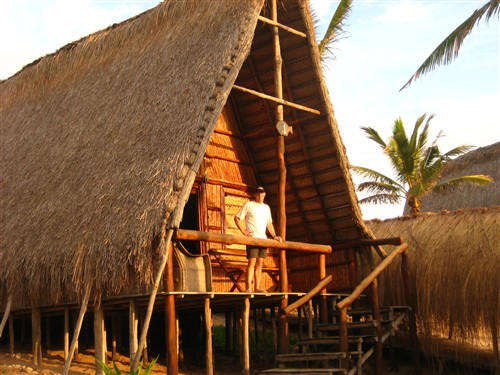
We had made a reservation at Bamboozi, which had been recommended by someone we’d met in Coffee Bay. The gray sky was raining down on us in fat, wet drops, which easily penetrated the thatched roof at the reception desk. We carried our packs up a thatch-covered ramp to our chalet – a charming slant-roofed cottage on stilts with patio, private bath and kitchenette. It was oozing character with its walls made of bamboo bundles tied tightly with reeds and ceiling of woven palm fronds covered in thatch. The furnishings were rustic; one look at the dark wood floors, handcrafted kitchen cabinetry and two-burner gas range with antiquated metal tea pot made us smile at the illusion of paradise. The rain continued to pour down while we settled in and we soon realized just how much of an illusion it was.

Water blew through the spaces between the bamboo bundle walls and seeped through the ceiling onto the upper part of the bed, which was soaked through to the mattress. The kitchenette was devoid of pots, pans, cooking utensils, silverware and a refrigerator, though it did have a full set of dishes, a cutting board, a can opener and a spatula. What anyone thought we were going to do with that combination of items still escapes me. We discovered that first evening that we had no hot water and, at least once a day throughout our stay, we would be without either water or electricity. Most of these little inconveniences fall easily into the “This is Africa” category but we also found the staff to be so unfriendly and unaccommodating that we spent the majority of our time and money away from Bamboozi.

Luckily, we found solace at Tofo Scuba, with whom we did our diving. The staff was incredibly friendly and welcoming. They also had a patio restaurant, facing the beach, with the best salads in Africa and, best of all, two tiny Rhodesian ridgeback puppies that tumbled around and tried to chew scuba equipment and everything else in sight. So cute!

Mozambique scuba diving is known for two things: whale sharks and manta rays. After our dive trip to the Red Sea, Aaron had warned me that I would probably be ruined for future dive destinations because my standards would be too high. I didn’t understand what he meant until we dove in Mozambique. We had signed on to dive with Tofo Scuba and planned to do a shallow introductory dive that afternoon, as is usually required when diving with a new shop. As we left the shop to walk around town for a while, one of the dive guys came trailing after us. He said that he’d spoken to his manager and could get us on an earlier deep dive, circumventing the intro dive, if we were interested. Aaron perked up at the suggestion but I was hesitant. It had only been two months since our last dives but it was a new company and unfamiliar equipment. I needed to think it over. Within a half hour, my excitement overtook my reluctance and I acquiesced. We hurried back to Bamboozi to grab our masks and swimsuits and then hurried again to Tofo Scuba for the deep dive.

There were twelve divers on board the pontoon boat as it bounced over the waves and headed out to sea. I was nervous but tried not to show it as Aaron gave me his best reassuring looks. The boat ride to the dive site was about thirty minutes long, plenty of time for my nerves to fray and, when the boat motor cut off at Hogwarts, we quickly slipped into our equipment, which was already assembled. I checked all of my gauges and releases, inflated my buoyancy control device (BCD – inflates or deflates to help you float or sink), and took a couple of breaths from my regulator (tube linking your air tank and your mouth). I heard a funny wheezing sound on the exhale coming through my reg. I was already unnerved by the haste of the dive preparations, the foreign equipment, and the negative buoyancy entry (a first for both Aaron and me). With a negative entry, you enter the water with a fully deflated BCD, head-first down to your depth and collect yourself and your dive buddy at the bottom. It is a more advanced entry than the positively buoyant entry that I am accustomed to where you enter the water with a BCD full of air, which causes you to stay afloat until you calmly collect yourself, then deflate your BCD and descend slowly, feet-first, with your buddy. The negative entry is necessary in water with greater surface current because you don’t want the current to carry you away from your descent point while you’re getting yourself together on the surface.

While the wheeze in my reg added to my tension, I convinced myself that the reg was fine and that I was trained to handle any problems that might possibly arise underwater. Luckily, I didn’t have much time to think about it because the countdown was already in progress for the entry. “Three, two, one…go!” With a hand over my mask and reg, I flipped backwards over the side of the boat and found myself shockingly immersed in a cool sea of tiny white bubbles. I kicked a few times and then held my position, assessing my mental and physical state. The wheeze was still there, with each exhalation, but I was functionally convinced that my panicked breathing pattern was the cause of the noise so, after a few minutes pause, I slowly descended near the anchor line and found my cheeky buddy among the group below.

The day was overcast, following a rainstorm the previous night and the visibility was low. We had been told that manta rays feed on plankton so low visibility was not necessarily a bad thing for the manta seeker. The ocean floor was quite bare of corals and, aside of three different species of starfish, I hardly noticed any underwater life, though I admit that my frenzied mindset skewed my focus. The dive lasted about forty minutes, which included an excruciatingly long safety stop. We ascended without having seen sharks, rays or really anything of interest. As we reached the surface, inflated our BCDs, and waited in the choppy water for the boat to collect us, I said to myself, “I might be done here.” My equipment had worked fine but the whole of the experience was like a bad dream – the kind in which you’re conscious that you’re having a bad dream but still you cannot wake yourself. Once back on the boat, I kept quiet as the boat smacked against the waves on the rough ride back to shore. Anyone who knows me well enough would have seen that I was visibly shaken. Aaron was disappointed in the dive as well and we agreed to take the next day off from diving for sure and then reassess the situation.

The next day was sunny and gorgeous and we began it with a long walk down the beach. As an interesting side note, the guide book warns to be careful about walking along remote stretches of beach because there are still scattered landmines, which are remnants of the decades-long Mozambican civil war. The day was perfect for diving and the fact that I had the itch to hop on a dive boat that morning was reassuring. I felt confident that I’d be able to “get back on the horse” the next day. The beach at Tofo did not disappoint. It is a hotspot for surfers with big, tubular waves and soft sand. In the morning, at low tide, small white clams get washed onto the shore and you can see the clam’s soft, translucent body creep out of its shell and burrow beneath the sand. Young boys walk along the beach, peddling beaded bracelets, shell necklaces, freshly shelled and roasted cashew nuts, and coconut bread. One woman walked along with a baby tied to her back with a sash, carrying a large plastic bin full of mangos on her head. The baby’s head bounced back uncomfortably, unsupported by the sash. We bought some mangos from the woman the second time we saw her and she seemed both kind and desperate in the hot sun.

In the tiny town center, every day was market day. With a couple of guys (Sam and Tyler) whom we had met along the way, we walked to the town center to buy some prawns and a sack of rice to cook dinner. There were several tented stalls with fruit and vegetables and three or four “convenience stores” with packaged items. We bought butter, a bulb of garlic, a coconut, and some candles. We carried everything back to our chalet and borrowed a pot, pan, knife and silverware from the bar. The unfriendly bartender was annoyingly reluctant to lend us any of the requested items, despite the receptionists’ reassurance that we were welcome to use them, but he finally gave them up at Aaron’s insistence. With the tops popped off a round of delicious Mozambican beers (2M, Laurentina and Manica, which are large bottles, usually cheap, cold and easy drinking), we began the preparations for dinner. Aaron took on the nauseating task of cleaning the prawns, removing the exoskeletons and cutting out the “poop chutes”. Sam started the coconut rice with the milk from the coconut and then Tyler cut up the meat of the coconut with his Swiss Army knife so that we could chomp on it as an appetizer. I set the table and created the ambience with music from the laptop and a centerpiece of white taper candles stuck into empty beer bottles. The evening was lovely with great political and religious conversation – our two favorite topics to discuss with foreigners. Dinner was a delicious collaboration and we enjoyed it with coconut bread and bananas.

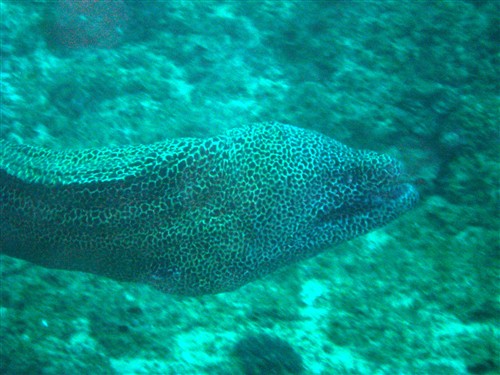
We had scheduled a two tank dive for the next morning and we arrived at the scuba shop refreshed and energized. There were only seven divers this time – a much better number – and as we pushed the pontoon into the water and hopped in over the side, the excitement began to percolate inside us. The first dive site was called Manta Reef and we felt confident about our chances of seeing mantas based on other divers’ reviews of the site. My equipment felt great and the negative entry was smooth. During the two dives combined, we saw five different species of rays, several schools of brightly colored yellow and orange fish and a free-swimming honeycomb moray eel. The visibility was better but still not good…about 8 meters maximum.
During the safety stop on the second dive at a site called Sherwood Forest, we spotted about five manta rays gliding through the water below us. Mesmerized by the grace of those beautiful creatures, I began gravitating toward them, unaware of my increasing depth in the murky water with no reference points. And then I felt “the squeeze”. I had learned about the squeeze during my Open Water certification course. It is a pain arising from excess pressure at depth. Before I realized what was happening, a sharp pain shot through my inner right ear. It was an almost mind-numbing pain that shocked me to attention. Suddenly frantic, I looked up, saw the other divers above and realized that I had sunken too low. I ascended slowly while trying desperately to alleviate the pressure in my ear. Nothing seemed to work. The pain didn’t increase but it persisted. One of the dive masters noticed that I was struggling and came over to help but there was nothing he could do. I maintained relative composure and managed to ascend to the surface with the rest of the group, which may or may not have been the best decision but I went slowly and felt okay.

On the surface and throughout the afternoon, my ear continued to throb – a lasting reminder of the importance of following dive protocols and controlling your depth. We returned to the scuba shop and sat down for a couple of their killer salads while reveling in the success of our ray spottings. My ear did eventually did find its happy place again but we were finished diving nonetheless. Despite religious application of sun block, both of our faces got sunburned such that we had to hide beneath the brims of our hats for the last sunny day in Tofo. Our chalet was without power for most of the day so we wandered around the beach and found other places to relax. The waves looked so intense and inviting but the threat of more sun exposure on our already rosy mugs kept us ashore.

That night, as we packed our things once again in preparation for the four a.m. bus ride back to Maputo, we both agreed that we were not sad to be leaving. We had come for the diving and, even though we didn’t see any whale sharks, the manta sightings were fantastic. The beach was beautiful and the town had a feeling of quiet serenity. The discomfort of our accommodation, in conjunction with weather that was either pouring rain or oppressively hot and humid, kept us from truly relaxing. I honestly believe that our experience would have been better at a different resort but that’s the breaks on the road. Sometimes it’s good and sometimes it’s bad. Sometimes it’s preferable to endure a bad place for a few extra nights than to pack it all up again in an attempt to upgrade. It really depends on your mood.

I couldn’t, in good conscience, end this entry without touching upon the border crossing from Mozambique to South Africa. We took a Greyhound bus from Maputo to Johannesburg. The bus arrived at the border and all of the passengers disembarked and walked to the Departure area on the Mozambican side. Being Saturday morning, a long line had formed, spilling outside the door and into the already hot morning sun. As we waited in the queue, sweating along with the other civilized people, a group of tourists cut into the section of the line that was just inside the door while no one up there did anything to stop them. Aaron yelled from the back of the line but with minimal effect. We stood, annoyed, while people pushed, shoved and cut into line without a second thought. Once inside, we found ourselves literally sandwiched between sweaty Africans as we defensively held our position through the resurrection of some of our old basketball skills (pivoting, boxing out…and a little elbow action when necessary). After about an hour, we reached the front of the line and, with the exit stamps still gleaming on our passports, left Mozambique, probably never to return.

With a sigh of relief, we walked quickly to the Arrivals area on the South African side. We arrived to find a beautiful single-file line that stretched around the building, almost all the way to the Departure area on the opposite side. The line moved slowly but we eventually reached the inside of the building, which was packed with more sweaty people (and when I say sweaty, keep in mind that most Africans do not wear deodorant), kept in queue by a series of guardrails. At first glance, it seemed like a reasonably efficient system until we realized why the line had been moving so painfully slowly. Of the six windows, four were occupied by working agents and two were empty. One window was reserved for “Diplomats” of whom there were none. The Diplomat window attendant, rather than taking the next person in the official queue, seemed to take selected persons who managed to circumvent the inside part of the queue. Meanwhile, on the opposite end, a shortcut had been discovered wherein a separate small but consistent line had formed by people who had sneaked over from the Departure side; these people were being served without having waited in the queue at all! The attendant at that far window saw what was happening but did little to stop it. All that it would take to remedy the situation at the borders is a couple of stern-looking guards with night sticks keeping order in the queue. It took us a total of two infuriating hours to cross the border and continue on our journey.

Situations like the above-mentioned border crossing make me want to throw my hands in the air and scream, “Why? Why? Why? Why is it so difficult to be civilized?” After more than three months in Africa, I am no closer to finding the answer to that question and I find it maddening! For all of its appealing wild beauty and colorful culture, sometimes Africa can feel like an incorrigible child. It takes patience and determination to endure the many discomforts involved in African travel, particularly in a place like Mozambique where years of civil war have dramatically damaged the infrastructure. If you can look beyond the blemishes and peel back the rough exterior, you will find a sensational raw beauty and vulnerability that touches your soul and forever changes your life for having witnessed it. In hindsight, you’ll always find that it was worth it.

1 Comment

December 13th 2007 by Tina
Swaziland

Posted under Africa & South Africa

It rained. It rained all day, every day, with a fog so thick and so low that we could just barely make out the beautiful mountain ranges surrounding the colorful rural Swazi landscape. With the exception of one rain-soaked trip to the Mozambican consulate to obtain visas, we hid out in our hostel, cooked all of our meals in the kitchenette and devoured our last two bottles of wine. Despite driving the entire length of the country, we left Swaziland, one of the last three remaining African monarchies, after two nights, as yet undiscovered.

Comments Off on Swaziland

December 11th 2007 by Tina
Umoja – “The Spirit of Togetherness”

Posted under Africa & South Africa

We reached Durban after a long day in the car and checked into a terrific hostel called Gibela’s Backpackers. We had made the drive with two lovely young German girls whom we’d met on our last night in Coffee Bay. They were pleasant company and, more importantly, they had CDs! The eight hour reprieve from South African radio stations was a welcome change. We would stay only two nights in Durban, South Africa’s third largest city, on our way to Swaziland.

The owner at Gibela’s was friendly and knowledgeable. Before showing us to our rooms, he sat us down with a city map and pointed out areas of interest. He then circled two areas on the map and filled the circles with x’s, instructing us not to go into those areas under any circumstances.

After settling in, Aaron and I walked a few blocks to the restaurant district and splurged on a decadent Italian dinner with a great bottle of pinotage and then retired early to our room. Our past week of travel had taken on a rather furious pace as we realized what a long distance lay between the Garden Route and Nelspruit, where we planned to drop off the rental car. I was in need of some down time so despite the gorgeous sunny weather the next day, I spent the majority of it reading and writing while Aaron sent out the laundry and attended to some other family business around town. He finally coaxed me outside in the early afternoon for a walk to the Victoria Street Market, which is known for its eclectic mix of Indian and African wares. After a couple of wrong turns through some questionable streets (close to but technically not in the “do not enter under any circumstances” areas), we found the market and entered to find the same spices and dime store junk that we’ve found all over Africa. We made one cursory lap around the first floor and then headed back into the sunshine and made our way back to the hostel.

We had bought tickets earlier that morning for a musical theater performance called Africa Umoja. Uta and Stephanie joined us for the show, which was being held at a beautiful new casino just outside of town. “Umoja” is a Swahili word meaning “the spirit of togetherness”. The musical was created to preserve in the hearts of young Africans and share with others the music and dance of African tribal culture as it has transformed through the ages.

As we sat down in the theater, we weren’t sure what to expect but as the lights dimmed and the curtain rose, the power of Umoja took hold of us. It began with a quartet of drummers, in full tribal dress, pounding out their wild, synchronized beats with the ferocity of warriors. As we sat, riveted, the stage filled with a chorus of sleek, beautiful brown-skinned bodies in traditional beaded and multi-colored costumes of the early African tribes. The soulful singers belted out a succession of precisely tuned a cappella harmonies interspersed with passionate solos that sent chills through our bodies. The narrator of the story guided us through two hours of bold, energetic performances of songs and dances, which told a beautiful story of the changing tribal culture from the early years before the white settlers arrived in South Africa, through the painful and dehumanizing apartheid era, to the raucous erotica of today’s youth. One song that nearly brought tears to my eyes was a heartfelt cry into the wind of early apartheid-era women whose husbands left their villages to find work in the new towns, leaving the lonely women to raise the children. Another number was performed by a group of men whose only instruments were the thick industrial galoshes on their feet and the plastic garbage bins which they pounded, slapped and flipped about. It demonstrated that music is in the soul of every African and, no matter how they have struggled and how much has been taken from them, they have always found joy in their God-given beats and melodies.

The passionate performance gave us a greater understanding of the powerful effects of apartheid on the tribal communities than all of our other South African experiences combined. However, the most emotional portrayals of those painful experiences were delivered with a light-hearted humor that allowed the spellbound audience to laugh while still feeling a sting in our hearts.

The remnants of the apartheid that plagued South Africa for generations are still shockingly apparent in the township ghettos which stretch for miles on the outskirts of most major towns. The ghettos consist of hundreds to thousands of ramshackle dwellings, built practically on top of each other and constructed from whatever miscellaneous materials could be secured: scrap metal, wooden slats, old signage and often trash. The township communities house South Africa’s poor black and “coloured” (any mix of African and European descent) citizens and are a stark contrast to the lavish vineyard estates and Western-style homes which house the more affluent, predominantly white population.

As tourists, it is often easy to indulge in the comfortable Western culture of South Africa while putting the stunning economic racial disparity out of our minds…until we drive by the townships on our way to yet another beach town. As we pass by the crude communities, I am emotionally stunned by the darkness of poverty. I cannot help but stare and think about how hard a life must be that begins in there but also how much love, music and laughter is shared.

South Africa has a long way to travel down the road to redemption – a frustrating path of trial and error that our beloved United States has been traversing for the past fifty years. Africa Umoja touched our hearts. At the end, we felt like a part of something positive and inspiring for young Africans with the power and responsibility to make tomorrow better than yesterday. As the finale concluded, we cheered and clapped and, as I looked around the theater, I noticed for the first time the predominantly white audience and a sudden sadness came over me. The ratio of ticket holders for that evening’s performance solidified, in my naïve mind, the reality of just how long is that road to redemption.

Comments Off on Umoja – “The Spirit of Togetherness”

December 8th 2007 by Tina
Coffee Bay: A Germophobe in a Hostel World

Posted under Africa & South Africa

Coffee Bay is a small hippie surfer town on the Wild Coast and another one of South Africa’s premier surf spots. About two hours off the tourist trail, it is a remote stretch of beach inhabited by Xhosa tribespeople. This would be the venue for Aaron’s thirtieth birthday celebration and I was determined to find a way to make it special.

The drive to Coffee Bay was long, hot, and most memorable for the last two-hour stretch, which was riddled with potholes so deep and treacherous as to give Kenyan roads a run for their money. For added fun, the winding, part gravel, part paved road is the main artery running through the rural tribal hills so both stray farm animals and Xhosa pedestrians present additional obstacles for the already-swerving vehicles. Aaron and I equated driving on that road to real life Pole Position – the old Atari driving video game. Our compact VW Polo bumped along like The Little Engine That Could and somehow reached our hostel without blowing a tire or flattening any Xhosas.

There are only two hostels in Coffee Bay. Coffee Shack is the party place, catering to the younger travelers who stereotypically divide their time equally between the bar and the beach while Bomvu Paradise is a more tame, Bohemian-style setup, which draws the late twenties, early thirties crowd who notoriously come for a few days and end up staying for months. Needless to say, we checked into Bomvu around five p.m. after a full day of driving, dropped our packs and went straight to the bar.

We ordered a couple of post-road trip beers just as the wild child surfer girl at the bar invited us to join a group for sundowners (Translation: watching the sunset from the top of a hill while drinking free wine from a box). Without any more pressing engagements, we signed on and followed the crowd up a very steep, grassy hill just outside the hostel door. It was extremely windy at the top but the ten of us sat around in a circle and passed around the box of wine. Some Xhosa women had followed us up the hill to peddle their bead crafts. Since it became clear upon our arrival at Coffee Bay that I would have no chance of securing any of the traditional birthday supplies, I picked my Birthday Bear a $3 beaded necklace in the colors of Africa. It wasn’t much but it was something. Four local boys had also followed us and sat shyly away from us, giggling until they managed to get up the nerve to ask if they could sing and dance for us. The group of us pooled our change, which the boys gleefully divided after they had exhausted their repertoire of ethnic ditties and dances.

There are no restaurants in Coffee Bay so both hostels have resident Xhosa chefs and we walked down the hill just in time for dinner. Afterwards, Aaron participated in a tribal drum workshop while I opted for a shower and a book.
The guest rooms at Bomvu were spread out around the property and ours was located in a dark, private corner just far enough away from the bar. There were shared toilets inside the bar and on the opposite side of the property and there was an outdoor shower near our room on the back side of the bar.

In a normal world, the sheer inconvenience of this setup would cause the left side of my snobby upper lip to curl up in a snarl of displeasure. I am a germophobe in a hostel world. I haven’t always been that way but, in my late twenties and early thirties, I have become increasingly concerned with treating my body like the shrine that God created. Sometime therein, I began obsessing about the cleanliness of my teeth, flossing religiously, performing periodic inspections with my prized dental pick and mirror, and proactively calling my dentist’s office to inform them that it had been almost six months since my last visit! I developed a heightened awareness of potential germ ingestion and developed such preventative habits as washing my hands more frequently, avoiding barehanded contact with public restrooms and door handles whenever possible and never touching my face with unclean hands. I probably don’t even need to add that my germophobic derriere had not touched the seat of a public toilet in ages because, like many women of my generation, I’ve perfected “the hover”.

I do recognize that some of the behaviors to which I’ve just confessed could be characterized as teetering on the border of Obsessive Compulsive. That said, I must also mention that there has been a noticeable decrease in the number of times that I’ve suffered from routine sicknesses, such as the common cold, since I bought my ticket for the Crazy Train. You might be wondering how a germophobe like myself could willingly expose her pristine buns to a world (often a Third World) of public pots. The answer is simple: I stubbornly refuse to let my petty ailments (and trust me when I say that I have a running list) prevent me from doing the things that I want to do. Nevertheless, life on the road has been challenging at times.

The hostel world is certainly an adventurous one, with accommodations in a wide range of cleanliness, convenience and comfort. Aaron estimated that we’ve stayed in about thirty different hostels thus far and we feel like connoisseurs by now. Most places offer private double rooms (sometimes with private bath, sometimes not), dorm-style rooms and, depending on the locale, campsites. We ALWAYS opt to pay a premium for a private room with a private bath if it’s available. We do this for two reasons: One, because we can. Two, because the shared baths are almost invariably shared with twenty-year-old, grungy male backpackers and we all know how those boys leave the bathroom – seats up or sprinkled and usually unflushed. Few things in this world make the bile rise faster in my throat. Also, shared baths usually adhere to the B.Y.O.S. policy (Translation: “Bring your own soap.”) Come on! Even an unabashed germophobe like me doesn’t walk around with a bar of soap (good idea but totally impractical) on her person. I must admit that, even after three months on the road, I still feel an Obsessive Compulsive twinge of panic when I exit the stall to find only water to wash with.

There is also the convenience factor that comes into play when I wake up a minimum of two times during the night to stumble, groggy and bed-faced, to the bathroom. I’ll never forget the night that we spent in Lusaka, Zambia at a place called Chachacha Backpackers. We had been traveling all day and just wanted to relax and go to bed early. We had just come from Zanzibar where we had splurged on one of our most luxurious rooms and I felt my spirits deflate as we were shown to our room at Chachacha – four thin walls with a lumpy bed, located in the courtyard of the property less than twenty yards from the hostel bar. The only toilets were in the main building of the hostel so, twice that night, I had to walk half-asleep in my pajamas through a bar full of rowdy, intoxicated patrons who kept their party going until three a.m. In these scenarios, I keep reminding myself that it could be worse. At least the toilets had seats!

Since we’ve been on the road, I’ve begun to notice gradually increasing levels of tolerance in myself regarding cleanliness. I noticed the first remarkable change at our hostel in Cape Town. We did have a private bath but it had no shower nozzle, just a grimy-looking tub with separate spouts for hot and cold water, making it impossible to combine the two into a single warm stream. There were two options: the communal showers downstairs or a bath! Surely you can guess my opinion on bathing in a hostel bathtub, especially one that gets cleaned (?) by African maids who sometimes have different ideas about what constitutes clean.

The weather in Cape Town was cold, rainy and windy on the first days after our arrival. In my former life of relative luxury, I always felt that the best way to warm up when you’re chilled to the bone is to sink into a hot bath. That particular night, we had just returned, cold and soaked, from our Cape Point adventure and I couldn’t stop shivering. There is no temperature control inside the rooms, aside of the window, so I hesitantly gave the tub an initial inspection. It appeared as though it had not been washed recently, at least not since it was last used and, in reality, probably longer. The germophobe in my head, who usually controls my decision-making process in these matters, was suddenly negotiating with a new contender: Granola Girl. The conversation in my head played out something like this:

Germophobe: There is no way in Hell that I am taking a bath in that filth! Who knows what kind of micro-organisms are crawling around in there, waiting to invade my shrine!

Granola Girl: Oh shut up! You’re OCD! You’re chilled to the bone and a steaming hot bath will feel so nice.

Germophobe: Maybe if I just turn on the hot water for a few minutes, it will rinse off the top-level germs. That would be better right?

Granola Girl: You’re not going to get sick from taking a Goddamn bath!

Germophobe: Fine. I’ll try it but if I get even the slightest touch of a cold or a rash, I’ll have no trouble attributing it directly to this flagrant disregard for germ evasion!

I drew the bath and soaked until I was sufficiently washed and thoroughly warm…and then I did the same thing for the next three nights. By the end of our stay, the tub was obviously filthy and I wondered if that was precisely how the next guest would find it.

Cape Town was a breakthrough and I lived to tell the tale. With that experience under my belt, I was already inspired, by the time we reached Coffee Bay, to take further steps toward becoming less high-maintenance and more granola. When we arrived at Bomvu and noted the toilet and shower situation, I made a command decision. This germophobe is going granola! Bring on the squat toilets! Bring on the camping! I’m just going to roll with it from now on. That is not to say that I’m going to stop shaving and start buying patchouli. It is simply another veil of snobbery lifted and tossed aside. I am not the girl I used to be.

As a right of passage, Aaron and I rebelled against the bathroom setup by brushing our teeth and attending to certain other unmentionable bath activities outside the door of our room in the privacy of our dark corner. The outdoor shower actually turned out to be lovely. The water stream was powerful and hot and the cool night air steamed off my skin as I washed while eavesdropping on bar conversations through the thin wall.

The next morning was December 3rd – Aaron’s 30th birthday. He mentioned taking a surf lesson that day but as we sat at breakfast, looking over the list of available activities – horse rides, cultural tours, abseiling and a couple of different guided hikes – Aaron decided on a hike to Hole in the Wall, a three-hour, nine-kilometer coastal hike to a large rock island wall with a hole in the center. We signed up and waited around for the hike to begin but were eventually informed that the only shuttle bus had a flat tire so they weren’t doing the Hole in the Wall hike that day. There was another, less appealing hike available but my forlorn Birthday Bear frowned because he wanted Hole in the Wall. Next, we took our laptop into the hostel office to try to plug into the internet but it turned out to be an antiquated dial-up connection (shockingly, the first one we’ve encountered on the road) so we couldn’t plug in. Strike two for birthday wishes! Things were looking grim and it wasn’t even nine a.m. but I told him to keep his chin up – things would improve – though I was beginning to have my own doubts.

We sat down for another cup of coffee and were soon joined by two groups of Europeans whom we’d met the previous night. They expressed interest in Hole in the Wall as well and, with enough interest buzzing around the table and visions of Rand (South African $$$) signs dancing around in the manager’s head, Hole in the Wall was suddenly back on the table with the understanding that we would have to find our own way back to Bomvu. Everyone was game and the prospect of doing the hike that he wanted with a fun group of people turned a little Birthday Bear’s frown upside down faster than you can say Lenasaurus Rexasaurus!

The hike took place on a succession of steep, grassy hills that bordered the majestic Wild Coast. The sharp, quad-wrenching ascents were divided by equally sharp knee-wrenching descents with occasional stretches of flat, rocky beach. Up and down, up and down we went for three grueling hours, feeling every year of our age and every beer we’d consumed in the past month. Even in my best shape (and I’m far from that after three months in Africa where you don’t walk anywhere), that hike would have been a challenge. The only one in our group who wasn’t heaving during the ascents was our barefoot Xhosa guide, Tando, who easily climbed each hill with the stealth of a mountain goat.

The scenery from the hilltops was breathtaking with enormous, tubular waves crashing down upon jagged, raw beaches. Cows and goats grazed on the grassy hills dotted with the round clay, thatch-roofed Xhosa houses, distinctive with their bright turquoise paint. The day was slightly overcast which kept us cool and a fierce wind whipped through the hills, nearly blowing me off the trail a few times. As we neared our destination, a group of Xhosa children walked alongside us with their bead and shell crafts for sale. I marveled at the ease with which their nimble young legs carried them effortlessly over the most laborious passes.

The Hole in the Wall was an anti-climactic conclusion to our very intense hike. We sat on a pebble beach, watching the whitewater rush through the hole with each incoming wave. On a nicer day, we might have gone swimming. Instead, Tando led us to the nearby Hole in the Wall Hotel where we could get snacks and cold drinks. With no prospects for finding a ride back to Bomvu, the group decided to have lunch in the bar before starting the painful walk back to town. I made one feeble attempt to negotiate a ride from the lodge owners and, when that didn’t materialize, we started up the long road on foot. Just as I was quietly stewing about how three more hours of those grueling ascents might literally be the death of me, a miracle happened! A white mini-bus, only about half-full, came motoring up the road. Desperately, I hailed the bus. I could sense the driver’s hesitation but, thankfully, he decided to stop. The driver and Tando had a brief conversation in Xhosa, wherein the driver asked Tando if we had money and Tando negotiated a fare of ten Rand apiece. We hopped in, filling every available seat. As we silently rode over the winding, gravel road, I know that each of my peers was quietly sharing my relief that God sent that mini-bus to save our tired bodies from the near-death experience that would surely have resulted from the walk back to Bomvu.

We ended the evening with dinner at Coffee Shack, which was reputed to have better food than Bomvu. The place was packed with forty to fifty young men and women, indulging in the merriment of pre-dinner cocktails. The dinner was excellent but the seating was scarce and we ended up sitting on a stone ledge, nursing our beers and feeling like we were at a high school kegger. We left shortly after dinner and retired to the quiet serenity of Bomvu. With our last Cuban alight, a cappuccino for me and a glass of port for Aaron, we ended the night in a quiet booth with a deck of Uno cards. We are easily amused.

Ten years ago, Coffee Bay may have had a chance of drawing us in. These days, it takes a little more than bars full of young twenties surf bums discussing their alcoholic experiences at the dinner table to keep these yuppies-turned-vagabonds engaged. No sooner had we recovered from the potholed, Pole Position drive than we were right back on it, leaving Coffee Bay and its resident hippies in their perpetual state of Bohemian bliss.

2 Comments

« Prev - Next »