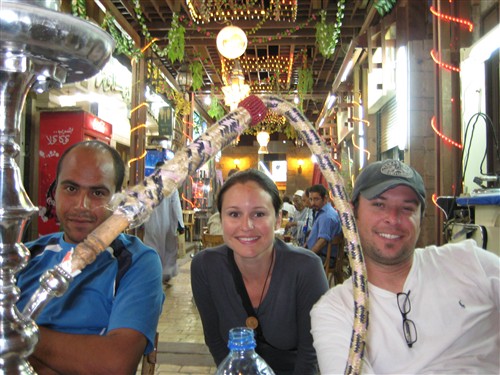
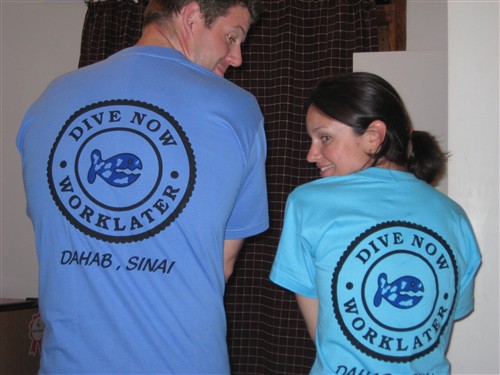
 Dahab, Sinai. We’ve been here almost a week in this laid back resort town that caters to backpackers who come specifically to scuba dive. The main area of town consists of a long row of resorts along a rocky beach with clear, calm waters and one row of restaurants and shops just behind the resorts. Our room at Penguin Village is the bare minimum of comfort: the sheets and towels are ratty and worn, there is no maid service and the shower is questionable on a good day but the staff is mellow and accommodating and the common area offers the perfect beachside atmosphere for relaxing after a long day of diving. The music is chill and you can look out over the sea to Saudi Arabia. The primary activities are windsurfing, snorkeling and diving and the remainder of your time is for eating, drinking, socializing, snoozing, and finding that Zen place inside your head. We have begun to feel at home here. We were ready to relax after our fast-paced travel in the earlier part of our Egypt trip but, after our first day of diving the Red Sea, we knew that it wasn’t going to happen.
Since I had only just completed my PADI Open Water certification in Texas before we left and hadn’t been diving in the ocean, we weren’t sure of my reaction to getting my fins salty for the first time. We paid for a quick skill refresher and a guided first dive at a site called the Lighthouse. I immediately felt like a fish underwater and the reefs were so amazing that I told Aaron that we would be diving every day and that was final. He was tickled by my reaction, since diving is one of his most beloved activities, so I signed on to start the Advanced Open Water certification the following day. The certification was a course of light book work and five certification dives (deep, drift, naturalist, navigation and night) to be completed over the course of two days. Aaron accompanied me on all of the dives except for the navigation dive and each one was amazing! It is almost a religious experience to realize and become part of the existence of life under the sea; the world suddenly seems so much bigger!
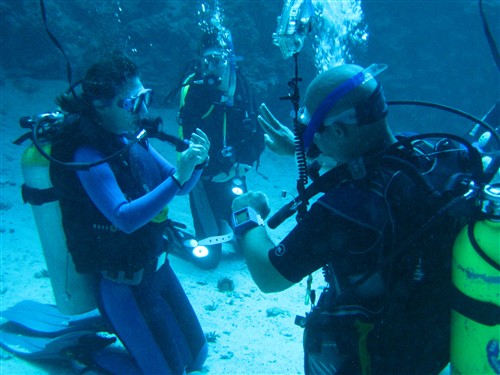 Led by my seasoned and competent instructor, Ahmed, we descended to a depth of about 30 meters for the deep dive at Canyon Coral Gardens. The crevice through which we descended was narrow and rocky, which surprisingly did not trigger any claustrophobic reactions though I did have to talk myself down off the ledge at the realization of our depth. I did a couple of math and hand coordination exercises at the bottom to examine how much more slowly the brain works at deeper levels due to a condition called nitrogen narcosis. The exercises were short and we spent the majority of the dive exploring the reef. Aquatic life is both fascinating and beautiful. We glided through schools of colorful fish, the sun glistening off their sleek, sparkling bodies. I didn’t feel threatened by them; I was one with them – just another big, slightly clumsy fish in the sea. The delicate corals along the reef were simply breathtaking! The colors were muted by the distortion of light in the water but the intricate shapes and gentle flowing movements brought them to life before my eyes.
Our second dive, the drift dive, took place at a site called the Blue Hole. The idea of the drift dive is to let the current gently carry you along, doing all of the work for you, so that all you have to do is breathe and admire the waterscapes. The current for our drift dive was light so we lazily drifted and slowly, peacefully enjoyed our surroundings. The Blue Hole is an enormous expanse of deep, blue abyss and swimming through it gives you a sense of flying or floating in space. You are weightless and free, exhilarated yet tranquil. It is the deep blue sea.
Our third dive, the naturalist dive, was all about exploring and identifying the coral and sea creatures. The ecosystem – the interrelation of living and nonliving things – is a subject of study that we intend to undertake slowly and patiently in different parts of the world. At Coral Island, the reef was teeming with life and, in my opinion, it was the most beautiful reef in all Dahab. The clownfish sleep and play in the anemone. The crocodile fish glides along the ocean floor. Schools of small shimmering fish in silver, orange or blue dart through the water in instinctively synchronized movements. Ahmed pointed out blue triggerfish, fire coral, barracuda (a whole school of them floating overhead!), Emperor angelfish and blue fin trevally. Coral Island was the ideal location for a naturalist dive. The light of the midday sun shines through the crystal clear water such that at 17-33 meters deep, you can see your surroundings vividly with natural light. If you look up from below, you can see that big ball of fire burning brightly in the white sky.
Ahmed and I went to the Lighthouse alone for my navigation dive. It was more of a chore than an enjoyable experience, probably due to my innate sense of misdirection, but I passed and that’s enough said about that. Aaron knows well enough not to put me in charge of navigation on land or underwater. He is my compass and has never steered me wrong.
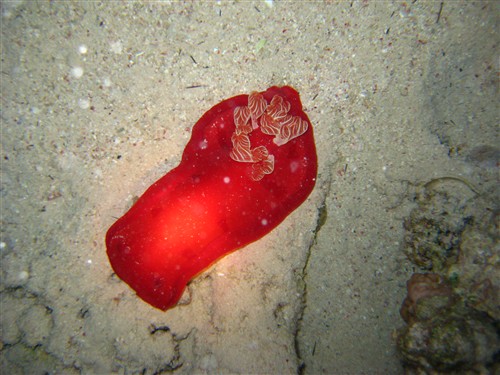 For my final certification dive, we did a night dive at Penguin House Reef, just off the coast of our hotel. We were a larger group this time (seven, including Ahmed), which turned out to be an unsavory dynamic. As soon as we began to descend, I disliked the blackness of the moonless night and disorientation of the dark, even with a torch in hand. With no moon, we could see very little outside the torch beam, which did illuminate colors in the coral that are otherwise invisible to the eye in the filtered sunlight. The reds, in particular, were much more detectable. Two of the divers, an Israeli guy and a German guy, were decidedly unskilled and uncontrolled and, because they were in front of us in the sequence, we spent the entire dive avoiding their long, lanky, erratic, flailing limbs. Everyone was perturbed, including Ahmed, and the constant worry and eventual reality of being kicked in the face added a tone of anxiety to my already nerve racked night dive mindset. Though I was uncomfortable from the beginning of this dive to the end, I felt in control of my own devices. I did not feel unsafe but rather annoyed and anxious. There is a critical faculty of being able to “talk yourself down off the ledge” and avoid panic that is crucial to being a good diver; it allows you to maintain composure in stressful situations. You can usually breathe yourself back to a happy place if you have the wits to do so. The redeeming feature of the night dive was our discovery of a Spanish Dancer. It looked like a bright red flimsy Frisbee and, when Ahmed gently touched it, it began to slowly, erotically sway like the flowing red dress of a swinging seniorita. It was one of the most beautiful things I have ever seen. So I am an Advanced Open Water Diver now! A rewarding achievement! This labor of love opens the door to a lot of amazing dives all over the world and our trip around the world has now turned into our dive trip around the world. Aaron has been so encouraging and supportive along the way and it has enhanced my love for him even more, if that’s possible. I would follow him anywhere and, decidedly, we will go everywhere!
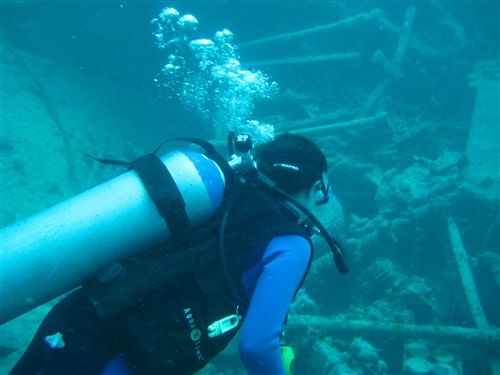 To celebrate my accomplishment, we booked a one-day dive trip to the SS Thistlegorm, a WWII British warship wreck which was bombed by the Germans in 1941. The wreck is 415 meters long, with tonnage of 4898, is quite well intact and coined as the most impressive wreck in the Red Sea. On the cruise to our site, a pair of dolphins glided along the bow of our boat, playing and entertaining us. The dives were absolutely, positively thrilling! For the first dive, we descended down an anchor line and explored the perimeter of the ship. The highest point of the wreck is about 17 meters deep while the lowest point is at 33 meters. I must admit that I find wrecks haunting – graveyards under the sea. I thought that I would be more intimidated by that notion but when I got down there, I couldn’t take my eyes off it. We explored the area where the bomb had hit and marveled at the debris. Two guns on the front were still intact and, as we floated around the outside, I realized that this was a real artifact of world history. Our second dive (40 min in duration) was spent almost entirely inside the wreck! We penetrated the captain’s cabin and his bathroom with tub and toilet as well as storage quarters full of boots, motorcycles and car parts. The cabins were cavernous and we carried torches to investigate the details but there was enough natural light illuminating the passageways to make me feel safe…the proverbial light at the end of the tunnel. We saw a big sea turtle, sitting on top of the ship and it stayed there throughout our dive. The experience of seeing the wreck sparked such a hunger inside me for the stories of war, however gruesome and heartbreaking they may be. I want them from the perspective of those who were there, in the trenches and on the ships. I have never been especially interested in the study of history but the American classroom does not compare to the exhilaration of putting your hands on the broken wood and metal of a sunken battleship.
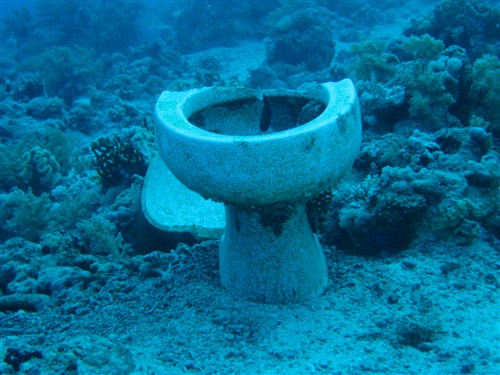 I much preferred diving from a boat than diving from the rocky shores in Dahab. It is much less laborious because you don’t have to stumble over jagged, uneven terrain in heavy dive gear to reach your entry point – you just put your gear on and step off the back of the boat. Our third dive of that day, and final dive for the week, was at Shark Reef and Yolanda Reef in Ras Mohammed National Park. It was supposed to be a drift dive but we ended up swimming against a strong current which was tiring and a little frightening. You kick and kick and hardly move until you exhaust yourself and find a piece of rock among the coral to hold onto and catch your breath. We did reach our final destination, though: the remnants of a cargo ship that wrecked, carrying a load of toilets which are now laid to rest along the ocean floor. Mentally and physically shaken from the current and weary from ten dives in four days, I didn’t enjoy that dive as much as I might have had it been earlier in the week but the purples and reds were more vibrant in the coral there than on any other reef that we had explored. When we returned to Dahab, we were happy to relinquish our dive gear and immediately got ready for bed. All night, I tossed and turned with dreams of negative buoyancy and falling towards the corals. Aaron says that I’m a real diver now.
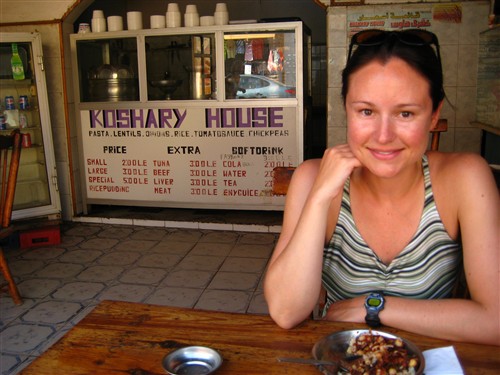
Dahab is an oasis in the desert. We have escaped the horse carriages and feluccas and, in a week’s time, we have not heard an utterance of the word “baksheesh”. It is peaceful here and I can wear a bikini and shorts without getting disgusted looks or beastly grunts from the locals. We have discovered a favorite eatery, the Koushary House. Koushary is a traditional Egyptian dish consisting of pasta, rice, lentils, chickpeas, crispy fried onions and a spicy tomato sauce. It is the only dish served at Koushary House and it is delicious and cheap! The smallest size is plenty for me and costs 2 Egyptian pounds (about 40 cents). We finish off the meal with cool, sweet rice pudding and leave happily stuffed every time. The resorts along the coast all have similar menus and the maitre des are always out in full force, beckoning you inside. One night, as we were walking along the causeway, a maitre de caught our attention and wanted to show us his fresh catch of the day, which was displayed on a bed of ice. In an attempt to prove the freshness, he grabbed a fish and opened up the gills to show us the redness of its lungs. Instinctively, I screamed and ran with my hands over my eyes, trying to erase the image from my mind before it lodged itself in my permanent memory. The man was so apologetic, even when we walked by later that evening. I have always had an aversion to raw meat. When I was younger, if my mother was cooking chicken for dinner, I could not eat it if I saw the raw breasts defrosting in a bowl on the counter. I didn’t touch raw meat of any kind until I was well into my twenties, and even then hesitantly, but the aversion waned gradually. Still, I don’t like the final presentation on my dinner plate to resemble the live animal. I occasionally enjoy a marinated, thinly sliced chicken breast but if you put a half chicken on my plate, with a leg protruding from the carcass, it’s simply not happening! Likewise, when we sat down to dinner that evening at one of the resorts with a nice table overlooking the ocean and ordered the recommended mixed seafood grill, I could not touch the whole grilled snapper with skin, head and teeth. It was our most expensive and least enjoyable meal in Dahab.
 We have truly enjoyed our time here and have begun to feel at home. To consider dropping anchor here in the long term, however, is nearly impossible. We’d really like to land in a place that has ice. We are beginning to feel about ice the way Tom Hanks felt about fire in the movie Castaway. It seems like such a simple pleasure but when we ordered a bottle of mineral water at the Oasis Café on our last night in Luxor and it arrived with a tall glass of cold, shimmering ice cubes, we were as giddy as two kids in a candy shop. I’ll never take for granted another icy schooner of beer. Also, in Dahab, toilet paper is a hot commodity. You must either carry your own or often go without and that is “no buenos”! You can buy two-roll packs in the markets and we have come to carry them religiously in our day pack. It is a perfect example of the well-known phrase, “It’s better to have it and not need it than to need it and not have it”. One of the greatest beauties of our trip so far is gaining a new perspective of appreciation for something formerly taken for granted. We have no regrets about relinquishing our fine jobs and material possessions in search of adventure. The freedom and personal enrichment that we have felt over the past month alone have been as valuable as our comfortable, though often monotonous, life in the suburbs. We have already begun to question whether we will ever be able to return to that life. We know that, somewhere out there, there are lucky devils who get paid to travel and that we can definitely fathom.
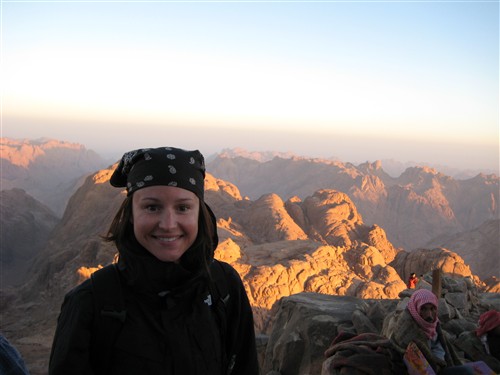 Departing from our hotel at 11pm on a minibus, the two-hour ride took us along climbing, winding mountain roads site of St. Catherine’s Monastery and the trailhead for our trek summit of Mt. Sinai. The 14-person minibus would have comfortably fit about six people so the 12 weary passengers squeezed into it looked (and felt) like tightly-packed sardines. The high-speed ride was an adventure in itself that included police checkpoints with repeated passport checks and is best characterized by our driver’s apparent desire to set a new “land speed record” through the Sinai mountains. In general, Egyptians drive with reckless abandon of speed limits and safety measures (like seatbelts) but this driver was a maniac in comparison and our lives flashed before our eyes each time he took a curve at what seemed like 90 miles per hour. Our hearts raced for the duration of the ride and no one got a wink of sleep.
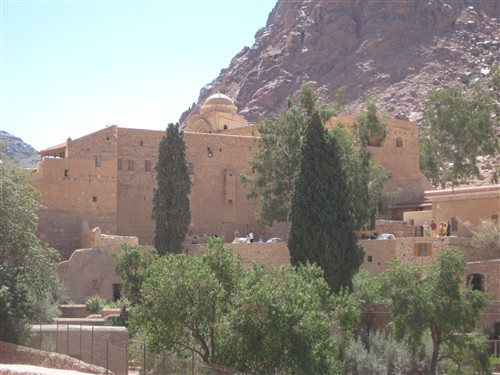 St. Catherine’s (the oldest Christian monastery still in existence in the world) opened to tourists at nine o’clock so we had almost two hours to kill. In the courtyard of the compound, a small coffee shop was open so we grabbed a couple of coffees and sat at a table in the courtyard. There were quite a few people there – a lot of Greek yiayias – waiting for the church to open. We had pulled out some snacks that we had packed and munched quietly. There were several children running around the courtyard, who seemed to belong to the monastery, and one of the boys approached us and asked for the rest of our orange cake. We gave it up and he hungrily walked away. The monastery is located in such a desolate, isolated spot that the children, if in fact they live there, don’t see a lot of packaged treats. When 9:00 rolled around, we lined up in the heat of the morning sun and eventually got in around 9:30.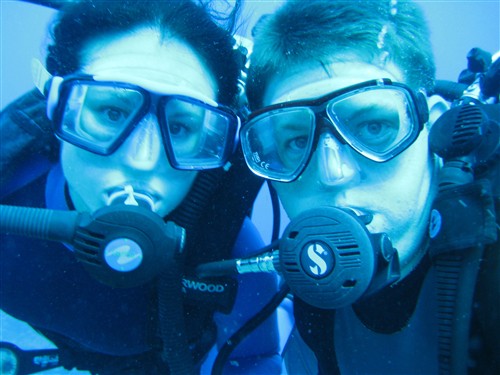
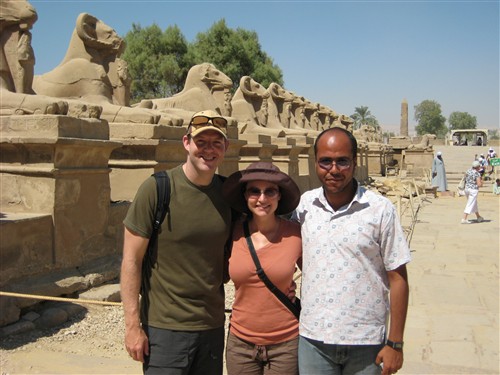 Archeologists and historians would no doubt argue that Luxor was one of the greatest ancient cities and the sheer number of temples, tombs, and ruins that remain provide unprecedented insight into the rise and fall of ancient Egypt. The remains of this once-great city have created a Mecca of Egyptology but to experience this history, travelers must endure the present-day city. Luxor is very small in comparison to Cairo and is actually made up of three separate areas: Luxor town, Karnak on the East Bank, and Thebes on the West.
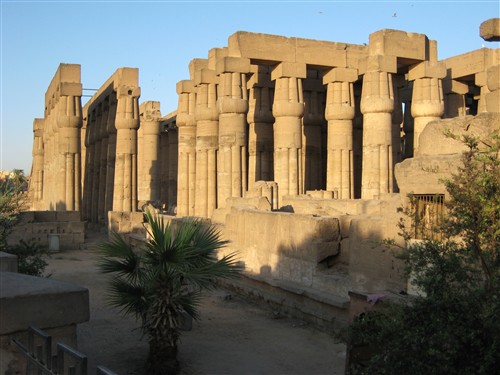 Arriving at each of our appointed destinations, we are greeted by rows of tour buses, all picking up or dropping off their cargo. We’re thankful for the privacy of our small entourage but we still are subjected to the touring masses in huge groups all pushing their way through the (insert featured attraction here) for a quick (often forbidden) picture of the claustrophobic tombs and narrow temple passageways. The oppressive heat of Upper Egypt penetrates the mind, body and spirit, invoking a mind-blurring sense of weariness. The history imparted by our all-knowing tour guide Mohammed is fascinating but soon all of the Pharaohs, Gods, and temples begin to run together. On our final day with Mohammed we visited Karnak Temples and Luxor Temple. One of the largest ancient complexes of courtyards, sanctuaries, pylons and obelisks in the world, Karnak Temples are interesting because generations of Kings contributed to the development of the sixty-acre complex by erecting temples and monuments to themselves, all in the same place.
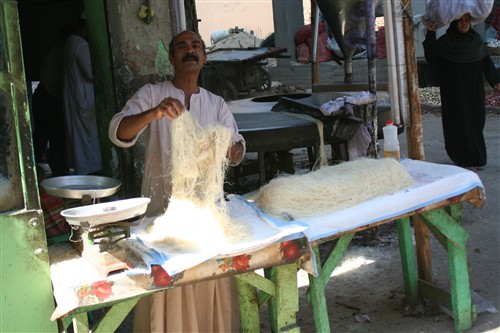 On one of our first evenings in Luxor, we hired a carriage because the offer price of five Egyptian pounds (less than $1) was too low to resist. The eager driver offered to take us to a market where we could buy souvenirs and he took us on the scenic route so that we felt like we were getting our money’s worth. After a few zigs and zags through some back streets, we came upon a local (not tourist) street market similar to the one in Esna. Buffered by the security of our carriage, we rode through the market, absorbing the sights, sounds and smells of daily life. Old men sat on the dirt road, with their wares for sale: fish, fruits and vegetables, spices, tails, hooves and heads of various animals. Skinned carcasses of meat hanging in doorways and freshly cut sheepskin on carts overwhelmed our senses with wild-eyed amazement. Women bartered for their daily meal stuffs and children wandered the streets with nothing to do. There is no free public education and many children do not attend school.
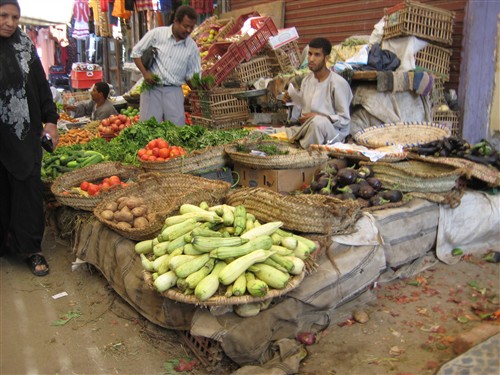 As our carriage pulled away from the local market, I conceived the idea of going back to the market the next day on foot, with a camera and a pocketful of baksheesh to see what kind of pictures we could get. The guys were on board with it so we spent that evening and the next morning working to break our bills into smaller denominations. Thanks to the Aaron and Andrew’s uncanny sense of direction, we found our way back to the street and the market was bubbling with activity. I should also note that I dressed more appropriately for the occasion and we all felt immensely more comfortable. The people were engaged in their daily business of buying and selling so, while we drew the typical “gringo” stares to which we have grown accustomed, less people actually approached us. For whatever reason, we did not disrupt the flow of activity to ask for photos but rather held our cameras inconspicuously low and snapped a few great shots of the interactions. As we reached the far end of the street, we began to turn down another alley that would lead us back into the market for another lap. As we started down the alley, we were engaged by a group of young girls who began following us and, despite our best efforts to thwart them, craftily enticed us into sparse conversation. The further we walked, the more they began to merge themselves with us, the stickier they became. If we tried to take a photo of something or someone, they would scamper into the shot and there were too many of them to manage. I found myself wanting to swat them like flies, to hiss at them, anything to shoo them away. With their scheming little black eyes, they seemed more like animals, like vultures, than children. Innocence has faded from the hardship they have already known in their young lives. As we came to the collective realization that our situation was not going to improve, we gave up and turned to walk back the other way. The little leaches followed us, of course. The ringleader (the oldest of the group; probably eight or nine years old) stuck to my side and continued to gradually crescendo her magnitude of annoyance. Both Andrew and Aaron were carrying backpacks and, while I had been walking with my purse clutched and my arms tightly against my pockets of baksheesh, I randomly glanced back to catch one of the smaller scamps trying to open Andrew’s backpack. I sternly swatted her grubby little claw away and, when I realized that their strategy was to steal, I firmly swiped my hand between the ringleader and myself and, in a raised voice said “NO”! As long as I live, I think I will never forget her response. She raised her petite four-foot frame, pointed a scrawny, brown finger in front of my face and, in the evil, muted tone of a gypsy’s curse, said “Be careful, Madam. Be careful”.