 So you finally get situated in your room on your “Five Star” Nile River cruise ship. You’re rank and sweaty from three full days of touring ruins in the dusty, of the Sahara Desert, the stink of the camel is marinating in your clothes. You’ve been dreaming about nothing but a hot shower for days since your last hostel had no hot water and the overnight train to Aswan had no shower at all (not that you would have gone there anyway) so you peel off your ripened duds and turn the hot water dial and brown water comes pouring out. What do you do?
“Welcome to Egypt!” said the seemingly hospitable gate attendant at the Pyramids of Giza as he hurriedly popped the tops off of two lukewarm bottles of soda (which we didn’t want) and handed them up to us on our camels. “Here is a (tourist junk, thirty-for-a-penny plastic) scarab for good luck and bend down so that I can put a white sheet on your head to protect you from the intense Egyptian sun”. Caught off-guard and more than slightly out of our element, we hesitantly obliged. This once seemingly gracious man began to aggressively demand a ridiculous sum of money and when he only got nine Egyptian pounds (less than $2 US) out of us, he demanded his sheets back and angrily walked away. That was how we learned the crucial lesson that nothing in Egypt is free.
Welcome to Egypt! Where every man and boy is after the same tourist dollar and everyone wants “baksheesh” or tip over and above the price that you’ve already negotiated for a service. This is the urban jungle of Africa, where the Nile vitalizes miles of lush, green coastal cities and rural villages some thousands of years old but the lands beyond are desolate, lifeless desert. These ancient cities along the Nile boast some of the oldest and most magnificent temples and artifacts in the world and the Egyptians are capitalizing on all of them. Poverty is rampant and, as a tourist, you are constantly approached by a man or child trying to sell you some worthless trinket or a ride somewhere or a bottle of water that has been sitting in the sun all morning. The others simply say, “Hello! Money? Baksheesh?” I have to keep reminding myself that these people live hand to mouth and they are willing to do whatever is necessary, without regard for self-respect or decency, to sustain their lives. When your children are starving, there is no such thing as decency, no matter where you are.
 We had been moderately concerned about traveling to Egypt during Ramadan, the fourth pillar of Islam, in which observant Muslims fast from both food and drink (and sex and smoking) from 4:00am to 6:05pm each day for 30 days. Approximately ninety-percent of Egyptians are Muslim and also, according to our trusty guide book, it is frowned upon to eat or drink in public during these strict fasting hours. The unforgiving sun drives temperatures upwards of 100 degrees in September so the mere thought of spending whole days touring desert ruins with no water sounded dreadful but since we had already bought the tickets to Cairo, we decided to go. We have had no regrets! In fact, being here to witness such an important facet of Islamic tradition has added a new level of religious education to our experience.
We arrived in Cairo at 1:30am and managed to secure a couple of visas and a taxi ride to the King Tut Hostel in downtown Cairo. As we were waiting in line to enter the country, I noticed a sign on the wall, warning that drug offenses perpetrated in Egypt are punishable by life in prison and, in some cases, death by hanging. I had to read it about ten times to truly comprehend its underlying meaning: “we’re not in Kansas anymore”! We are in Africa! Wild, raw, exotic Africa! The city is very much alive for the wee hours of the morning. We later learned that during Ramadan, the people break their fast at 6:05pm and then create a kind of festival in the streets until it’s time to begin the fast again at 4:00am. The men sit in groups outside small storefronts until sunrise, playing games, smoking sheesha, and conversing, and the whole city is illuminated!
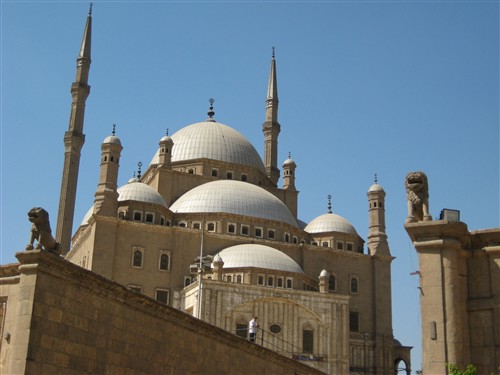
The King Tut Hostel occupies the eighth floor of an old building that looks like it was once a large hotel or office space. We pushed the button for the elevator to be sent down and after about ten anxious minutes, it came down and we rode up in a wooden box of a lift that looked like an old dumbwaiter. We had been flying through the night and wanted nothing more than to slip into bed but our host at the hostel was eager to offer us tea and help us plan our entire Egypt trip…and book it through the hostel, of course. We decided to book our first two days of tours to check it out. Our guide, Mohammed, picked us up the next day to show us the Egyptian Museum, the Citadel, and the Hanging Church. There is intense competition in the tourism industry so the stewards are extremely knowledgeable and accommodating. Our tours were private – just the two of us, Mohammed, and a driver – and the car was surprisingly nice and new with leather interior and a/c, which seems to be rare around here. Most of the vehicles are old and beaten up because the driving in Cairo is CRAZY!!! Aaron aptly described it as “organized chaos”. There are few lights and no lanes and the streets are packed with cars whose drivers all honk incessantly and change lanes by sticking the noses of their vehicles into small openings in traffic and hitting the gas. Pedestrians – even children – walk fearlessly through the madness, bobbing and weaving, and somehow emerge safely on the other side of the street. The guide book strongly suggests finding an Egyptian who is crossing the street at the same time and using him as a human shield and that’s exactly what we did to survive in Cairo.
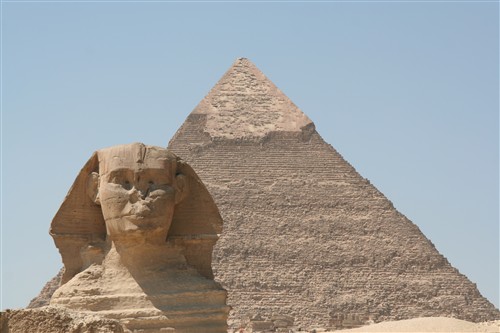
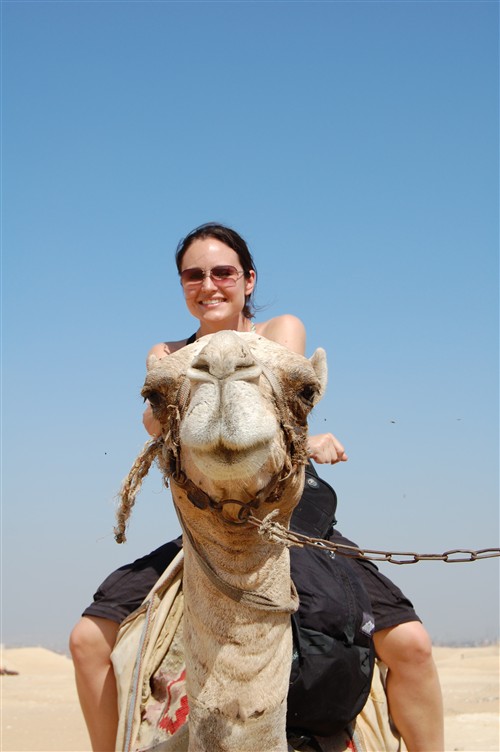 On our second day of touring, we saw the Pyramids and the Sphinx. Mohammed suggested that we see these by camel and he took us to the camel and horse stable, where the stable owner successfully negotiated an exorbitant price, using the animated intimidation tactics of his home court advantage. The man jumped around and scratched calculations into the dirt with a rock but his most convincing gesture was his fierce and penetrating stare into the depths Aaron’s soul. While we had every opportunity to walk away, we were mesmerized by the dramatic showmanship displayed in this tiny square of the world and we succumbed to the hypnotic guiles of this crafty negotiator. Satisfactorily mounted atop our trusty camels, Alibaba and Kilobanana, we set off for the Pyramids led by our camel guide, another Mohammed. It is important to note here that a camel ride is more of a box to be checked during African travel than a luxurious or comfortable experience. The ride is bouncy and, to my unwitting surprise, camels don’t just walk – they trot and canter! Holding on for dear life, we galloped into the desert and snapped some great pictures at the Pyramids. When we returned to the stable, dust-covered and chafed, we were happy to bid farewell to Alibaba and Kilobanana, who hopefully enjoyed a large trough of water after we left.
Though Cairo is teeming with automobiles, the use of animal power is still very common. There is an abundance of donkey carts, camels, and horse drawn carriages, which carry loads of fresh vegetables, papyrus, and various other wares. For such an ancient culture, it seems so primitive, which adds to its intrigue. The style of dress is also fascinating. The most common male attire is a long-sleeved, ankle-length shirt dress (called “galabiyya”) that is lightweight, flowing and looks incredibly comfortable and appropriate for the hot climate. Many also wear turbans. Egyptian women remain a mystery to us. We see very few of them on the streets and the ones we do see are covered from head-to-toe, excluding the face, or donning the traditional “khemar” (which is all black and covers the whole face except the eyes) and usually following, with down-turned, oppressed eyes, obediently, reverently behind a man. We are told that the women choose to cover themselves in this way. It would take a much longer and more intense period of observation to make our own educated determination. In a culture where women do not have equal rights, my American-born instincts tell me that women would not choose to cover themselves from head to toe without generations of severe consequences for disobedience. This is a culture that is thousands of years old and I cannot even begin to scratch the surface of understanding.
A few nights ago in Cairo, we headed out in search of dinner after a hot afternoon of sightseeing. Our guide book had suggested dinner at a place downtown, called the Greek Club, but finding our way there proved most difficult because of the markings on the streets or lack thereof. Two middle-aged Nubian gentlemen collected us and walked us to a place that they recommended for traditional fare, a place called Alfy Bey. We were uncertain walking in but our hunger and thirst greatly outweighed our uncertainty so we took a table. At this hour, about 5:00pm, the restaurant was quite empty, except for two or three tables. The menu had both English and Arabic descriptions so we were able to decipher a bit of it, though ordering was analogous to diving face first off a cliff. Luckily, the water was fine and the food was excellent. We ate spiced veal and braised lamb with assorted dolmas and plates of pita, hummus, tahini, and a spicy tomato salsa. Interestingly, the Muslims began to file in and take seats around 5:30 and soon the restaurant was filling up. I watched the wait staff delivering drinks, salads, and steaming platters of meats, rice and vegetables to the tables of the Muslim patrons; however, the food and drinks remained untouched. The people were waiting for the clock to strike 6:05 so that they could break fast. They were contentedly smiling and chatting over the aromatic dishes, seemingly oblivious to the scrumptious temptations right under their noses. The Herculean strength of the will power of faith is both frightening and humbling! We finished our meal, paid our bill, and were rather abruptly asked to relinquish our table in time for someone’s Ramadan feast. We didn’t mind because we were finished, happily fed and weary from our long day so we stepped back out onto the streets, which were now crowded with outdoor seating and people everywhere, all seemingly in a festive mood.
We decided to book the remainder of our Egypt tour through the King Tut Hostel. This is a difficult country in which to independently navigate your way and we decided that it was worth the premium to have our transportation and accommodations arranged. Everything is still private but we have come all the way to Egypt and found a Texan! Andrew Leonard lives the Dallas area and was traveling solo but the three of us have been inseparable. We took the overnight train (13 hours) to Aswan. Our first class cabins had a row of three seats, which folded into a bed and there was another bunk bed above. There was a small sink in each cabin but a common restroom (water closet, as it is called here) and we quickly discovered that the toilet opened right onto the train tracks! Our passage included dinner and breakfast and we rested well, except for the abrupt movements of the train which periodically jarred us from sleep. In Aswan, we were transferred to our Nile River cruise ship, the M/S RA. Our rooms were not yet ready so we hired a felucca and set sail on the river. The felucca was pleasant with the shade of its canopy, the view of the river banks lined with date palms and papyrus, and the hazy, gentle breeze. We returned to the ship and checked into our rooms. As I entered the bathroom and turned the dial, I longed for a hot shower as if it were a desert oasis and when the steaming brown water came rushing down, I stood bug-eyed for a moment and then thanked God for the hot brown shower and hopped in. We are in passionate pursuit of experience in the art, architecture, culture, industry, landscapes and waterscapes of the world. An occasional brown shower and many other small sacrifices of comfort along the way are unavoidable and we are happy to endure them for the privilege of this journey.
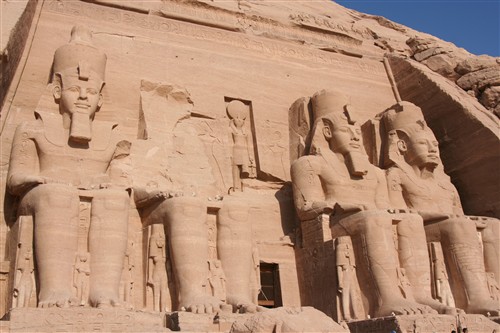 We crawled out of bed at 2:45 the next morning for a half-day trip by minibus to Abu Simbel to see the colossal temples of Ramses II and his wife Nefertari. Mohammed explained that the construction of the Great Temple of Ramses II (built between 1274 and 1244 BC) is fascinating for two reasons. First, there are four enormous statues of Ramses II, carved into the stone entrance and the sheer size of these magnificent statues is jaw-dropping as you round the corner to the temple’s entrance. Inside there are several cavernous rooms, adorned with stone columns, more giant statues of Ramses II, and floor-to-ceiling etchings of ancient battle scenes portraying Ramses II slaying his enemies and making offerings to various Egyptian Gods in the afterlife. Even more remarkable is that the precise alignment of the temple is such that, on February 22 and October 22 (the day of Ramses birth and of his coronation) each year, the first rays of the morning sun shine on the faces of three of the four statues of Egyptian Gods carved in the innermost sanctuary of the temple. The fourth statue of the God Ptah is not illuminated on these two dates because Ptah is the God of Darkness. We are utterly bewildered by the advanced degree of calculation and measurement involved in such a feat that was achieved over three thousand years ago!
Our “five star” cruise ship is far from luxurious, two stars at most by American standards, but we have enjoyed our cruise nonetheless. Gliding down the Nile brings a wave of tranquility over us and we have spent most of our time on the sun deck: reading, writing, snoozing, talking and watching with fascination the life along the river banks. The tribal women are washing their clothes, pots and utensils in the (notoriously polluted) river while the farmers are loading the backs of their donkeys with reeds of papyrus and other crops. They fish and sow the land and live on the fruits of their labors. Farming seems an unimaginably hard way of life but I think that the daily communion with the land must cultivate the soul to its richest purity.
The ship docked for several hours in what we initially thought was the West Bank of Luxor. Hungry for a little adventure, the three of us decided to take a walk through the town. I should interject here that until now, we had stayed primarily in tourist areas and while the traditional Egyptian dress code is the polar extreme of conservative, the standard is relaxed in the tourist spots and we flesh-baring foreigners can safely wear our shorts and t-shirts. Thinking that we were in the tourist town of Luxor and having spent days on the cruise ship, I unwittingly exited the boat in capris and a little spaghetti strap top. I would soon realize my error in judgment. Luxor is often coined the “hassle capital of Egypt” and we braced ourselves for a more intense magnitude of harassment. The moment that we arrived on the shore, we were approached for a horse carriage ride, which we firmly declined. The driver proceeded to follow us down the road, trying to negotiate a continually decreasing fare but to no avail. Then a group of young boys began to follow us, begging for a pound, just one English pound! The children are fascinating; they are persistent and savvy in their pursuit of a handout. They speak fragments of about eight languages and try to engage you by greeting you in all eight tongues to see which one is yours.
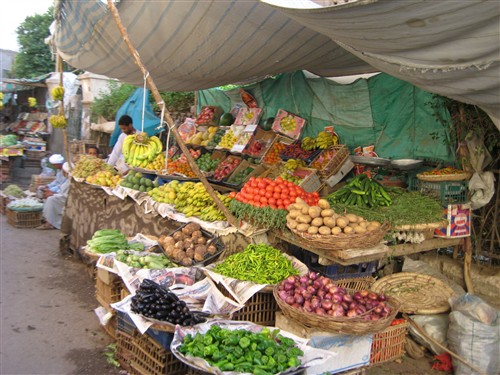 As we turned to walk deeper into the town, we came upon a small street market on a poverty-stricken stretch of dirt road. The stalls were lined with fruits and vegetables, spices in heavy burlap sacks, clothing, shoes and miscellaneous household wares. There were motorcycles, bicycles, donkey carts and goats on the road and the stench of filth and feces invaded our nostrils; it was the smell of true poverty. As a woman opened her door and dumped a bucket of who-knows-what into the middle of the road, Aaron noticed the dim light and dirt floor of the interior. There were no tourists here and we drew the stares of every man, woman and child as we hesitantly walked, wondering what exactly we were getting ourselves into. The harassment continued for the entire length of our walk with hawkish stares, honks, whistles and unmistakably derogatory Arabic and English comments, mostly directed at me. The adult men stared their fierce, penetrating, stares while the children aggressively taunted us, a few times throwing rocks at our backs. The rural women, even more conservatively dressed than in Cairo, looked at us in wonderment and then quickly averted their eyes and moved on.
We wanted desperately to photograph everyone and everything in this place, to capture the untamed spirit of the people but we were honestly too afraid to take out our cameras. Everyone wants baksheesh and you can’t seem to get small bills anywhere. The ATMs spit out hundreds. The eyes of Egyptian men look through you, intimidating and preying on your innermost vulnerability. You don’t know what is in their hearts and minds but their piercing stares imply suspicion, distrust and hatred. The uneasiness in our gait only fed their hunger for our fear. We handled the situation with poise, ignoring the insults and the rocks, walking around the people who stepped in front of us and remaining guarded and cognizant of the volatility of our environment. Near the end of the road, we spotted a hand-painted sign for the “Politie Esna” or Esna Police. We had only been a couple of streets from the dock in the port town of Esna but we felt like we were in another world. No photograph or story could truly capture the adrenaline rush, the sheer exhilaration of that experience but the vivid memory of it will stay with us for a very long time.
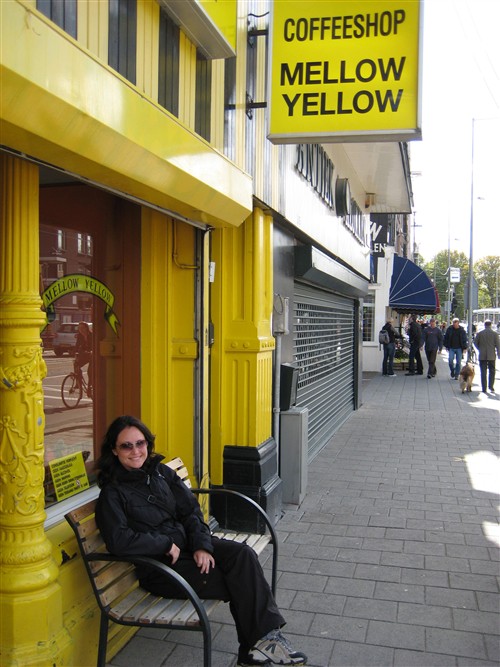 First, a little drug education: Probably most famous are the “coffee shops” that dot the streets in the greater metropolitan area.
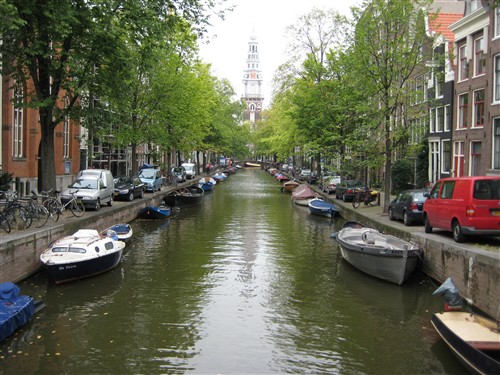
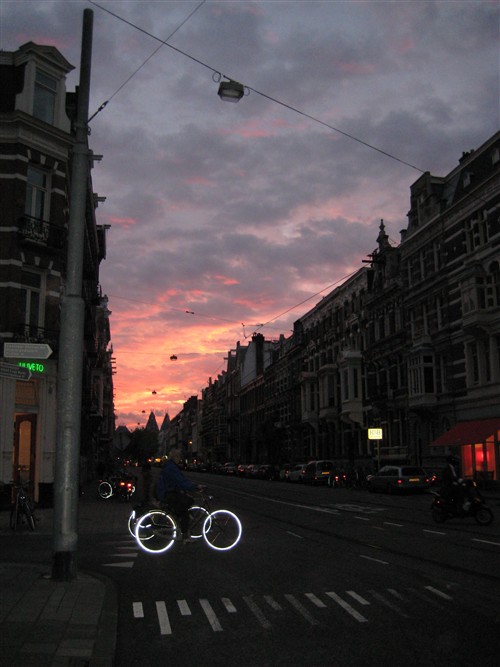 Finally, as in most large cities there are of people hurriedly rushing around from one place to another, but in Amsterdam they are all on fiets (bikes).
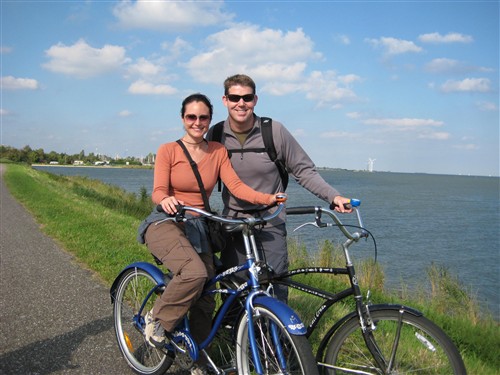 After stopping for lunch at a small café in Broek in Waterland, we continued on our journey through a number of small towns, occasionally taking wrong turns but eventually making our way to the center of Edam, our final destination about 25km northeast of Amsterdam.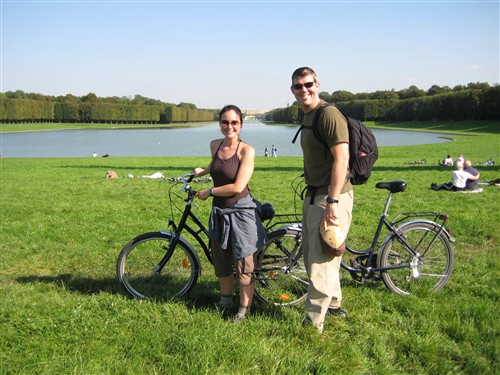
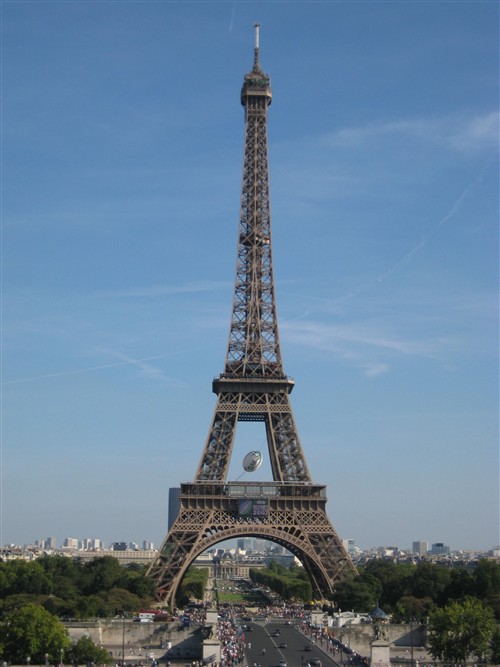 Everything about Paris has been wonderful!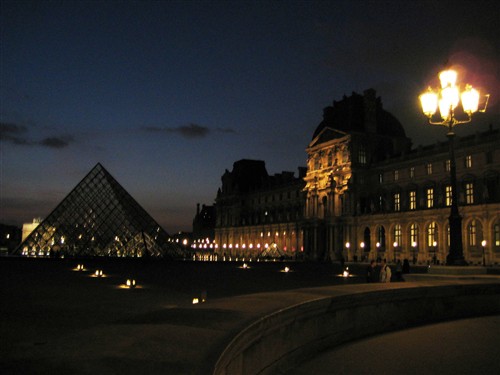
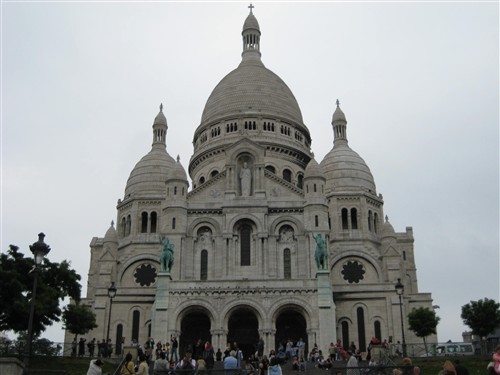 This city is so alive with its eclectic mix of art, architecture, and multiculturalism, all of historic significance. One has no choice but to dive right in and so, powered by adrenaline and cafe au lait, that’s exactly what we did!
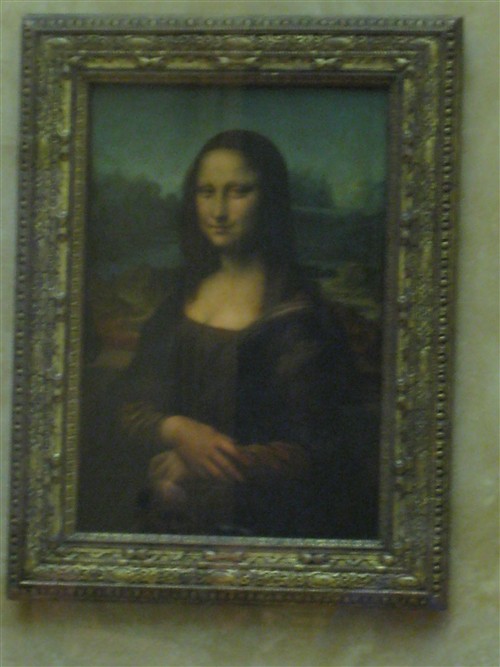 Musee du Louvre: Let me preface this next excerpt by saying that I am a total museum fanatic! When I check out a new town, the first thing I want to know is what kind of museums it has. This bias is important to note when I say, without hesitation, that every person should make it a priority to experience the Louvre at least once in his/her life. Once a fortress, the U-shaped building is lined with sculptures and the famed glass pyramid at the main entrance is a fine, if unexpected, contrast to the squared building. We arrived early and made a beeline for the Mona Lisa, rushing past brilliant works of art on both sides of the long corridors. The draw of the Mona Lisa has more to do with its fame than with the painting itself but nonetheless, a crowd of early-risers had already congregated around it. After snapping the required photos, we worked our way casually through the Pavillion Denon, which houses many of the awe-inspiring Renaissance oil paintings (my favorite) and sculptures from France, Italy and Spain. For anyone who has the slightest interest in the Christian faith, these oils are not only humbling for their artistic magnificence but they also bring to life the scriptures read during a lifetime of Sunday liturgies. (As a side note, I must confess that I am enamored with the perky but voluptuous female subjects of the Renaissance and am anxiously awaiting the day when that body-type is back in vogue. Until then, I’ll just keep turning down that second “croissant du chocolat”). Also unforgettable are the marble sculptures. I read The Agony and the Ecstasy some months ago and was intrigued by Michelangelo’s methods of studying corpses to learn the musculature of the human body. With that in mind, I studied these incredible carved marbles with an eye for muscle tone and curvature. The definition of each curling lock of hair, the torsos so exquisitely arched and curved that you think they are going to heave with breath; they are simply astounding! The art and architecture of the building itself are nearly as marvelous as the works inside. The brilliant, high ceilings are laced with murals with incorporated sculpture and, if you don’t spend a few moments admiring these masterpieces above, then you have done yourself a disservice. We have not even scratched the surface of the Louvre; we must DEFINITELY go back again soon!