Posted under Italy
Over the many months of this adventure, I have written occasionally about our experiences in the hostel world. In our attempt to travel so long and far, we have mostly restricted ourselves to youth hostels and budget hotels. To borrow a line from Forrest Gump’s mama, “Hostels are like a box of chocolates. You never know what you’re gonna get.”
After a long, wonderful day in Pisa and Cinque Terre, we arrived at our hostel in Bologna around nine p.m. There seemed to be some confusion regarding our reservation though we were never made privy to it as we stood patiently listening to the two clerks banter in Italian. When we finally received our keys – one for a men’s dorm and one for a women’s dorm – the clerk informed us that our rooms were in the other hostel just two hundred meters down the road. After some frustrated wandering in the dark, we found the “other hostel” and carried our load up to the second floor. I tried our Room 303 key in the 303 lock but the door would not open. I tried again. Natty tried while I stood aside, cursing under my breath. Finally, we summoned Aaron who confirmed that our key would not open 303 and then randomly discovered that our key would open neighboring 301. Hesitantly, we peered inside to find and empty room with three naked beds. With no hostel staff to be found in this “other” building and no phones, we agreed that it was too cumbersome, too late, and too cold to go back for a new key. We collectively decided that Nat and I would set up camp in 301 in hope that we would have the room all to ourselves.
 By ten p.m., we had made up our beds, showered and settled in. A brisk fall chill had swept through the whole building and, as I opened the wardrobe doors to look for heavy blankets, I discovered a pile of possessions behind door number two: leather jacket, white collared shirt, camouflage dob kit, some miscellaneous articles of clothing, and a large metal wrench! The items clearly belonged to a man and our heads began spinning with paranoid ideas of a crazy wrench murder with a key to our room. Why would a backpacker need a wrench?
After Nat and I had catalyzed each other’s fears into a paranoid frenzy, I knocked on Aaron’s door across the hall to warn him that by morning, he might possibly be a widower. He thought we were being melodramatic but gave us the key to his room and told us to come in if anyone suspicious entered our room in the middle of the night. We could re-evaluate the situation then.
We were fast asleep in our cozy beds when, at one a.m., we heard a key clinking in the lock. I pulled the covers up to my nose and pretended to be asleep meanwhile spying in the dark as the young male latecomer tiptoed around, trying to organize his things and make his bed in the dark. I kept my eyes on the area around Natty’s bed. If he raised a wrench, I would leap out and scream bloody murder before he had time to strike. I sensed that Natty was awake and playing possum as well. As it turned out, he never raised the wrench but rather stripped down to his skivvies and crawled into bed. My heart finally stopped racing after another half hour and I drifted back to sleep.
At four a.m., I woke again to the sound of a key in our lock, followed by the horrid stench of stale cigarette smoke. Two male backpackers, who had obviously been assigned to the two beds in 301 that Nat and I were occupying, opened the door (at four a.m.!) to find all the beds full. Nat and I lay perfectly still, pretending to sleep, waiting to see what they would do. They stood in the doorway laughing for a few minutes and then left. We heard them talking and laughing outside the door for a while and then they were gone. I felt bad for them but I was too cozy under my warm blanket to be a Good Samaritan. There were no further disturbances after that. Natty and I both popped up before our alarm went off, packed up quickly and quietly, and got out of there.
 We met Aaron in the hallway at the designated time, loaded the car, and laughed over breakfast at our crazy night in the hostel dorm. Natty has been officially initiated into the hostel world.
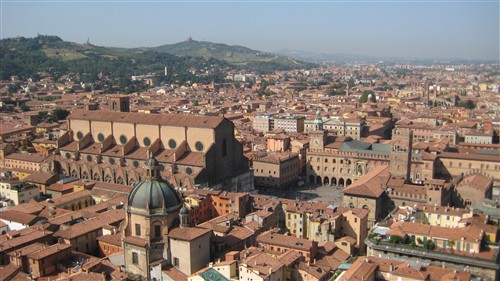
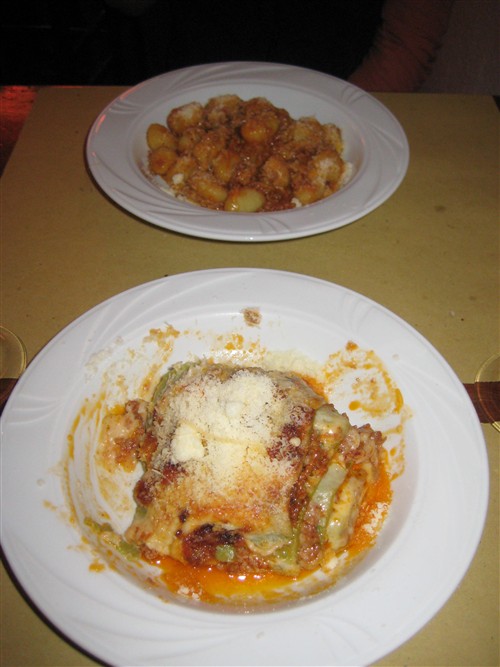
We spent the first half of the day walking around Bologna – the food capital of Italy. The few hours that we spent wandering through the city’s endless porticos and quaint university quarter were enough for all of us. Not surprisingly, the most memorable part of the day was the decadent lunch that we shared in a little “Mom and Pop” establishment with checkered tablecloths. The long walk and steaming plates of fresh made pastas in rich, meaty “Bolognese” sauce helped to soothe our nerves and lure our thoughts away from psycho wrench murderers. By the last bite of tiramisu, all seemed right in the world again.
Comments Off on Drama Bolognese
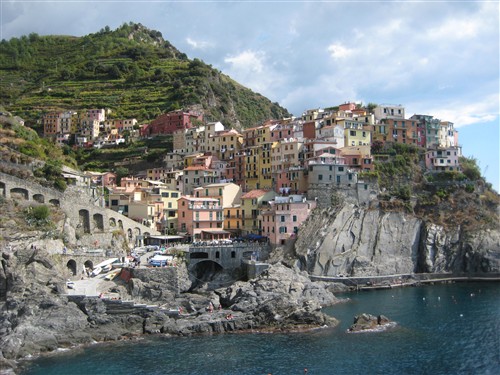
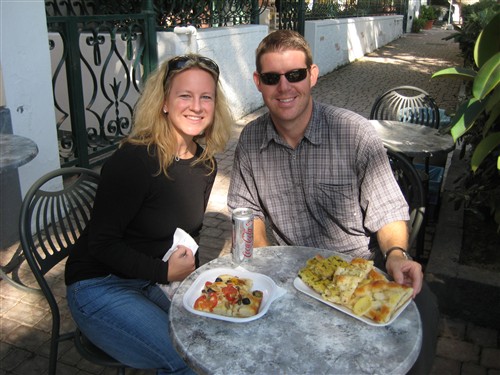 Next, we walked a scenic, one-kilometer trail, called Lovers Lane, between Manarola and the easternmost village of Riomaggiore, browsed around town for a while at the focaccerias and ceramic shops, and snapped countless shots of the photogenic villagescape before hopping a train to the westernmost village of Monterosso. Monterosso has the longest stretch of beach of all five villages and the ocean was beckoning us for a swim. Of the utmost importance, however, was finding Focacceria Enoteca Antonia which reportedly served fifteen kinds of focaccia from scratch. Our stomachs were rumbling and our mouths watering before we reached the doorway just across from the beach. All four varieties of piping hot, generously topped focaccia were unbelievably delicious, making it hard to refrain from stuffing ourselves silly. After that, I felt wholeheartedly that my Cinque Terre experience was complete.
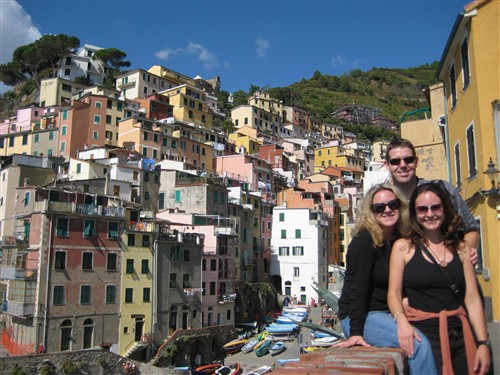 Leaving Cinque Terre was like losing touch with a good friend. You find happiness in other things but every now and then, when your mind stops spinning with the day’s distractions, your friend’s face flashes through your mind and warms you with fond memories. I hope someday to return to Cinque Terre, to wander the colorful streets of Manarola, to swim in the sea at Monterosso, and to explore the villages that we missed this time. In the meantime, I’ll rejoice in the quiet moments when my mind is free to swim with happy memories of a very special place.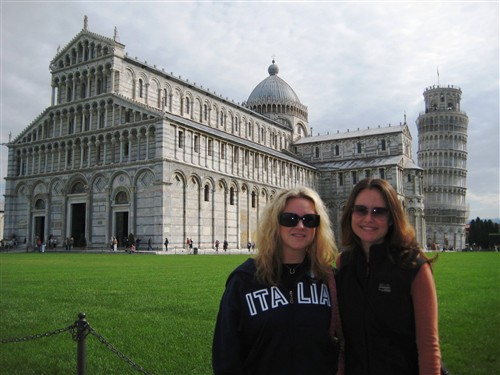
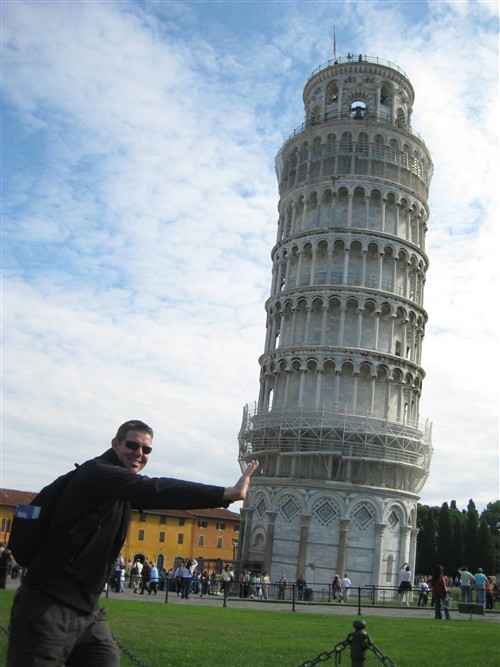 The Leaning Tower, which was designed as a bell tower for the Cathedral, began to lean even before it was completed. Shifting soil is the most widely suspected cause. In 1998, the ever-increasing lean was halted to 4.1 meters and successfully reinforced.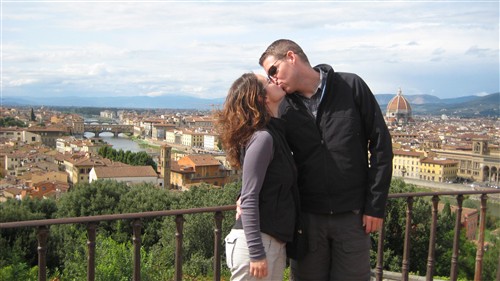
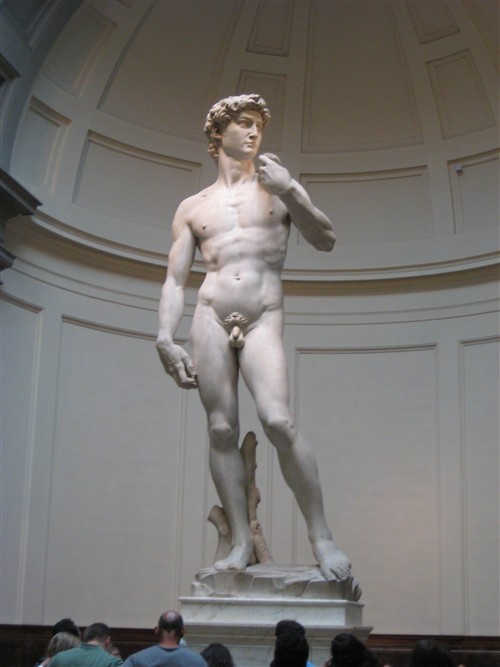 David, standing 5.16 meters tall in pearly white marble, bathed in perfect soft light, muscles tensed, with a mane like Adonis, is a vision of jaw-dropping perfection of the male form. I had seen countless photos of him and still he was more beautiful than I imagined. He is so striking that you cannot take your eyes off him; you can only stare at him in total awe. There were rooms of oil paintings surrounding him but I could not concentrate on them – I kept coming back to David. Soon I gave up on the idea of seeing anything else and took a seat, letting my mind envelope David completely. He was so magnificent that it almost hurt to look at him because you knew that eventually you would have to leave him. I realize that it sounds silly, this instantaneous obsession with an exquisitely carved piece of marble, but it wasn’t just me and it wasn’t just the women who fell in love at first sight. The men were equally smitten with David’s beauty and unabashed in expressing their admiration, which is likely due to his nonthreatening, aesthetically pleasing, classically small penis. In any case, we were all heartbroken when the time came for our inevitable departure and, even as I write this now, I feel the pain of loss and the hope that I will see him again.
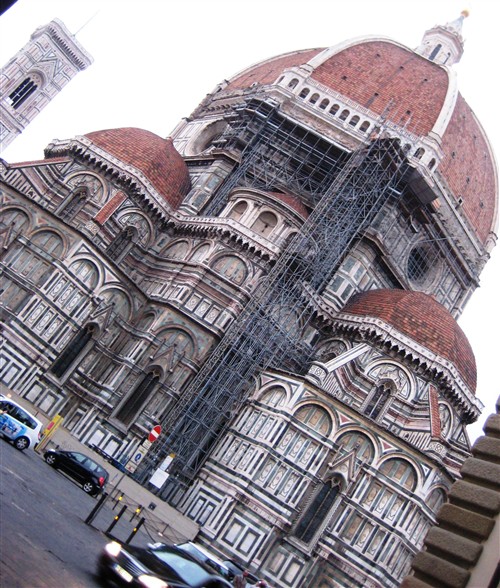 We attended a decidedly uninspiring Catholic mass at the Duomo, mostly because it happened to be starting when we arrived and because we thought the service would be beautiful. It was the Duomo after all! Disappointingly, there was no music and the sermon was so dry and monotone that we struggled to stay awake. We said our prayers and silently missed our wonderful church in Fort Worth, where our dear Father Michael Stearns delivered moving and memorable sermons that made us eagerly anticipate Sunday services.
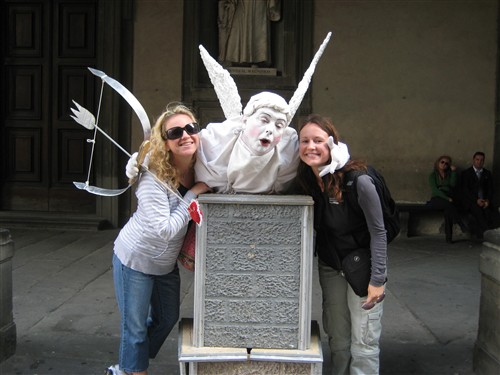 The best thing about Florence however, besides David, is just being in Florence. The neighborhoods are beautiful to walk through with their colorful weathered buildings and pretty café-lined piazzas. A walk along the Arno River that runs through the city affords some of the best views, especially around the Ponte Vecchio – a picturesque bridge with small jewelry shops lining both sides all the way across. But you haven’t seen Florence until you’ve seen it from Piazzale Michelangelo on one of the many hills that surround the city. Only from an elevated position can you take in the sea of red rooftops punctuated by the Duomo and the dreamy Arno, its small bridges reflecting on the lazy river’s glassy surface. We spent over an hour just looking across the cityscape.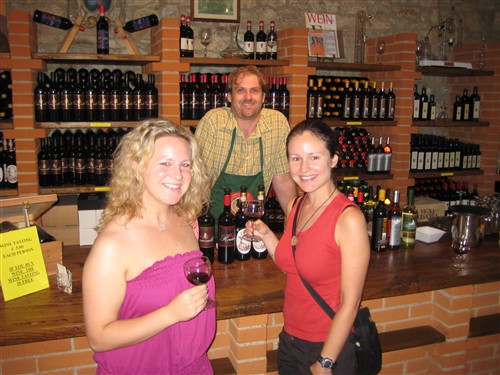
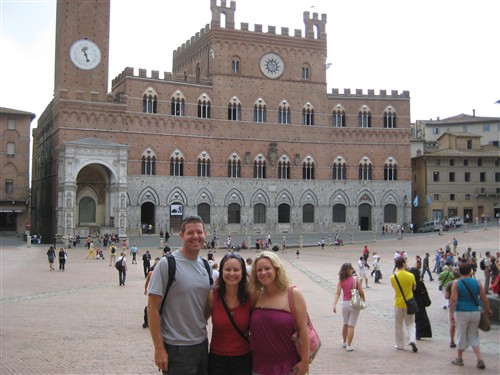 Siena flourished in the medieval period, as evidenced by its enduring Gothic architecture and narrow stone streets. Auto traffic has been banished from the town center, making for pleasant pedestrian walkways and a frustrating time for tourists with cars. We managed to find our way into one of the parking garages just inside the medieval city walls and walked uphill into the historic town center – the sloping, bricked Piazza del Campo. Il Campo, as it is also called, is Siena’s social center. The extraordinarily large piazza, surrounded by museums, shops and ubiquitous outdoor cafés, is a pleasant spot for a rest, despite the throngs of tourists (mostly Americans) who pour into it like herds of cattle. Italy is overflowing with tourists and we have encountered more American tourists in Italy than anywhere else in the world.
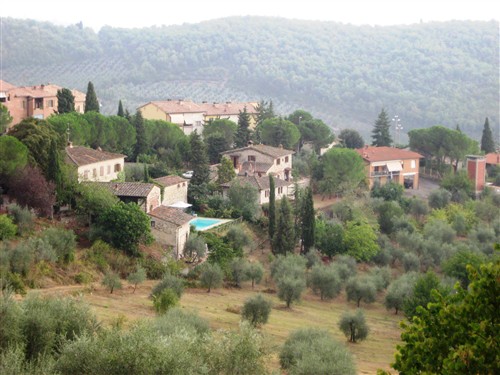 The Chianti region, also called Chiantishire, is divided into two sub regions – Chianti Sienese, and Chianti Florentine. Within the region are pretty little stone towns and surrounding the towns are the wineries. As it was already midafternoon, we chose a handful of wineries solely for their geographical location; we knew nothing about any of them. After our frustrating wine tasting experience in Bordeaux, I sent up a silent prayer that the Tuscan winemakers would be a bit more hospitable than the French. The Big Man delivered.
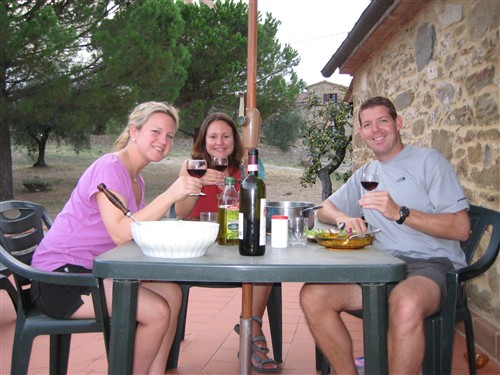 Inside the office, the woman set out three glasses on a desktop, opened a bottle of wine slowly and poured. It is always a bit nerve-racking at the tiny wineries where you’re the only ones there and the family owners conduct a tasting just for you. You know you’ll end up buying a bottle out of obligation and you pray that it’s halfway decent and not too expensive. We each took a sip and smiles spread across our faces. It was fabulous! We happily bought a bottle and then one more of her more expensive vintage which she offered to open for us to taste but we declined, not wanting her to open another for just one taste. It turned out to be the best bottle in our booty from Chianti – and it was a big booty! In a matter of a few hours, we had filled the back seat of our crappy blue Fiat Punto with wine bottles from four different wineries and were on our way back to our wonderful house at Castello di Selvole. It was a damp, chilly night so we cooked another decadent Italian feast and devoured it with our bottle Monteraponi Chianti Classico Riserva “Il Campitello” D.O.C.G. in the warmth of our cozy kitchen.