Posted under Spain
 Never again will we underestimate the contributions of the Spanish to the overall beauty of the world…and I’m not just talking about the dark hair, Mediterranean skin and heaving cleavage. We have waded into the Barcelona art scene, a playground of Picasso and Modernista architect, Antoni Gaudi. With six nights to play, we felt sure that we could visit Barcelona’s most impressive sights with plenty of time leftover for sangria and the beach. We were mostly right.
We arrived in the late afternoon and went directly to La Rambla, a beautiful tree-lined pedestrian walkway lined with cafés and restaurants. Barcelona’s most famous street was thronged with locals and tourists alike, strolling the lane and absorbing the vibrant activity. Interspersed with the fresh flower stalls, souvenir stands, small pet shops and street artists, costumed street performers drew the biggest crowds. Nowhere have we seen more elaborate costumes outside a theatre than we have on La Rambla. The street was full of life and we would stroll it nearly every day during our stay.
The next day, we began by walking through the tangled medieval stone alleys of Barri Gotic, Barcelona’s Gothic quarter, walking through its magnificent Gothic cathedral and then, the highlight of our day – the Picasso Museum. Barcelona’s most visited museum is housed in five medieval stone mansions. The corridors are dim and cavernous while the galleries are bright and airy to showcase the work. The museum exhibits Picasso’s earliest works, including oil paintings on postcard-size pieces of wood, sketches, sculptures, many works from his famous Blue Period and a tireless study of Las Meninas by Diego Velazquez. The museum was fascinating because it displayed many works from Picasso’s earlier, more traditional style of painting and followed his transition to the Cubism for which he is most famous.
The artist who has left by far the most stunning and visible fingerprint on Barcelona is Antoni Gaudi (1852-1926). He was a pioneering architect of the Modernista period in Spain, during which innovative artists showcased bold, modern designs in architecture as symbols of the rising affluence of the Spanish bourgeois.
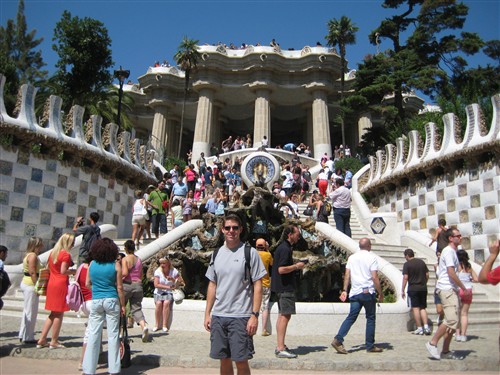 We devoted an entire day to admiring Gaudi’s brilliant work, beginning with a visit to Park Guell. The project began in 1900, on a piece of prime real estate overlooking the sea, as a housing development for the wealthy but ended fourteen years later as a commercial failure. The city later purchased the incomplete development and turned it into a public park. From the metro stop, a series of escalators carried excitable tourists up the side of a steep hill. Once inside the park, landscaped gravel walking trails wound around the hillside overlooking the Mediterranean. The trails eventually led to the remnants of Gaudi’s creations for the original housing development project: two “gingerbread” gatehouses, a colorful, curvy plaza and 3km of roads, walks and steps. The park was a beautiful place for a picnic and many people had copped a squat in the pillared pavilion at the entry while musicians played for tips. The plaza was a large open area surrounded by a squiggly mosaic bench and it was there that I really began to visualize the potential of the original project. It would have been like living in a fun house with pretty touches everywhere to make people smile. That was Gaudi’s way.
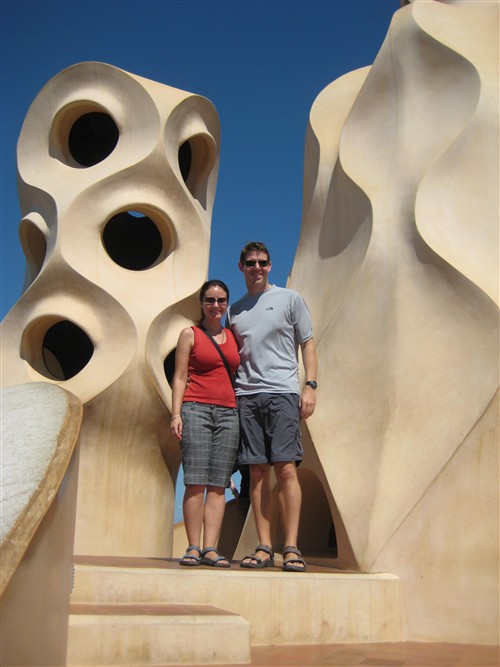 After the park, we moved on to another one of Gaudi’s creations – La Pedrera – an apartment building commissioned by a well-to-do couple. “La Pedrera”, meaning stone quarry, was a nickname given to the building because it looks like it is carved out of stone. The completed building consists of two blocks of apartments, each with its own interior courtyard, and with one continuous façade that curves around a corner lot. An apartment on the fourth floor was decorated as it would have been in the early 1900’s, when it was inhabited by the Barcelona bourgeois. The floor plan encircled a large interior courtyard, filling the apartment with light. From the swirling ceilings and parquet floors to the moulding, door knobs and other ornamental embellishments, every detail of the interior has Gaudi’s personal touch.
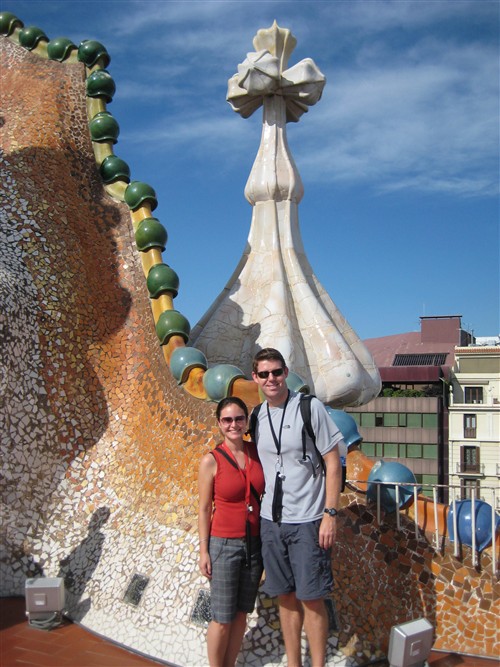
Just a few blocks down the road, Casa Batllo was my favorite Gaudi masterpiece. It was a remodel of an existing house, commissioned by the Batllo family, and created by Gaudi with an “under the sea” theme. The façade is a vision of waves in blue, mauve and green tile, leading up to an uneven blue-tiled roof. Inside, everything waves and swirls – hardly a single straight line can be found – and the rooms are full of color and light. The rooftop terrace, which overlooks pretty Passeig de Gracia, is a surprising delight with mosaic chimney sculptures, multiple levels, and a small cavernous room with a water feature that makes an echoing sound of rain. Every aspect of Casa Batllo is beautiful and functional and brilliant. It is a dream house!
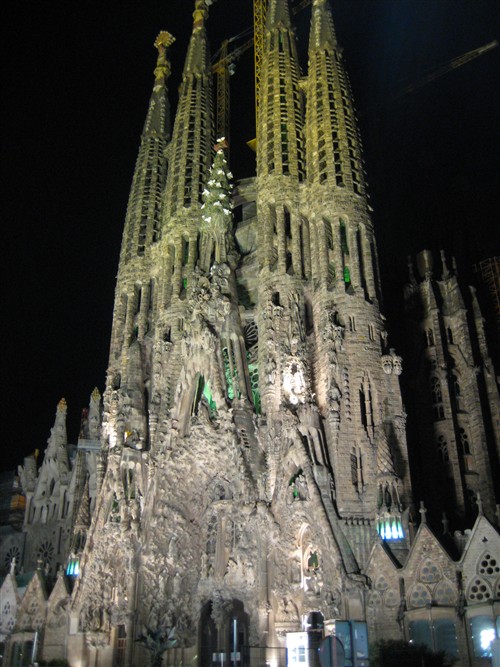 Exhausted but still trudging along, we made our way to Gaudi’s most famous creation and Barcelona’s most famous work-in-progress: La Sagrada Familia. Begun in 1882, the church was the project to which Gaudi dedicated the latter part of his life and was left incomplete when Gaudi died in 1926. It is an awe-inspiring synergy of a traditional Gothic design and Gaudi’s shocking Modernista flair. Stunning sculptured façades seem to jump off the church and the narrow pointed towers are breathtaking to behold. La Sagrada Familia looks more like a fairy tale castle than a church. Work continues slowly, according to Gaudi’s original designs. The completed structure will be a glorious monument to an artist who left an unforgettable mark on Barcelona. The photos simply do not do it justice. It is a church unlike any the world has ever seen.
Antoni Gaudi has been the highlight of our visit to Barcelona. His masterworks light up the city. They make people point and smile. He was unconventional and inventive. His sense of humor and zest for life are manifest in the many works he has left for the world to enjoy.
Comments Off on So Gaudi
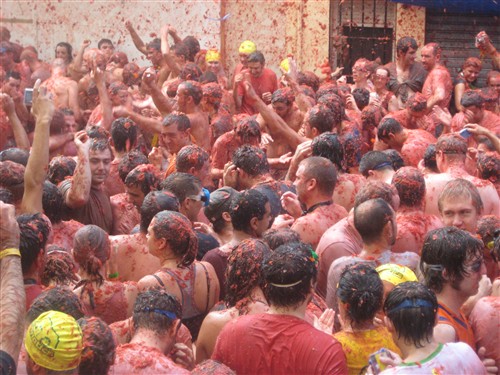
 We checked into our three-star hotel in Valencia – the cheapest room we could find during La Tomatina – joking that it was three more stars than we usually get. The tomato fight takes place in Buñol, a town of about 8,000 people, 40 kms away, but Buñol has little in the way of accommodation so everyone stays in Valencia and trains in for the event, with the exception of those who drink all night in Buñol the night before and sleep on the street. That’s not really our style.
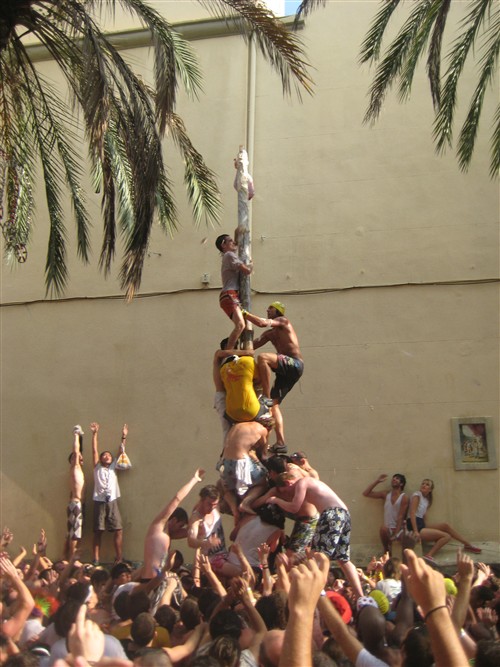 The ham pole went up around nine. An integral part of the annual tomato fight, a telephone pole with a ham leg tied to the top is fastened into the ground. The pole is slathered from top to bottom with a thick layer of what looked like animal lard but smelled more like soap. Per tradition, the crowd must climb the pole and cut down the ham before the tomato fight can begin. With two hours and a little coordination, that should be no problem, I thought to myself. Wrong!
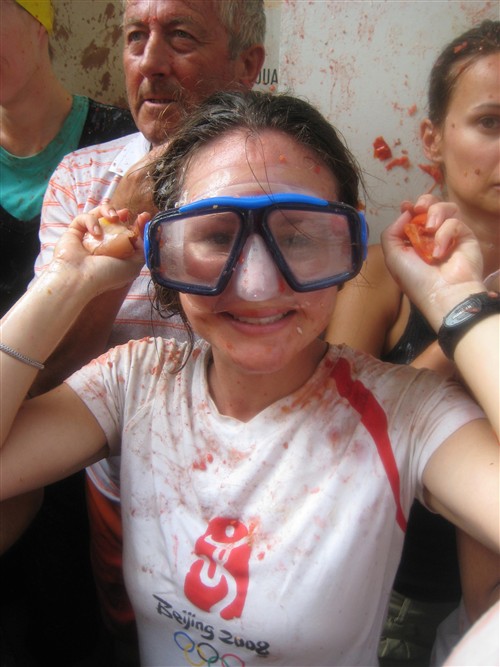
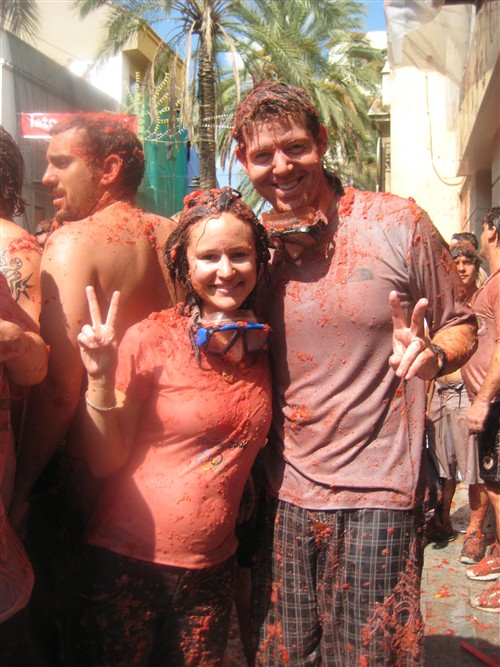 Thankfully, Aaron and I had established a rendezvous point and found each other again shortly before the bell rang to announce the end of the tomato fight. We were exhilarated, exhausted, and covered in tomato from head to toe. It was caked in my hair, stuck to our clothes, and coming out of our ears. Luckily, our scuba masks had worked perfectly, leaving our eyes the only body part immune from the mess. As the crowd shuffled slowly back uphill toward the train station, the sun which had remained sympathetically hidden behind the clouds all morning, made its glorious entrance and I began to feel the acidity of the tomatoes on my skin. Many good-spirited locals sprayed hoses into the crowd but there were so many people vying for the same sprinkles. We arrived at the train station to find long lines everywhere…long lines for the now disgustingly vile portable toilets, long lines for the makeshift showers, and long lines for the trains. We paid our dues in all three lines over a span of two hours before finally boarding the train back to Valencia.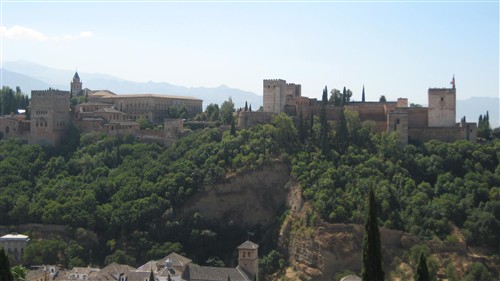
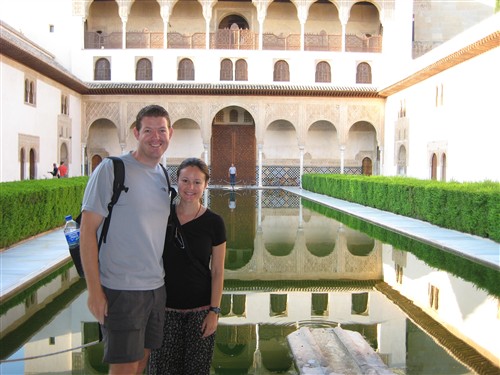 The palace was exquisite. The rooms were elaborately decorated with mosaic tilework, carved wooden ceilings, molded stucco walls with intricate lace patterns, and traditional Arabic calligraphy. There were picturesque courtyards with manicured gardens, reflecting pools and a labyrinth of covered corridors connecting it all. The design and décor of the Palacio Nazaries was similar to the other medersas and Arab-Islamic palaces that we’ve seen in Morocco and southern Spain but we were awed by it nonetheless. The sheer magnitude of the Alhambra was impressive. The Generalife, or architect’s garden, was a pristinely manicured labyrinth of hedged corridors, arbors, cypress trees, and flowers of every imaginable color. Its magic compelled even the most macho of men to pose giddily for photos among its storybook backdrops.
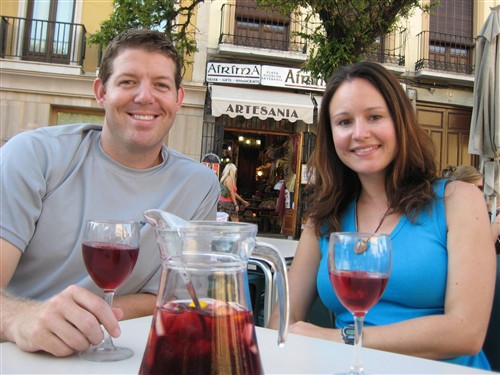 The Albayzin, the old Muslim quarter sprawling up a hill facing the Alhambra, afforded the best views of the fortress-palace. The Albayzin was a maze of narrow alleys meandering within the old stone ramparts. The neighborhood, though largely residential, had lovely plazas with outdoor cafes, small shops selling souvenirs and Moroccan imports, and remnants of mosques-turned-churches. The five kilometer walking tour, winding through zigzagging streets, up and down the hillside, was a great opportunity to stretch our legs and work off some of that gelato.
 After a casual lunch at one of the ubiquitous outdoor cafés, we made our way to Cordoba’s most impressive sight – the Mezquita, meaning mosque in Spanish. The Mezquita is also commonly referred to as the Cathedral of Cordoba, which seems contradictory until the story of its current incarnation unfolds.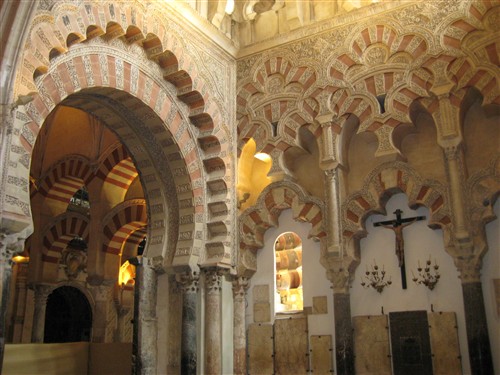
 From Tangier, the fast ferry carried us only 35 minutes to Tarifa on the southern coast of Spain but disembarking that ship was like stepping into an old familiar world…and that world was full of boobs! Hooters, knockers, jugs, chi chis…whatever you want to call them, Mediterranean sun-tanned boobs were bulging out of push-up bras, bouncing and jiggling above plunging necklines. After Morocco, it was a bit of a reverse culture shock but we weren’t complaining. Although these were my first steps on Spanish soil, I felt myself thinking, It’s good to be back! Only when you’ve spent time in an ultra-conservative environment, like a Muslim community or perhaps a convent, do you come to truly appreciate the ways that women beautify the earth like bright summer flowers.
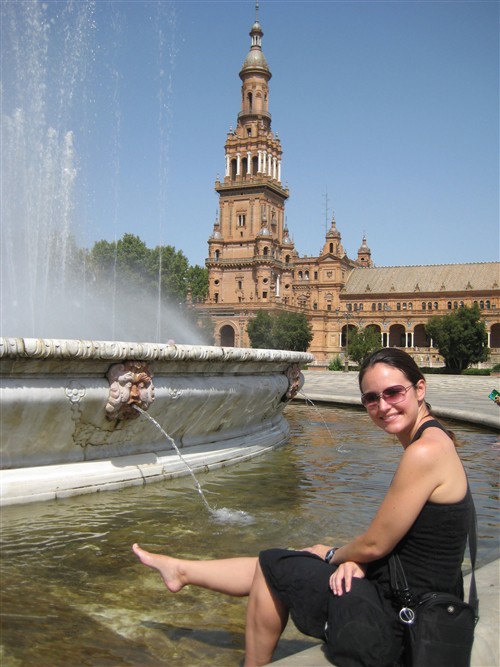 The Alcazar, a palace complex expanded and modified over eleven centuries to suit the tastes of the Muslim and Christian rulers, is a polyglot of Arab-Islamic and European architecture. The main building is distinctly Arabic – a grand rectangular structure built around an open garden courtyard. The interior walls are adorned with beautiful tile work, intricate lace patterns and Arabesque inscriptions etched into plaster. Stucco stalactite detail drips from arched entryways. Marble and granite columns abound. Elaborately carved and painted wood ceilings loom overhead. The style is identical to that of the palaces and medersas of Morocco. The tone of the design is cool, quiet, and clean.
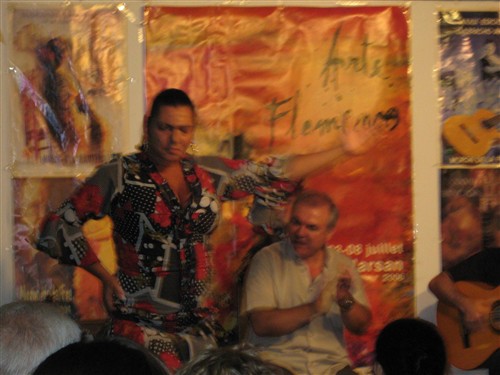 One guitarist, one singer, and one buxom dancer sat facing the beer-fueled crowd. The guitarist strummed the intro. The singer – a middle-aged man who was also the barkeep – intoned a passionate, soulful declaration while he and the buxom dancer clapped out a flamenco beat. A few more bars and then, suddenly, she was up! Clapping, stomping, and waving her arms, staring seductively through the crowd with her coal-black eyes. She was aged, heavyset, clad in a too-tight ruffled number with bulging cleavage, many would say unattractive, but she was all attitude. Her eyes were bold, her hips confident. She owned her audience who roared with generous applause. We were immediately drawn in by Spain’s spicy flamenco scene; however, despite our siesta, our thirty-year-old bodies were resisting the transition to night mode. We left just as the room was steaming up from the adrenalized performance and hit a tapas bar on the way “home”.