Posted under China
On our last day in Beijing – we were booked on the night train to Xi’an – the sky was gray and drizzling. We stayed around the hostel until our noon checkout time, then stored our bags in the luggage room and went out for the day. There were several family-owned restaurants in our alley and an older man – probably the grandfather – had sat outside the door of his restaurant yelling “Ni hao!” (hello) at us in a loud, gruff voice everyday as we passed. It had always made us smile and we decided to stop in for an early lunch. No one spoke English, of course – we had forgotten our guide book and couldn’t even figure out how to order a bottle of water – but everyone was friendly and smiling and the whole family came over to help us order. We ended up ordering enough food to feed a family of five, the highlight of which was a foot-high haystack of shoestring potatoes. We left fat and happy.
Contrary to everything we had heard about the Chinese lack of receptiveness to non-Chinese-speakers, after three days in Beijing, we could not help but notice the pre-Olympic excitement in the air and the genuine desire of the locals to make foreigners feel welcome. People stopped us on the streets to offer help; we were beckoned into restaurants and the signage around Beijing had clearly been updated with English titles. This is the first time in twenty years that the Olympic Games have been held in a developing nation and China is determined to show its best face. The entire city is under construction and the ubiquitous presence of the world’s largest military is keeping watch.
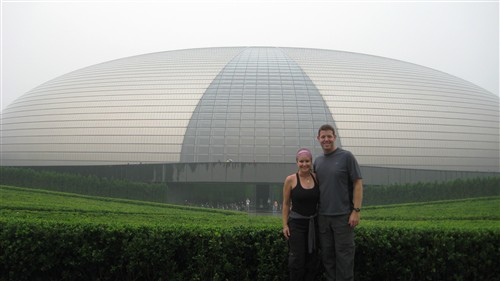
We started our day by walking to the newly constructed Grand National Theatre, colloquially referred to as The Egg. Located just west of Tiananmen Square, behind the Great Hall of the People, the theatre is a titanium and glass dome surrounded by a round moat. The reciprocal image of the dome on the lake moat creates the illusion of an egg. The dome entrance is a single walkway which dips under the moat, preserving the continuity of the design above. Intended to rival such signature structures as the Sydney Opera House, Beijing’s Grand National Theatre is an awe-inspiring vision of modern architecture. The cost of the project was 3.2 billion Chinese Yuan Renminbi, or about US$465 million, a figure which implies a goal of dynastic legacy rather than profitability. One cannot deny the symbolic power that this structure exudes or the feelings of inspiration and awe that overwhelm the senses on a stroll around the circumference.
We headed next to the Wangfujing district to spend some time wandering through the shopping mall and restaurant lined streets. The Saturday crowds had descended on Wangfujing and we sat at one of the outdoor soda shops to rest our feet and watch the world go by. Aaron had been talking about seeing two of the other Olympic venues – the Beijing National Stadium and the National Aquatics Center – but two hurdles stood in our way: the venues were too new to be shown on any of our tourist maps so we weren’t sure how far they were; also, we had not yet taken a taxi in China and were intimidated by the language barrier. After a recent experience with a dishonest taxi driver in Hanoi who, after agreeing to charge according to his meter, drove us in circles around town before stopping at our destination, thereby attempting to extort four times the correct fare, we were hesitant to take a taxi to a destination of unknown distance. After much deliberation, we agreed to go for it anyway.
With only a few hours before we needed to depart for the train station, we hurried to the end of Wangfujing where we had seen an abundance of taxis. It took us a while to get one to stop – our foreign faces seemingly a deterrent – and when a driver did finally stop, we soon discovered that Chinese taxi drivers were clueless about the Olympic venues, or at least did not comprehend the English names for them. This is going to be a big problem for the Olympics, I thought to myself. Finally, we found a driver who, after many repeated utterances of the word “Olympics” and grand gestures indicating large buildings, pulled out a handy little book from his glove compartment. It was a government-issued Chinese taxi driver’s guide to the Olympics and contained photos of all of the Olympic venues. Aaron pointed to the correct photos, the driver nodded, and we were off!
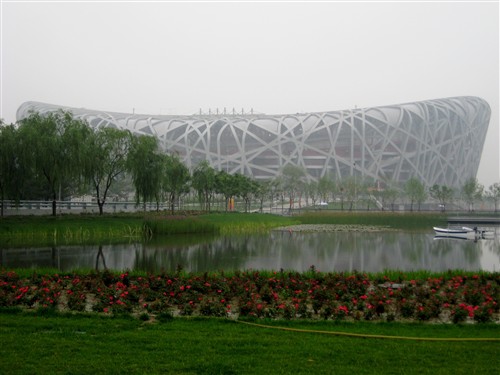 The Beijing National Stadium, a.k.a. the Bird’s Nest for its architecture, will be the site of the opening and closing ceremonies of the 2008 Summer Olympic Games as well as the main track and field events. The area around the Bird’s Nest was fenced off so we could not get very close to it. We had the driver stop for a few minutes along the side of the road so that we could join the other gawkers. The building was a massive display of modern architecture, in which soaring curvature has replaced the maximum functionality of space as the primary initiative of the endeavor. The gargantuan steel structure invokes shock and awe in the beholder rather than admiration of beauty in the traditional sense. It is inarguably an impressive artistic and architectural feat.
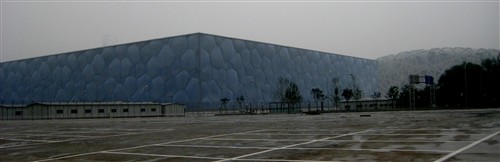
Directly adjacent to the National Stadium was the National Aquatics Center, commonly referred to as the Water Cube, which will host the swimming, diving, and synchronized swimming events. Masterfully designed to resemble the foam created by soap bubbles, the structure is made of steel and Ethylene tetrafluoroethylene (EFTE), a kind of plastic that “allows more light and heat penetration than traditional glass, resulting in a 30% decrease in energy costs” (http://en.wikipedia.org/wiki/Beijing_National_Aquatics_Centre). The EFTE pillows take on a light blue, watery hue, similar to that of the glassy surface of Lake Kunming, and you cannot help envisioning grand swimming pools inside. The Water Cube was also roped off, denying us a closer look, but we will definitely be watching the Olympics this year to get a glimpse inside this and Beijing’s other spectacular venues.
We had our driver deliver us back to Wangfujing for our “last supper” in Beijing at the famous Quanjude Roast Duck Restaurant. We sat down for what would be our fanciest Chinese dining experience amid a sea of upper-middle class Chinese families. We looked around the dining room as roast ducks were being sliced and diced by hospital mask-clad chefs in tableside presentations. The menu listed every imaginable preparation of duck, with all of the questionable body parts highlighted as delicacies. Our waitress assured us that a half-duck would be sufficient for both of us and we ordered a side dish of mashed potatoes. Naturally, the mashed potatoes arrived long before the duck and, to our surprise and disappointment, they were served chilled. Life is like a box of chocolates…
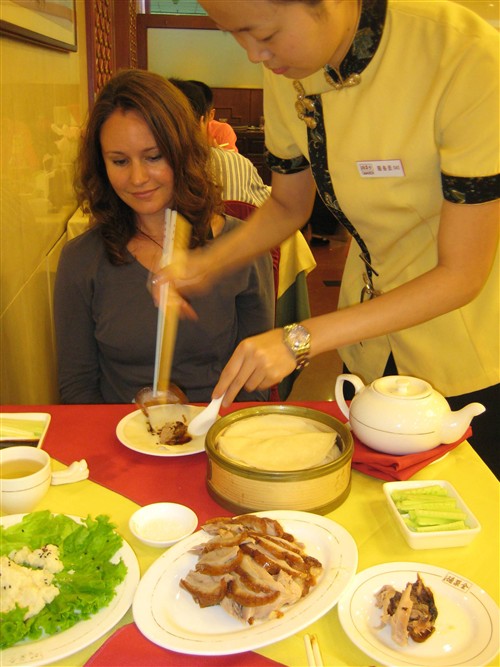 Our duck arrived after about thirty minutes and the chef began carving it up. Due to my little carcass phobia, I kept my eyes on Aaron and prayed that nothing that arrived at the table would resemble a living animal or its internal organs. We were served a few slivers of flavorful skins first, which we happily doused in plum sauce. Next, the sliced meat was presented in an expertly carved pile. Thankfully, the carcass was then taken away. The waitress demonstrated the traditional assembly for Peking duck by dipping two pieces of meat into the plum sauce and placing them in the center of one of the rice pancakes. She then added a sliver of spring onion and a julienne cucumber and folded the pancake neatly around the filling, using my chopsticks. Dinner was delicious! We finished just in time to race back to the hostel, collect our bags, and head to the train station.
We found Beijing to be a fascinating city, one that has embraced many aspects of modernism while clinging to its colorful culture and traditions. The modern Chinese have completely embraced Western dress; the women adore high heels, Louis Vuitton handbags and trendy, layered hairstyles. The McDonalds, Pizza Hut and Kentucky Fried Chicken restaurants do a thriving business and Chinese children are showing the first signs of childhood obesity. Beijing has all the signs of civilization. The one thing that I (the self-appointed Potty Police) just cannot get over is the abundance of squat toilets. Here we go again. Though I am admittedly impressed by the number of public toilets in Beijing, I am outraged by the fact that they are almost all squat toilets and rarely have toilet paper or soap. If there is paper at all, it is in a single common dispenser outside of the stalls. Even McDonalds has squat toilets! It seemed like such a gross contrast to have magnificent modern buildings and impressive infrastructure everywhere…and then squat toilets.
A young woman whom we had met earlier in our travels had formerly done a work study in China. She told us that, at her office, the squat toilets were all replaced with Western toilets. Subsequently, the Western toilets were all ripped out and the squat toilets replaced because the Chinese were squatting on the toilet seats rather than sitting on them, leaving dirty footprints on the toilet seats. The moral of the story was that the Chinese simply prefer squat toilets to Western toilets! In my opinion, this is the most difficult part of China to digest because the squatters are more prevalent in China than anywhere else that we’ve traveled. The disgusting public smoking, uninhibited spitting (and I mean hocking up big, nasty loogies), pollution, mediocre food quality and rampant overcrowding that results in inhaling more people’s breath (and germs) than ever before…all of these things I can handle with relative understanding. Squat toilets are my nemesis. I find the notion of squatting like a dog to relieve oneself totally uncivilized. While some people may determine restroom visits to be a small part of their day, I believe that when the Western world, accustomed to their clean toilettes with paper and soap, descends upon Beijing for the Olympics, the Chinese squat toilets will be reviled by all.
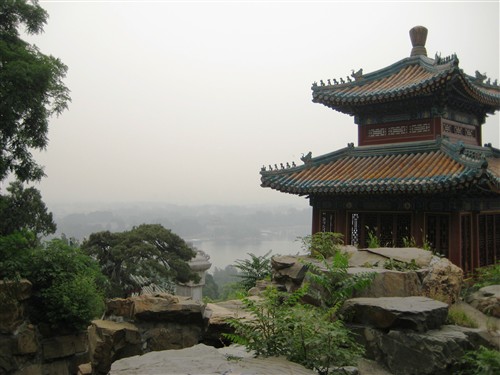
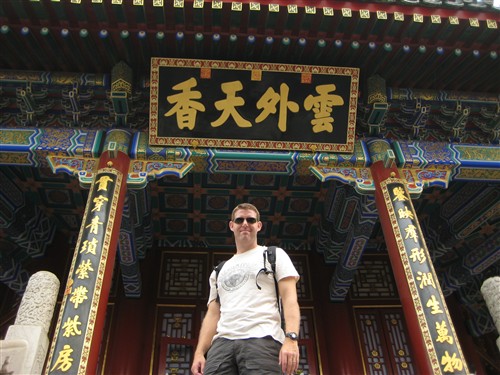 The architectural design of the entrance to the Summer Palace was strikingly similar to that of the Forbidden City – a pagoda-like structure ornamented with the same ornate patterns of red, gold, green and blue. Once inside, we wove our way through the throngs of tour groups – each group with its own matching hats – in the courtyard. We emerged at the edge of the sparkling blue Lake Kunming, which occupies three-quarters of the palatial grounds. A bluish-purple haze – likely a combination of clouds and smog – cast a mystical glow across the glassy surface of the lake and obscured the “templescape” on the northern shore. An elaborately decorated ferry cut through the glass as it carried visitors back and forth across the lake while paddleboats and rowboats careened about on the breezeless day.
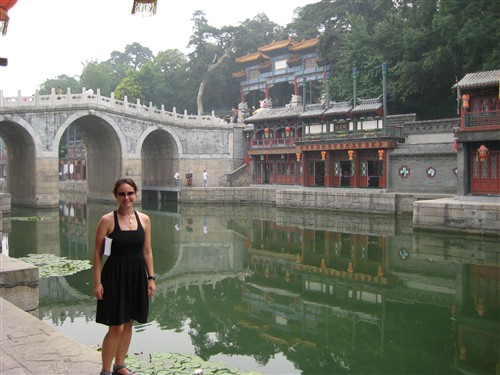 Past the dancers, we came upon my favorite area of the Summer Palace – Suzhou Street. Crossing an arched stone bridge, we caught our first glimpse of the traditional, red-laced shopfronts edging around a narrow canal. Suzhou Street was created as a replica of Jiangsu, a famous Chinese canal town. Its charming shopfronts were fully functional with tea houses, souvenir shops, Chinese calligraphers, painters, and photography studios in which visitors could dress in traditional Chinese silk costumes. A lone flute-seller demonstrated his instrument on the walkway, filling the entire canal town with his eerie, tranquil notes. We took a single leisurely lap around the riverside walkway and were beckoned inside every shop, gallery and tea house that we passed, which detracted only slightly from the charm of the experience.
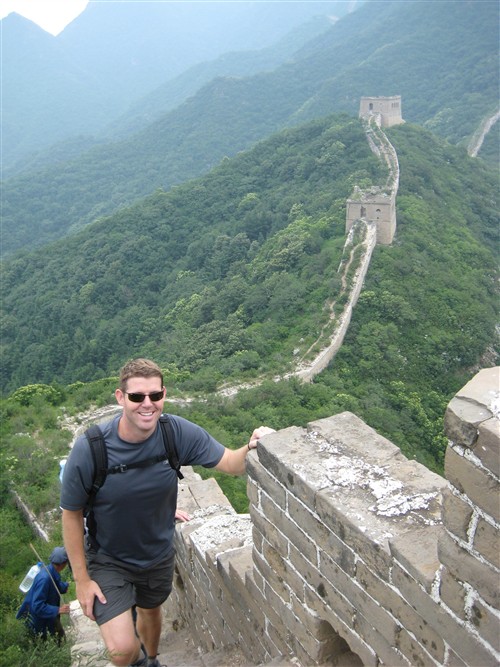 Our Chinese guide was a little old man (perhaps sixty, though it is always hard to tell with Asians because they age so well) who spoke only one word of English: “okay”. We never caught his name; he was introduced simply as “the guide” when we picked him up on the side of the road. From now on, I’ll refer to him as Wang because he needs a name. Wang led our group in slow, measured steps up the mountainside, on a narrow, rocky trail encroached upon by thick brush from both sides. The slow but steady pace of the ascent made the otherwise rigorous terrain quite manageable, even for a little whiner like me who hates steep inclines. Wang clearly felt no sense of urgency and everyone in the group was in fine spirits.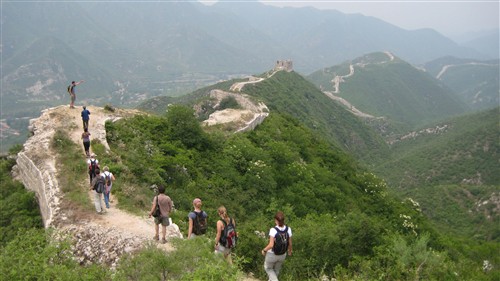
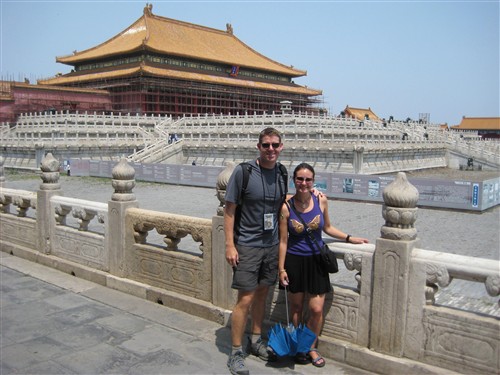
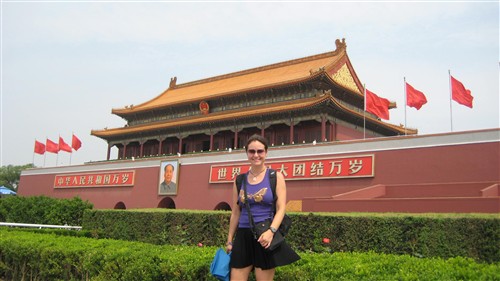
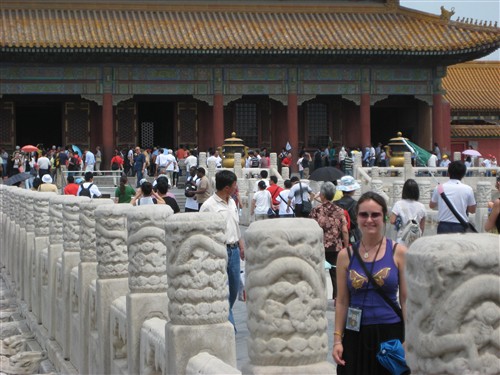 The Forbidden City lies adjacent to Tiananmen Square. We headed toward the entrance, drawn to the colorful rooftop of the hall towering over the Meridian Gate. We rented an audio guide with a built-in GPS system and walked inside. The Imperial Palace, now know as the Forbidden City because it was off-limits for 500 years, was constructed during the Ming dynasty in the 15th century and served as a secluded palace home to two dynasties of Chinese emperors: the Ming and the Qing. The compound was designed such that the emperors rarely had to leave its decadent, insulated confines. With a 2.6 million square foot area of halls, galleries, gardens and courtyards, it is not difficult to imagine living an entire life inside the foreboding city walls. The emperors held court, gave public speeches, received felicitations on special occasions, hosted foreign dignitaries, studied, amassed a great many treasures and lived their daily lives within the city walls. The main areas of the city were its various great halls, built in perfect alignment through the center of the compound. Each hall had a specific function and was richly decorated in blue, green, red and gold. The design of the halls and their opulent adornments were intended to acknowledge the divine right of the emperor to rule the people.
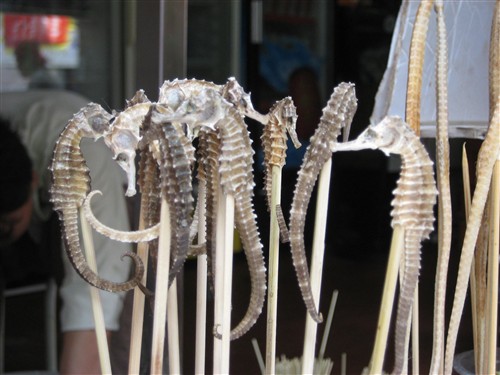 We had worked up quite an appetite and decided to walk to a narrow side street in the nearby Wangfujing district, nicknamed “Snack Street”. In reality it was more like an alleyway ornamented with a large colorful archway at the entrance. It was lined with food stalls and a few small restaurants. One vendor displayed skewers of scorpions, seahorses, snakes, starfish, and a variety of insects which could be fried upon request. I found it quite disturbing, especially the seahorses, which are so rare and beautiful. We passed on the exotic fare and were instead lured into one of the restaurants where there was no menu whatsoever and no one spoke English. We managed to order some dumplings and noodles (although we actually got noodle soup instead). We have found the food in China to be oily and mediocre so far but, after a long, hot day of walking in the Forbidden City, we were happy just to sit.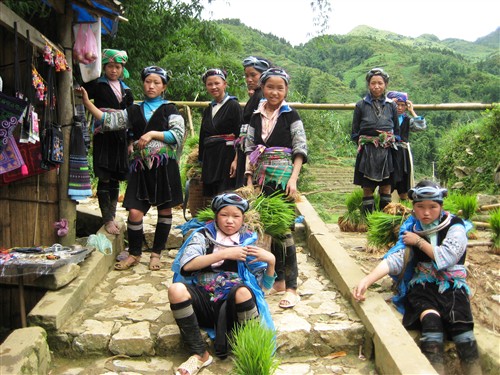
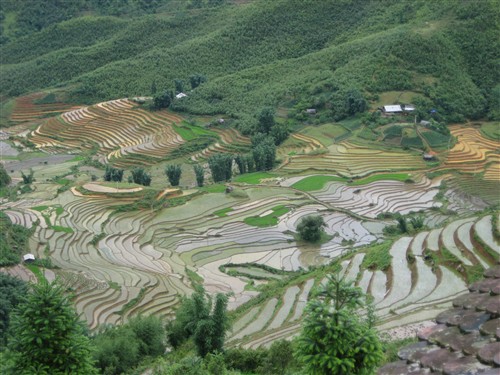 Sapa is known for its many opportunities to trek among the dazzling contoured valley and indigenous villages. From the city, we found one of the trailheads and started down into the valley. The views were truly amazing with mountains and fields covering the entire spectrum of green, cool white mist rising and falling over the peaks, and sunlight dancing off the glassy surfaces of the waterlogged rice paddies. We watched farmers planting seedlings and a group of young Black H’mong girls preparing to work in the fields. Cows and water buffaloes grazed the fields and two very pregnant sows provided a snorting roadblock. Every turn on the path opened up a new breathtaking view.
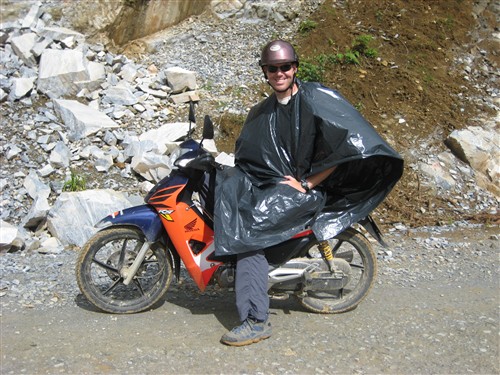 Suddenly, without any warning at all, the front tire of the motorbike slid in the mud, diminishing Aaron’s ability to control it. Engrossed in the scenery, I didn’t realize what was happening until we were falling, in slow motion, on our left side. We hit the ground with a thud, landing in a puddle of mud. We had been going slowly so the impact was minor but I felt the outside of my left kneecap hit the ground first. It hurt, but not badly. Instinctively, I crawled in the mud away from the bike and turned to see Aaron’s leg trapped under it. I screamed in panic but he assured me that he was okay and immediately moved to lift the bike off his leg. It took us a few minutes to get over the initial shock and determine that we were both okay. I had broken the fall with my hand, which had a few small cuts. Aaron had landed on his hip and had some bloody scrapes on his left arm. I must have been in a mild state of shock because when Aaron asked me if we should get back on the bike, it seemed like an utterly preposterous notion. It occurred to me then that we had to get back on the bike. No one was going to drive along this remote mountain road in his Ford pickup and offer us a lift.