Posted under Vietnam
I must backtrack now to talk about the fragments of Ho Chi Minh City and the surrounding areas that we managed to take in amid the chaos of the Chinese visa ordeal. We toured the War Remnants Museum and the Reunification Palace; visited the famous Cu Chi war tunnels and a government-sponsored workshop employing victims of Agent Orange. In order to better comprehend the significance of these war-related sights, a brief history of Vietnam is necessary. The facts and figures interspersed in the following narrative are cited to Lonely Planet Vietnam, August 2007.
While the American War in Vietnam remains one of the most significant and controversial military endeavors in American history, it is perceived by the Vietnamese as the expulsion of another in a long line of foreign invaders over thousands of years. Vietnam’s geographical location along the sea trading route between China and India made it a valuable conquest. As such, the Chinese dominated Vietnam from around the 2nd century B.C. through the early 10th century A.D. until the Vietnamese capitalized on the fall of the Tang dynasty in China and fought successfully for independence. Two centuries later, Mongol warrior Kublai Khan seized control of China and made a play for Vietnam but his soldiers were defeated by the Vietnamese resistance. The Chinese returned again in the early 15th century and seized control of Vietnam for what would be an oppressive and bloody but short-lived occupation.
The 17th and 18th centuries brought the rise of the powerful Vietnamese Trinh Lords who ruled the north and the Nguyen Lords who ruled the south. Both groups wrestled for control of Vietnam, supported respectively by the Dutch and Portuguese traders who undoubtedly had their own interests. The Nguyens emerged victorious. Under the Nguyen emperors, Vietnam seized large areas of neighboring Cambodia and Laos, facing down the Thai army in the process.
The French arrived militarily in 1847, initiating what would be four decades of French colonization and near-slave labor of Vietnamese citizens. Opposition to the French simmered throughout the country. The frustrations of the oppressed were harnessed most successfully by a communist faction led by revered patriot Ho Chi Minh. Ho formed a group called the Viet Minh, which lobbied for an independent Vietnam. Ironically, Ho did receive some aid from the U.S. around this time.
World War II brought the fall of France to Nazi Germany and the arrival of Japanese troops in Vietnam but as both the French and Japanese struggled to maintain a foothold, the Viet Minh gained control of much of the country, especially the north. On September 2, 1945, Ho Chi Minh declared independence for Vietnam and appealed to U.S. president Truman for support, a request that was never answered.
The French fought to regain control, resulting in the eight-year Franco-Viet Minh War that, despite significant U.S. aid to the French, brought the end of French colonization in Vietnam. After the French left, North and South Vietnam remained divided. The communist Viet Minh, later called Viet Cong, ruled in the north while an anti-communist Catholic leader, named Ngo Dinh Diem, ruled the south. As the communist north rallied to control the south, the Diem government quickly faltered and Vietnam seemed poised to fall to communism.
In 1950, American soldiers began to arrive in Vietnam under the guise of preventing the spread of communism and U.S. forces would remain there for the next 25 years. The American War in Vietnam has been documented in countless books, movies and television shows, often with a primary focus on the battlefields. Before my arrival in Vietnam, my only knowledge of the events of the Vietnam War came from Hollywood and vagaries from my secondary studies. I knew nothing of Vietnam before or after the American War. I have often heard the Iraq war compared to the Vietnam War and I was eager to learn more about the past in order to help me make sense of the present.
The following sites are described not in the order in which we viewed them but rather in the order that most logically supports the chronology of events in the war.
Cu Chi Tunnels
“In total, 3.14 million Americans (including 7200 women) served in the US armed forces in Vietnam during the war. Officially, 58,183 Americans were killed in action or are listed as missing in action (MIA). Pentagon figures indicate that by 1972, 3689 fixed-wing aircraft and 4857 helicopters had been lost and 15 tonnes of ammunition had been expended. The direct cost of the war was officially put at US$165 billion, though its real cost to the economy was double that or more.” (Lonely Planet Vietnam August 2007)
How could a heavily outnumbered, outgunned, out-financed militia comprised of half a broken nation survive against a colossal force of American military power? The answer, in my opinion, is a combination of ingenuity, home court advantage and raw determination.
Pre-war photographs of the village of Cu Chi show lush vegetation, including dense mangrove forest and fruit-bearing trees. An antiquated (and very biased) film strip at the beginning of our tour of Cu Chi portrayed simple peasants living in peace until the evil Americans began their unprovoked, unadulterated killing spree of innocent Vietnamese men, women and children. About eighty-percent of the Vietnamese population were farmers living in rural villages. The villages played a very strategic role in the war by providing the Viet Cong with food, shelter, medicine and weaponry. In an attempt to flush out the Viet Cong guerrillas hiding out in the villages, American forces often employed the use of heavy artillery and napalm, which resulted in numerous civilian casualties. Surviving family members of those fallen villagers later joined the Viet Cong. The film focused on the transition of these simple peasants to valiant fighters and idolized demure, ruthless female soldiers who became heroines for the number of American lives they took. The film strip was like something that might have been shown to schoolchildren to instill national pride – it was fascinating to see it from the Vietnamese perspective.
 The elaborate network of Cu Chi war tunnels was dug over a period of about 25 years that began in the late 1940s and originally used in the resistance of the French. The brilliantly designed tunnel system comprised more than 250km of narrow, maze-like tunnels spanning from Saigon to the Cambodian border, even penetrating the perimeter of the US military base at Dong Du. A model of the tunnels showed a system three stories deep with layers of tiny dugouts connected by passageways as narrow as seventy inches in diameter – just wide enough for a petite Vietnamese body to shuffle through on his or her stomach. The system included dugouts designated for shooting, storage, weapons production, medical treatment, command centers, and cooking. The makeshift underground kitchens contained exhaust systems specially designed to release smoke from the stoves in gradual, inconspicuous streams so as to avoid sending smoke signals to American fighter aircraft overhead. The network was also used as a communication system among fighter groups. The tunnels were instrumental for the Viet Cong because they could launch an attack against the enemy and then disappear without a trace.
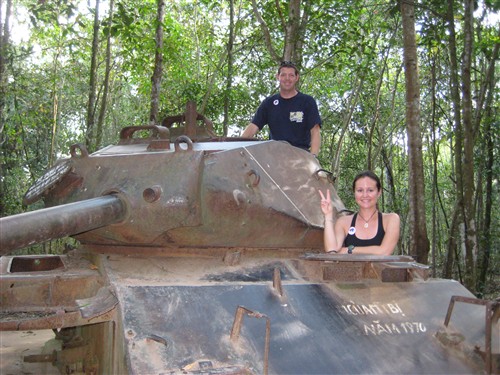
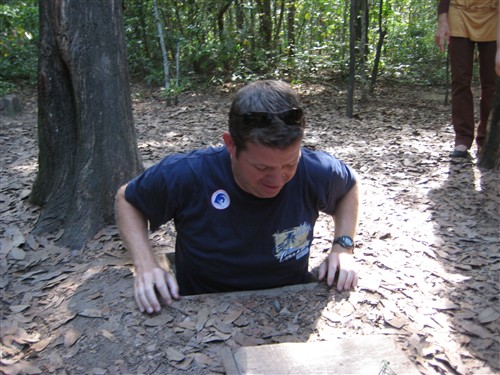
After a brief introduction, we were led to the tunnels for a closer look. We walked through an unimposing forest with scattered exhibits and remnants of war, including an abandoned American tank, several B-52 bomb craters, a display of Viet Cong booby traps, and startlingly lifelike mannequins donning the black pajamas and checkered bandanas of the Viet Cong soldiers. The tunnel entrances were amazingly camouflaged tiny wooden doors in the ground, obscured by leaves and dirt. We were allowed to slip down into one of the entrances which had been slightly enlarged for tourists. Aaron went first and just barely made it down, his hips pressing against the sides of the opening. I made it in with no problem but immediately noticed how little room there was to maneuver.
As our guide led us to another site, he paused to point out very discreet air holes for the tunnels, hidden in the surrounding landscape. Even if you knew what to look for, you likely would have missed the carefully disguised signs of life underground. We reached another tunnel entrance which had been enlarged even further at the opening and we were given the option to follow a guide through a short stretch of the Cu Chi tunnels. Everyone in our group hesitated at the thought of entering the narrow confines of the underground arteries. Aaron and I are both moderately claustrophobic. Crawling through dark, confined spaces is exactly the sort of activity we try to avoid. Aaron debated for about three seconds and decided to pass. There was a Malaysian family with three young children on the tour with us; one of the little girls was shaken and whining with fright, causing a minor scene at the tunnel entrance, but the other two kids seemed to want to go in. I don’t know what invisible force propelled me but when the young male guide, followed by a six-foot tall American woman disappeared inside the entrance, I instinctively crawled in next. The three Malaysian children entered behind me, followed by their mother and several others who were indistinguishable in the dark.
The first wave of claustrophobic panic hit me while the dim light of the tunnel entrance was still visible. I had changed my mind. I wanted out! I turned to look behind me and saw at least six people crammed into the tunnel with more coming in. I had no choice but to continue. The guide led the way with a small flashlight, moving gradually through but stopping every five seconds or so to wait for the female American bottleneck that followed. It really wasn’t her fault. She was just too tall to manage the expedient duck-walking posture without hitting the ceiling and losing her balance. To complicate matters, the bottleneck had neglected to leave her large backpack above ground, which hindered her movements even more and created a full eclipse of any guiding light from the flashlight. This did not help my situation.
Behind me, the chubby Malaysian boy was whimpering that he was scared. Behind him, his two younger sisters were crying. Behind them, their mother was in the midst of a claustrophobic panic attack. The bottleneck stopped in front of me to scold the chubby Malaysian boy for whining. This did not help my situation.
The air inside the now cramped tunnel was hot, damp and stale. Where were the air holes? With all of the people inside, it felt more like a box than a tunnel. I could die in here. I could suffocate and pass away. The journey seemed endless, though it couldn’t have lasted more than ten minutes. Ten torturous minutes. I didn’t see the light at the end of the tunnel until the bottleneck was already halfway out. The children’s collective whimpering had escalated to mild panic. I turned around at the enlarged exit and spirited the three children up the ladder to freedom. The poor little boy was sweaty and shaking. When the kids were climbing safely toward the light, I noticed their terror-stricken mother frozen in place, paralyzed by panic, hands grasping the walls on either side of the tunnel. She could see the light but she couldn’t move. I asked her if she was okay and when she didn’t answer after a few seconds, I climbed up the ladder, trusting that the people behind her in the tunnel would push her out eventually. She approached me a few minutes later and thanked me for helping with her children. She was still flushed and hyperventilating.
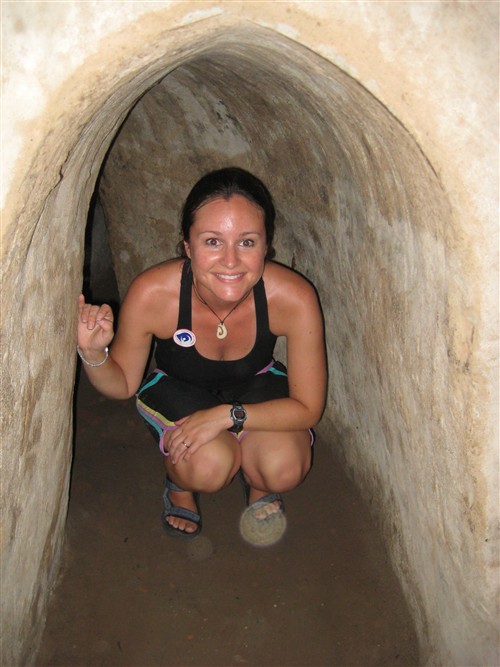 I found Aaron near the exit and he reported that he had also crawled through a section of the tunnels, circumventing the masses through a shortcut to a different exit. We excitedly exchanged the details of our experience and collectively determined that spending any extended period of time in those tunnels would have been Hell on Earth! The sensation inside was what I imagine it would feel like to be buried alive. Aaron estimated that we were about six meters below the ground level and, according to the model we had seen earlier, that was not even the deepest level. The tunnels were brilliantly conceived and crucial to the Viet Cong strategy but the practicality of a community living day-to-day like moles for an extended period of time is simply inconceivable, even after seeing the tunnels with my own eyes.
Near the end of the war, in the late 1960s, American B-52s indiscriminately bombed the entire Cu Chi area, destroying most of the tunnels. Napalm bombs were dropped, decimating hectares of the once-luxuriant forest that had nourished generations of villagers. Of the approximately 16,000 Viet Cong guerrillas who inhabited the tunnels during the war, less than one-third survived.
Today, the mangrove forest is finally beginning to thrive again. There is a quiet calm in the land once ravaged by gunfire and bombs. The tunnels are a popular stop on the tourist trail. To me, they symbolize the triumph of the underdog and the desperate will of human beings to survive.
War Remnants Museum
Formerly the Museum of Chinese and American War Crimes, the War Remnants Museum is divided into eight principal thematic exhibitions:
1. Historical truths: photos and documents regarding the causes, origins and processes of aggressive wars
2. Requiem: a collection of photos taken by 134 war reporters (from 11 nationalities) killed during the Vietnam War
3. Vestiges of war crimes and aftermaths (in military, economic, cultural and social fields; consequences on men, nature and environment
4. Imprisonment system: showing typical detention camps and prisons as well as physical and psychological torture methods used to interrogate and exterminate prisoners
5. Photo collections of two Japanese reporters
6. International support for the Vietnamese people in their resistance war
7. Children’s painting collection entitled “War and Peace”, created by artists between the approximate ages of eight and fifteen
8. U.S. state-of-the-art weaponry used in the Vietnam War
The old adage that “a picture is worth a thousand words” particularly holds true in comprehending the atrocities of war. The soldiers who fight in wars are fathers, sons, mothers, daughters, sisters and brothers. In struggling to uphold my belief in the inherent goodness of man, I must maintain a certain degree of naïveté. I must convince myself that the horrific acts of men at war are perpetuated by fear, ignorance, temporary insanity, and a necessity to preserve one’s own existence rather than hate and pure cruelty. The War Remnants Museum is full of evidence to the latter. Photographs of women and young children wading across chest-deep rivers to escape American bombs; prisoners of war, rightly terrified, being led by men with guns; hectares of once-fruitful forest and agricultural lands decimated by toxic chemicals; victims of Agent Orange and their deformed offspring; hospital photos of bomb victims with missing limbs, melted flesh, shrapnel wounds and no medicine for pain; trenches full of brutally massacred men, women and children; torture apparatus and photos of torture victims; a sea of corpses, some literally torn to pieces by an exploded landmine. The images swim through my mind.
One particular photo in the “Requiem” is branded in my memory. A young Vietnamese man stands behind his very pregnant wife, his arms wrapped tightly around her beautiful belly. There may have been children and other people cowering in the background. What struck me was the agony on the face of the woman – I could almost hear her screams, pleading for the life of her unborn child. The caption of the photo, taken by one of the fallen reporters, said that American soldiers were rounding up all of those villagers – including women, children, and infants – to murder them. The photographer screamed, “Hold it!” The soldiers paused. The reporter snapped the photo, then turned and ran. As he ran, he heard the gunshots behind him. He never looked back.
Throughout our travels, we have seen many exhibits documenting similar atrocities in human history – the Holocaust Museum in Jerusalem, the Apartheid Museum in Johannesburg, the Atomic Bomb Museum in Hiroshima. I almost feel as though I should be somewhat de-sensitized to the images of human suffering. I am not. I choked back tears as I walked through the various exhibits, each containing graphic evidence of man’s depravity and, when I reached the photos of the children, I let the tears fall.
Agent Orange
Agent Orange was a chemical toxin intended to kill en masse. It was a weapon of mass destruction, unable to differentiate between soldier and civilian or between man and child. The weapon was experimental when it was dropped on Vietnam. Of those who survived Agent Orange, many were burned and sickened; many died later of diseases from exposure. The chemical destroyed the forest and the farmland and nothing would grow again for many years. The land that had sustained generations of rural villagers was dead. Even worse, Agent Orange went on to affect the next generation – my generation. Children born years later to Agent Orange victims came into the world terribly deformed and handicapped, unable to ever care for themselves. Some women gave birth to two or three such children. It did not matter which parent had been exposed. My heart weeps for those families.
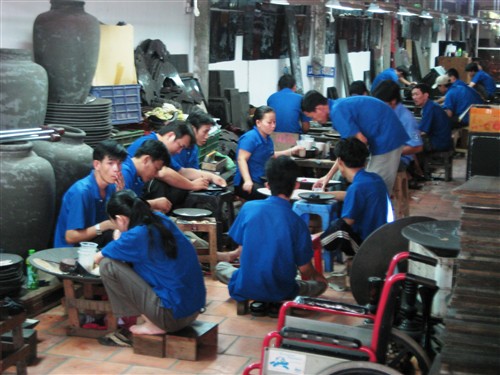 The Vietnamese government, with international help, has strived through the years to create opportunities for victims of Agent Orange to earn a living and contribute to society. The government has set up handicraft workshops where Agent Orange victims whose handicaps are restricted to their lower bodies can create art in a work environment where they can sit down all day. On one of our organized tours in southern Vietnam, our minibus stopped at what appeared to be the usual tourist handicraft mart. We sighed and rolled our eyes in exasperation until the guide announced that this was a workshop and gallery of Agent Orange victims. After our heartbreaking experience at the War Remnants Museum on the previous day, we were excited to see evidence of recovery. The young workers – all about my age or younger – sat at low tables or on specialized stools, worked their crafts and greeted us as we walked through the rows of work tables. They all seemed content and the work conditions pleasant. We made a brief sweep of the attached gallery – a warehouse-sized display of paintings, furniture, vases, lacquerware, kitchen accessories and jewelry among other things. The gallery was fully staffed by Agent Orange victims who humbly aided the tourists in completing their purchases. The work was impressive and we purchased a small token to show our support.
I wondered later how much was really known by the American government about the long-term effects of Agent Orange. Assuming they were fully aware of the consequences, would it have made a difference? Excluding isolated acts of terrorism, no American alive today has ever experienced war on his home soil. The more I travel to places like Vietnam, the more thankful I become for that fact and the more prayerful I become for my generation and the next. I cannot fathom a war zone in the midst of the safe, sterile, insulated place that I call home. I cannot begin to understand the specifics involved in making war – the pressure of making critical decisions that determine the value of innocent human lives and shape the future of the world. I am wholeheartedly grateful for the safe, healthy, comfortable, free life that I have been granted as an American citizen so it is difficult for me to criticize the people who laid the foundation for that quality of life. I am humbled before the brave souls who have made unimaginable and, sometimes the ultimate, sacrifice to protect my freedom. Despite my level of education and the boundlessness of the American free press, I have failed to comprehend the enormous price of that freedom. It is only now that I begin to see what horrific sins have been committed throughout history in the name of liberty; or with the intent of suppressing rival political or religious ideas; or simply out of greed and barbarity. But the transgressions of others are not for me to judge.
I still think about the “War and Peace” paintings in the War Remnants Museum, created by children of war. The images of war, colored by tiny innocent hands in the cartoon-like figures of youth, expressed sadness, desperation, pain, loss and a more vivid understanding of war than should ever be possessed by a child. Conversely, the vibrant images of peace awakened a sense of childlike hope in me. I wanted to imagine the possibility of a truly peaceful world but my adult experiences tell me that world peace is a childish dream. In Kurt Vonnegut’s novel, Slaughterhouse-Five, the author – a World War II POW and witness to the US bombing of Dresden – argues that peace on earth is a dream that will never come true, that mankind will continue to fight wars as it has done since the beginning of time. The best thing an individual can do is to focus on the good things and happy moments in life and try to create as many of them as possible. For lack of a better alternative, I am inclined to agree. The same sentiment was captured in a poem, written by my dear friend, Meridyth Andresen. It was written when we were in junior high or high school – I can’t remember which – so you’ll forgive me if I have misplaced a word or two in the years since then:
Checkers
War is now too childish
It’s almost like a game;
Presidents playing checkers
And leaving the world in shame.
There’s too much to be lost
And not much to be won.
I don’t see how this game of checkers
Could profit anyone.
But what is there for me to do
And others who feel the same
But quietly stand aside and pray
And simply watch the game.
Reunification Palace
Fast forward now to the end of the American War in Vietnam. Television broadcasting of bloody battles and stories of the slaughtering of Vietnamese civilians as well as a rising American death toll had made the war increasingly unpopular among Americans. In early 1968, the Viet Cong launched simultaneous attacks, called the Tet Offensive, on many South Vietnamese cities and villages, including Saigon. Catching the Americans by surprise, the Viet Cong even pushed as far as the courtyard of the US embassy. The US and South Vietnamese forces responded with massive firepower into the cities that crushed the Viet Cong but also resulted in heavy civilian casualties. Americans at home watched the footage and witnessed the bloodshed. Still, the fighting ensued for several more years.

In January 1973, the Paris Peace Accords were signed by the US, North Vietnam, South Vietnam, and the Viet Cong, which called for a ceasefire. At that point, the war had not been clearly won by either side. It was simply ending, at least for the Americans, who withdrew all military personnel. Throughout the war, the South Vietnamese had relied extensively on US forces, but now they were fighting alone. In April 1975, just hours after the last Americans were evacuated by helicopter from Saigon, the North Vietnamese tanks broke through the gates of Saigon’s Independence Palace (later renamed the Reunification Palace) and wrested control of the capital, immediately declaring its new name as Ho Chi Minh City. Ho had died in September 1969 and never saw his dream of a unified and independent Vietnam realized. He has been immortalized throughout Vietnam as a proud patriot.
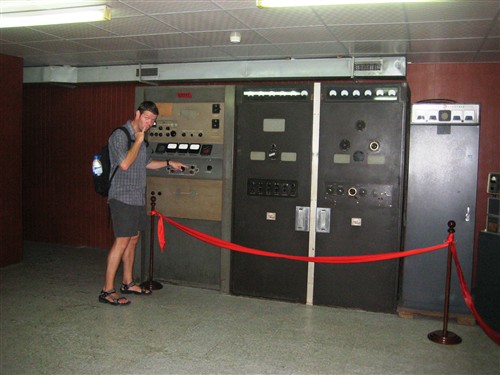 We toured the Reunification Palace, once a major political venue with its banquet halls, receiving rooms for foreign political figures, meeting rooms and suites. We saw the rooftop helipad from which the last of the American troops were evacuated from Vietnam and the gate that was bulldozed by the Viet Cong tanks. Most fascinating were the basement rooms of the palace, which served as command rooms during the war. The rooms have been left exactly was they were during the war, with wall-sized hand drawn maps of Vietnam, telephone rooms and radio rooms with their original equipment, and war time living quarters for the president. The narrow, cement halls and boxy cells resembled a bomb shelter. The equipment was antiquated – this war was commanded without computers. The hand drawn diagrams reminded me of my grandfather’s home office. As an engineer and inventor, his desk was always full of papers with figures and calculations, drawn meticulously straight using a pencil and ruler. The American War in Vietnam began with my grandfather’s generation and ended with my father’s. The Iraq War with its numerous parallels to the Vietnam War plagues both my father’s generation and mine.
In the absence of American resistance, Vietnam had fallen to the communists. In the years that followed, communism wreaked havoc on an already war-ravaged economy. More than a hundred thousand Vietnamese fled the country, seeking refuge in France, Australia and the US. Many people tied to the old regime in the South were imprisoned. Tense relations continued between North and South. To complicate matters, the civil war in Cambodia drew Vietnam over its western border to occupy the troubled nation and fight the Khmer Rouge, which caused further stress on Vietnam’s already diminished resources and incited China to enter a 17-day war with Vietnam.
Today, the Socialist Republic of Vietnam shows tangible signs of promise. The economy is growing at 8% per year and international investment is at an all-time high. Citizens from rural villages are flocking to the cities to earn a better living and the city streets are filled with people desperate to work. The Vietnamese government remains communist but the economy is distinctly capitalist, a conflict that will be interesting to follow in years to come.
Having completed our very hands-on crash course in Vietnam 101, we see the value in studying the events of our history, understanding the travesty of war, and striving to avoid the repetition of past transgressions. Perhaps if more of us – and I stand at the front line of the guilty – made the effort to educate ourselves regarding our own warring history, we would not so easily allow our politicians to lead us into war like lambs to the slaughter. In all honesty, I have never made it my business to care about world events before embarking on this amazing journey. I lived in my happy little suburban bubble; I drank Starbucks, went shopping on a whim, spent time with friends and felt sympathy for the victims of the Iraq War when I saw the news stories of that desert battle zone so far removed from my reality. I realize now that my ignorance is as much a travesty as war itself. From my experiences around the world, I have come to develop an insatiable hunger for knowledge; a new sense of human responsibility to learn and to care. In this lifetime, I may be convinced that war is a necessary action but I hope to have the wisdom to decide for myself.
Comments Off on American War in Vietnam
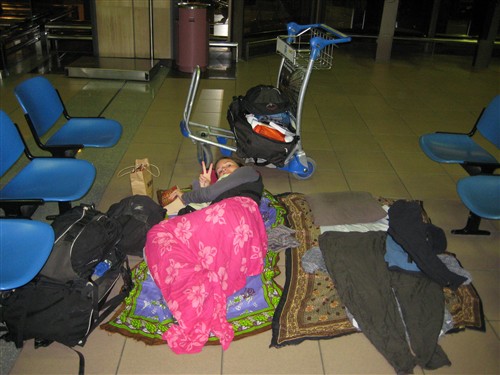 Our flight from Denpasar to Ho Chi Minh City was an undesirable itinerary to say the least. We had a seven-hour layover in Singapore from 12:35am to 7:20am. It was the cheapest itinerary, booked only by people like us who have more time than money. What we didn’t realize until checking in for the first leg was that, because the first leg was considered an evening flight and the second leg a morning flight, the airline would not check our bags all the way through. We would have to clear customs in Singapore and spend the night in the outer part of the airport until two hours before our morning departure when we could get a boarding pass for the second leg.
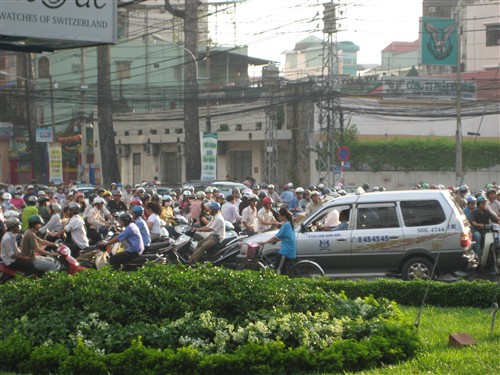 The taxi should have been the fastest mode of transportation but mid-morning traffic was in a steamy state of gridlock. Finally, at 10:57, with the embassy building barely in sight, we paid the driver, weaved through the gridlocked mopeds, and made a dead sprint for the embassy gate. It must have been 10:59 when we slipped through. We made a hurried stop in the first office to glue our passport photos to the application forms, then scurried through the cement courtyard to the application office. The queue was short and we breathlessly presented our documents to the clerk. We had everything on the list. We were pessimistic about our substitute for the hotel bill but at least someone official would examine our documents and confirm that everything else was acceptable. The clerk hastily perused our docs.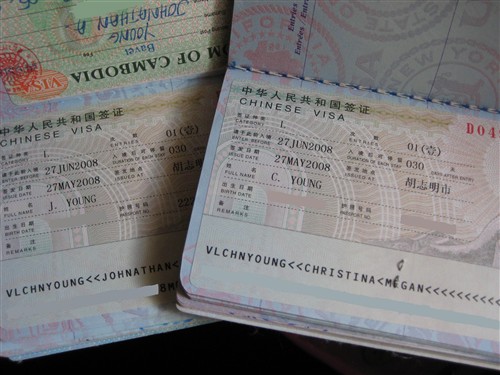
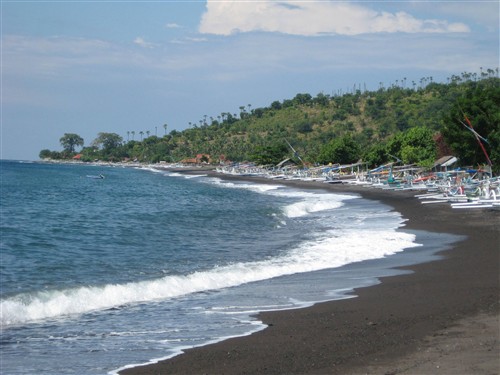
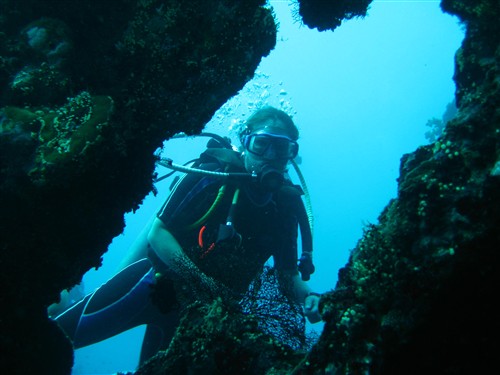 There is an eeriness that surrounds all sunken ships, similar to the feeling a child gets while walking through a graveyard, her young mind swimming with ghost stories. Shipwrecks all have ghost stories and, through the underwater silence, I always try to listen for them. They are not the chronological details of reference materials but rather the resonating cries of young shipmen; brave soldiers praying to God to return them to their wives and children, struggling against fate with all of their might; a captain summoning the courage to go down with the ship. Those are the stories I imagine I hear, stories that touch my heart and send shivers down my spine.
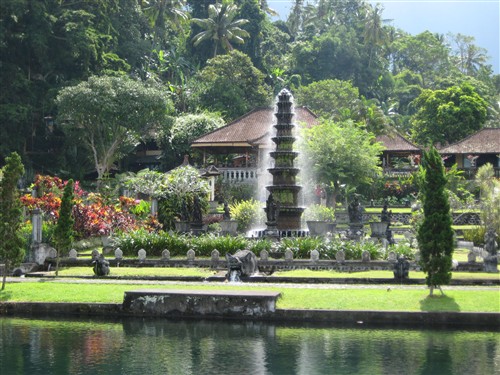 Our next stop was a famous water palace, called Taman Tirta Gangga, meaning Water of the Ganges. Our guide book made little mention of it but it had been recommended highly by a fellow diver. Unsure what to expect, we walked through the requisite vendor stalls and bought two tickets at the entrance. Our first glimpse of the water palace took our breath away. The grounds were composed of sparkling pools, their glassy surfaces almost perfectly still on the breezeless day. Landscaped stone walkways, an ornate footbridge, statues and fountains accented the pools and gave the grounds the appearance of a watery playground. We were delighted and skipped like children over the walkways and stepping stones. Our favorite pool was stocked with carp and had a maze of stepping stones within it that made you feel as though you were walking on water. There was no palace on the property at all but rather an old temple and a posh hotel and restaurant so we took our time through the magnificent grounds and then continued on our way to Ubud.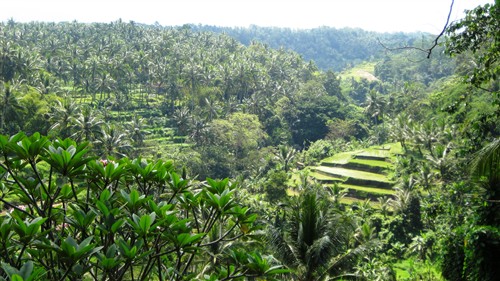
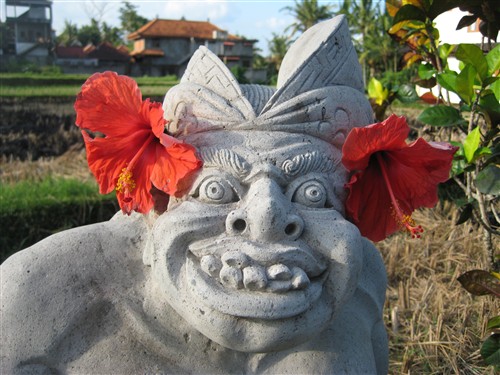 We checked into Nick’s Pension – a complex of two-story Balinese-style cottages surrounding a small rice field. It was located along a quiet side street, across from a larger rice farm, giving it the rural charm of a tropical hideaway. As we settled into our cottage, afternoon tea was served on our shaded patio – a lovely touch, we thought. Weary from our surfing exploits earlier that morning in Kuta, we dropped everything and sat down to enjoy the tea in the lush garden setting of the property, meticulously kept by an abundant staff. The grounds were adorned with ogre-like stone-carved statues decorated good-humoredly with fresh, bright red flowers behind their ears.
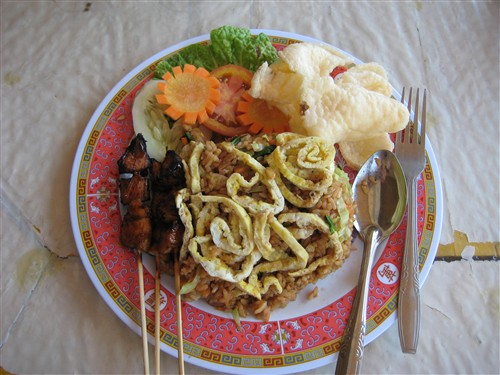 Our favorite Indonesian dish is nasi goreng – fried rice with chicken and prawns, topped with a fried egg and accompanied by prawn crackers and skewers of chicken doused in peanut sauce. Nasi goreng is offered in most restaurants for breakfast, lunch and dinner and, on occasion, we have had it for all three. There are many small, family-run eateries, called warungs, which usually have four or five small tables and cheap Indonesian eats, though many proprietors in central Ubud have commercialized the warung concept to a trendier and pricier level.