Posted under Bali
We hired a car and driver from our hotel for a day of sightseeing and tailored our own itinerary: the rice terraces of Jatiluwih and two Balinese Hindu temples. The first temple – Pura Luhur Batukau – was located in the mountainous interior of the island. As we drove north, away from the more populated southern cone, the scenery transformed from steamy city streets to green mountain slopes covered with ancient rice terraces. The terraces were designed to take advantage of the fertile volcanic mountain soil and retain all available surface water so that the rice seedlings could thrive in their plots of mucky utopia. The small villages surrounding Jatiluwih has some of the most beautiful rice terrace views in all of Bali.
The mountain regions are dotted with farming villages where children play in the streets and women carry heavy loads on their heads. Interestingly, on Bali, it is the women who do the heavy lifting, transporting such things as baskets full of bricks while the men take on the lighter tasks. The subject came up at our lunch table at the John Hardy compound the day before and one of the Balinese women said, first (with a laugh), that men are lazy and, second, that the Balinese women are strong for themselves; they do not wait for their men to be strong for them. Hinduism is the dominant religion of Bali and even the smallest villages have ornate temples which serve as the community center and venue for festivals and ceremonies. After about two hours of driving over winding mountain roads, both sealed and unsealed, through rice terraces and quiet villages, we finally arrived at the first temple.
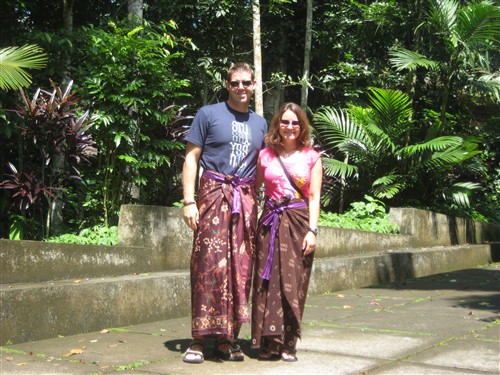 Pura Luhur Batukau was tucked into a tropical mountain forest; the cool, misty air bathed the temple grounds in an ethereal glow. Because of the temple’s remote location, the noise of tourists and touts is noticeably absent and replaced by quiet serenity. We paid a nominal fee to enter and were requested to wear the sarongs provided in the small baskets while on the temple grounds. A sign at the entrance listed restrictions for entry: pregnant women, menstruating women, and children with baby teeth among others were forbidden. Only Balinese were permitted entry into the inner sanctum so we walked the manicured gardens around the exterior and ventured a few steps through the main entryway on the heels of the only other pair of tourists whose guide ushered them a few steps inside. There were marvelous stone carved statues covered in rich green mosses which only added to their aged beauty. Some were adorned with fresh, brightly colored flowers.
The most striking and unique features of Balinese Hindu temples are the merus – multi-layered, pagoda-like wooden shrines with thatch-covered tiers. The merus are often dedicated to animist spirits of the Balinese religion and contain ceremonial items hidden behind the wooden doors. (Lonely Planet Bali & Lombok March 2007) After taking in all that we were allowed of the temple compound, we relinquished our sarongs and headed back down the mountain.
We stopped for lunch at a seaside restaurant near our next temple stop and invited our driver to join us. He was nice enough but his English was mediocre and conversation required some effort in order to avoid the uncomfortable silence. At the end of the meal, he thanked us for lunch and discreetly walked over to the restaurant owner to collect his commission for bringing tourists to this establishment.
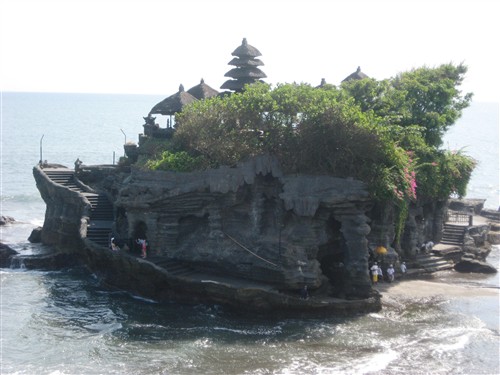 We drove around to the parking lot of Pura Tanah Lot – the most photographed and commercialized temple on the island. We purchased our tickets and walked through a large area of souvenir and refreshment stalls before reaching the entrance. Set on Bali’s west coast, the sea temple is reputedly thronged with tourists every day at sunset but it was relatively quiet in the early afternoon. The temple is built on a rock about fifty meters off the mainland. At low tide, you can walk across the shallow water to the temple although, again, non-Balinese are not permitted to enter. We found it slightly disheartening to pay an entry fee to a temple we could not enter. Still, the outside of Pura Tanah Lot was impressive. It had a mystical, storybook appeal with winding stone staircases leading into dark, mysterious caverns. There were several outdoor restaurants on the cliff overlooking the temple and it would have been a lovely place to watch the sunset but we were happy to avoid the crowds and catch the sunset on Kuta Beach instead.
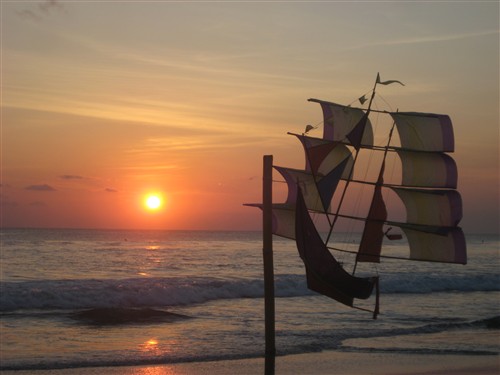
The beach at sunset is the place to be in Kuta and Legian. Aerobicized tourists walk in the sand; Balinese boys play pickup soccer games all along the shore; there are still plenty of surfers trying to catch that perfect wave before dark; and cheap, ice cold beer is served on plastic patio chairs for those who want to sit back, relax and take it all in with the postcard backdrop of hazy pink sunset. A cold beer is best enjoyed at the end of a long, hot day and we were completely relaxed with our icy Bintangs as a local guitarist played mellow American cover songs in the seat behind us. Even Aaron contentedly sat for a second round of beers before we wandered off through the darkened streets to find dinner.
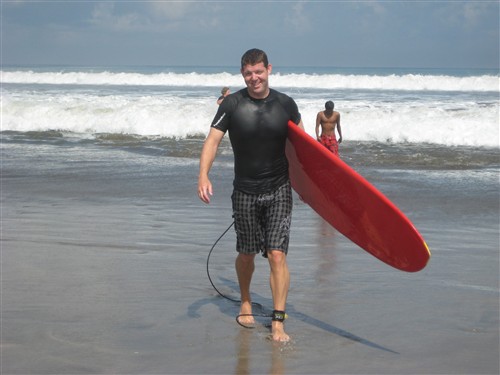 On our final morning in Kuta, Aaron decided to take a surfing lesson. He had been talking about surfing since South Africa and Kuta just seemed like the right place. We set out early for the beach. I had no interest in surfing – I’m still convinced that Jaws is waiting to mistake me for a seal – but I went along anyway in the capacities of family photographer and entourage. Aaron rented a board on the beach and started his lesson immediately with a few exercises in the sand. Five minutes later, he and his young Balinese instructor were headed for the waves. He got up on his third attempt and several times after that for the next hour. He took a short break and then went out again until I gave him the signal that it was time to go shower and check out of the hotel. He had a great time and I could tell by his big smile that a new surfer was born.
We rushed back to the hotel, checked out, and negotiated a transfer to Ubud. Our final assessment of Kuta and Legian is that they were a lovely first glimpse of Bali but a bit too touristy for us. The beach was an integral part of every day and the range of hotels and restaurants spanned every taste, whim, and budget. The travel is easy in Bali and it is one of the few remaining places where the American dollar still goes pretty far, much to the budget warden’s delight.
 We arrived in the late evening and stepped out into the breezy night air to find a friendly face with a sign bearing our name – always a welcome sight in a new country. The drive to our hotel in Legian, just north of Kuta, provided flashing glimpses of upscale resort hotels with patios bathed in incandescent glow; a startlingly ubiquitous presence of “culture Americana” with all of the usual suspects – McDonald’s, Starbucks, KFC, Dunkin’ Donuts – and random others. It was the face of a tourists’ haven, the likes of which we had not seen since Thailand. In the dark of night, I might easily have mistaken it for an American beach town but eventually the bright lights gave way to narrower streets and alleyways crowded with vendor stalls and smaller, locally-owned businesses. Our hotel – Sayang Maha Mertha – was tucked inconspicuously into the corner of two quiet alleys. Between the hotel and the beach – a ten-minute walk – lay every type of shop and service that we might need: laundry, tailor, transport, tours, garment and trinket shops, and enough restaurants and bars as to avoid repetition in a much longer stay than our intended four nights.
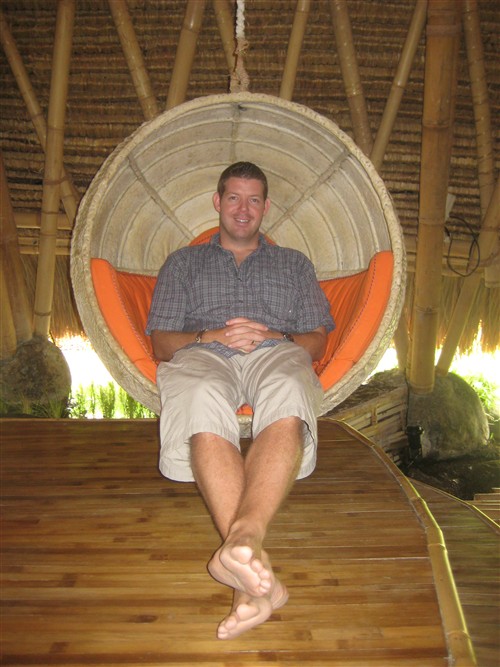 We arrived at 11:30 and began with a private shopping hour in the showroom – a tall, steep-pitched structure made of bamboo and thatch and built over a rice field. I could sense Aaron starting to sweat and justifiably so. We have spent the past eight months shedding our shallow materialism, one layer at a time, but get me into a room full of shiny, sparkling pretty things and, in two seconds, I regress to the former shameless victim of American consumerism whose gluttonous desires I’ve worked so hard to squash. Oh, the humanity! Only this time, I don’t have a job. My husband doesn’t have a job. Our sole source of current income is the unimpressive interest rate on our ever-shrinking pot of travel money. These facts alone should cause a rational person to say “Thanks, but no thanks” to the private shopping hour to begin with but the gleam in my eyes, reflecting off the hammered gold of the Palu collection blinded me to all rationality I might otherwise have been able to muster. What is it with women and the forbidden fruit? Fine jewelry is like a drug – the more you get, the more you want.
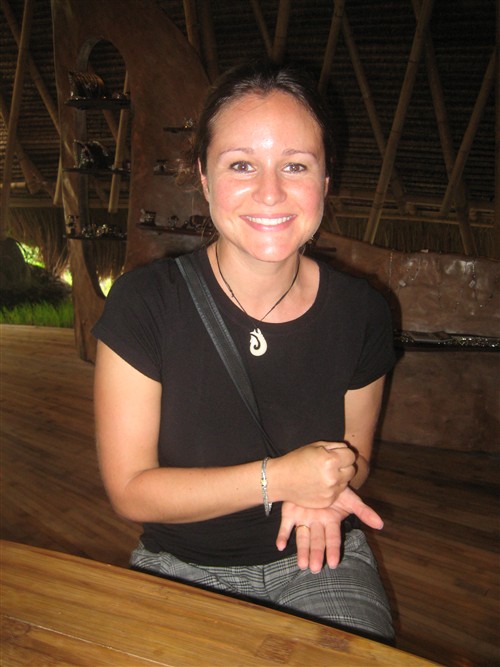 With renewed enthusiasm, I began circling the displays again. There were so many beautiful things. My natural (inherited?) affliction of champagne taste tangled with my desire not to take advantage of Aaron’s generosity, sparking a stalemate of indecision. My husband knows me like the back of his hand and sensed my plight. Both to assuage my guilt and hedge against the potential damage, he suggested a round of rock, paper, scissors – an elementary but effective way of decision-making. He suggested the following terms: if I won, I could guiltlessly take home any single piece in the showroom but, if he won, I got nothing. I’ve never been much of a gambler – a decidedly positive trait passed down from my father – so, at first, this seemed like a bad deal for me since I was technically already authorized to make a purchase. But in the glitter and gleam of gold, silver and precious stones, I somehow became that greedy game show contestant who puts her big winnings on the line to go for the grand prize. I went for it. My heart was racing as was Aaron’s, I’m sure. One, two, three! Tie: rock-rock. One, two, three! Tie: paper-paper. Madness! On what would become the third and tie-breaking round, my paper covered Aaron’s rock and the crowd (inside my head) went wild! I could hardly contain my excitement. I wanted to scream “The world is mine!”
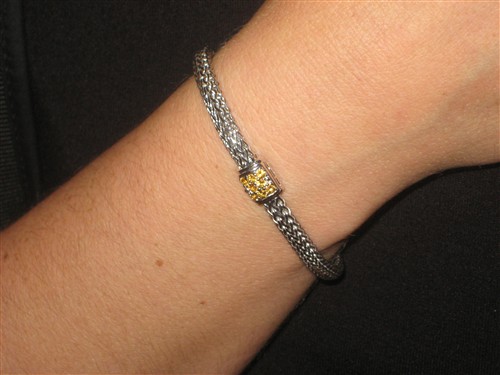 After the tour, it was time to pick my prize. I’d circled the showroom several times already. At lunch, most of the female employees were dripping with John Hardy jewelry and one of them had worn a small silver bracelet that was simple and pretty. With carte blanche to choose anything I wanted, I chose a similar small bracelet (notably one of the least expensive items on display), much to Aaron’s surprise. I liked it because I can wear it while traveling without worrying about getting mugged…and I earned some brownie points with my relieved husband, which will undoubtedly be leveraged at the appropriate time. I walked out of John Hardy’s showroom happy as a fat kid in a candy shop, my new treasure already shimmering in the afternoon sun.
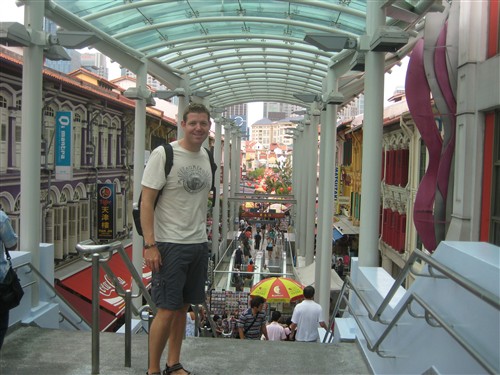 The cheapest route to travel between the Philippines and Bali was with two budget airlines and a layover in Singapore. We decided to spend a couple of days exploring this cosmopolitan sovereign state located at the tip of Malaysia, but were unable to find reasonably priced accommodation. To Tina’s delight, we used about half of our precious hotel points and booked two nights at the Hilton Singapore. After flight delays, long lines at Immigration and a short taxi ride, we arrived at our luxurious hotel well after midnight. We are always amazed at how comfortable these international business hotels are in comparison to the many budget hotels and hostels in which we normally sleep. We were warmly greeted at 2:00am by impeccably dressed attendants, fresh flower arrangements, marble-lined corridors, and the rich scents of good living. Sinking into the featherbed and swallowed by the down duvet draped over the bed, we agreed that we could easily spend the next two days in the isolated comfort of our fifteenth-story room.
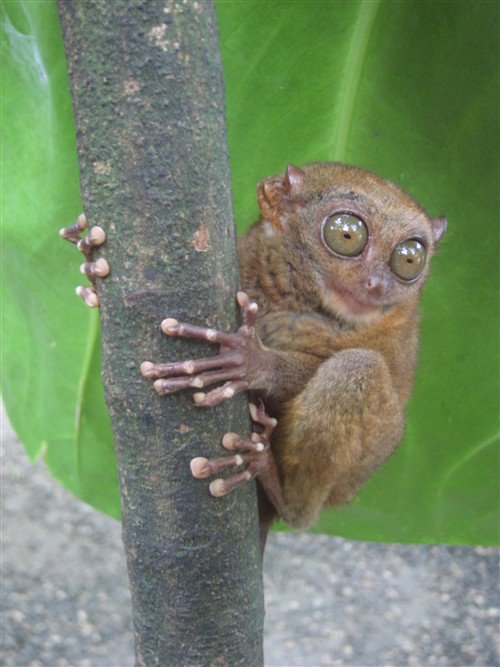 We arrived at the Tarsier Visitor Center with no expectations. We had seen the island’s mascot – the tarsier – immortalized in postcards, key chains, stuffed animals and t-shirts in the many gift shops along the beach. As we entered the rectangular fenced area of the conservatory and spied a pair of the tiny monkeys clinging to a narrow tree branch, it was love at first sight. The tarsier is the world’s smallest primate. It can literally fit in the palm of your hand. Tarsiers are indigenous to the Philippines and are currently endangered. The two tiny monkeys clung to their tree branch while we cooed and photographed them (without flash because their proportionately large eyes are nocturnal and would be damaged by the bright lights). We were each given a wooden skewer with a black bug on the tip to feed them. It was adorable to watch them grab hold of the skewer with their tiny, soft hands and lick every last trace of insect guts from tip of the stick. On our way out, I dropped some coins into the donation box. I hope that someone is working hard to save the tarsiers. If the little angels ever made it to the States, every kid would have to have one.
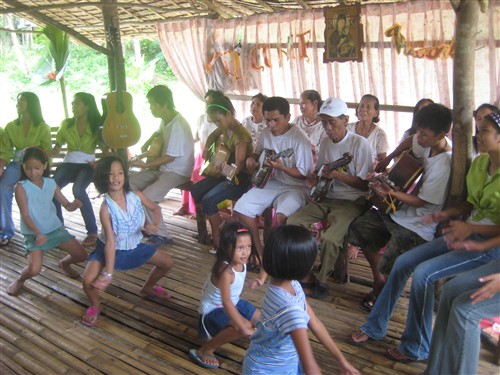 The river bank on both sides was thick jungle with simple homes built on the water’s edge. There were many locals outside, sitting on their riverside patios and waving to the boats going by. At several spots along the banks, large groups of local people, spanning three generations, sat on floating pavilions made of bamboo and thatch. As we neared them, the band stopped mid-song and one of the men tethered our boat to the pavilion. The group immediately commenced the first of several high-energy music and traditional dance performances. The young girls danced first; then the young boys and the mothers and grandmothers. Those who weren’t dancing strummed guitars, sang and clapped along. Everyone participated with faces exhibiting true joy. There were donation boxes attached to the posts on the pavilions and we were happy to contribute to such an inspiring and energetic display of local culture. Each group performed for about twenty minutes and then untied our boat and waved goodbye as we cruised away. It was a very moving experience that really epitomized the heart and soul of the Filipino people. We were continually inspired to see people with so little material wealth express such joy and love of life.
 We arrived back in Manila by bus and with great ambitions. We had booked a flight from manila to Tagbilaran on the southern island of Bohol where we planned to do more diving and hopefully get some beach time but, before that, we were going to attempt a shotgun trip – a nine-hour bus ride each way – to Banaue in north Luzon to see the famous rice terraces of the Cordillera. The logistics were exhausting to think about but the photos of the rice terraces were breathtaking and we’d certainly endured worse travel in the not-so-distant past. By now, our backs are strong and our patience is long.
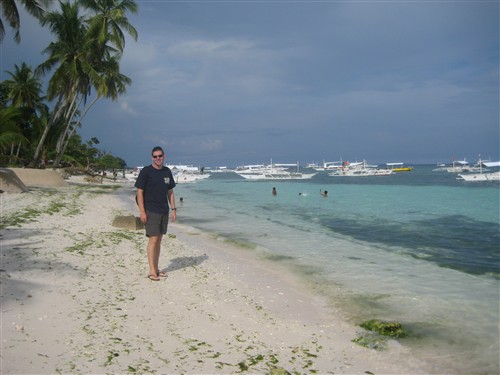
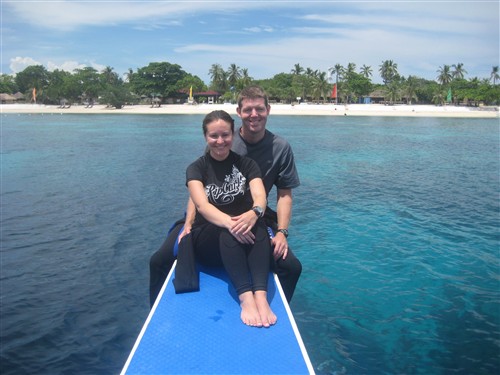
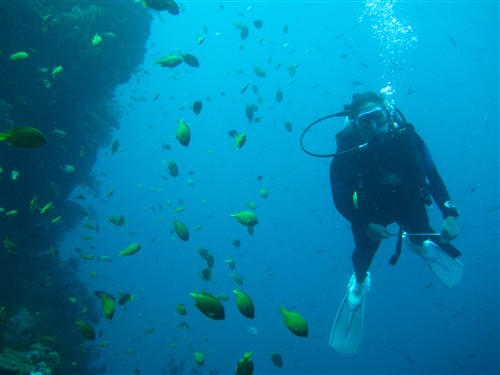 We had come to Alona Beach to dive and dive we did – ten times over the course of five days, dividing our time among Panglao, Balicasag and Cabilao Islands. The islands are known for their spectacular reef walls – tall underwater cliffs covered with colorful hard and soft corals. The water was clear and the marine life vibrant. There were daily, two-dive boat trips around the islands, which afforded us plenty of much-coveted boat time and an early afternoon return leaving hours to linger over a post-dive beer and hot shower before pondering the day’s most pressing decision: where among the beautiful candlelit seaside restaurants to have dinner.