Posted under France
After an overnight flight from Kathmandu, we arrived in Paris and found our hotel in the historic and eclectic neighborhood of Montmartre. We were surprised by the briskness of the air in the midst of summer and it was a welcome reprieve from the unforgiving heat of Nepal.
It was nine a.m. and we could not check into our room until 3:00 so, after dawdling around the lobby for a while, we decided to try to get in to see a doctor at one of the hospitals. We opted for a British-French semi-private hospital (France has socialized health care) and miraculously got in to see a doctor and have an ultrasound that afternoon. The outcome was sad but conclusive…finally. Surgery seemed the logical next step, given our strict travel schedule. However, we were unwilling to thwart our plans to leave for Grenoble the next morning and opted to deal with the surgery issue upon returning to Paris in a few days. Although we did spend our entire first day back in Paris at the hospital, we were thankful for the opportunity to be seen on such short notice. We returned to Montmartre just in time to check into our hotel, grab some delectable takeout, and melt into bed.
Grenoble was beautiful. The three-hour train ride from Paris took us through plots of sunflowers, golden fields with centuries-old farm houses, and the magnificent French Alpes. We had come to watch a stage of the Tour de France, which finishes atop a mountain called Alpe d’Huez. In planning this little detour, we were disappointed to discover how scarce and inadequate was the information online regarding the logistics of watching the stage on the mountain itself but we assumed that there would be plentiful info and public transport options for ushering the flood of cycling fans up the hill come race day. Our preoccupation with health issues for the past month had caused us to arrive in Grenoble completely unprepared. We realized when we disembarked from the train that we had no idea where our hostel was or how we were supposed to get there but, after that initial stressful realization, we pulled it together and found our way via public bus.
The hostel staff knew little about the Tour and, since Alpe d’Huez was the next afternoon, we dropped our bags and headed straight back to town to seek information. A few frustrating hours of pounding the pavement in Grenoble yielded the following: 1) the road to Alpe d’Huez would be closed on race day; 2) there was no public transport available since the road would be closed; and 3) no one in Grenoble gives a damn about the Tour de France. Our only option was to rent a car that day, drive up the mountain, and sleep in the car. Naturally, almost all of the rental cars in town were already rented and the few that were available were exorbitant. As fate would have it, we would instead watch Alpe d’Huez in a small corner tavern with a big screen T.V.
 Determined to make the most of our visit to Grenoble, we spent our second day taking in the town. Wandering through the historic town center, we marveled at old stone churches and quintessential French architecture with its signature wrought iron detail. The narrow cobbled streets were lined with outdoor cafes, patisseries, and fruit and vegetable stalls. At la rue Chenoise and la place aux Herbes, a quaint and busy courtyard surrounded by 14th-18th century homes, the aromas of the daily fruit, vegetables and spices market filled the air.
The colors, smells, and quiet bustle of the locals buying their fresh ingredients for the day brought to mind the concept of the art of living. I thought briefly of the shopping in the States – the “big box” stores like Walmart, Target, Costco and American grocery chains. In comparison to this beautiful, artsy neighborhood with its butcher, baker and candlestick maker, the “big boxes” seemed vulgar and utterly lacking in personality. Still, in spite of its status as an unapologetic bastion of consumerism, the United States of Awesomeness (thanks, Trish, I love that!) has the best shopping in terms of variety, quality, service and convenience on the planet Earth. With the exception of Martha Stewart and her loyal disciples, we seem to have forsaken much of the art of living with our “big boxes” but while there is a beautiful simplicity to the art, I’ll take Costco any day.
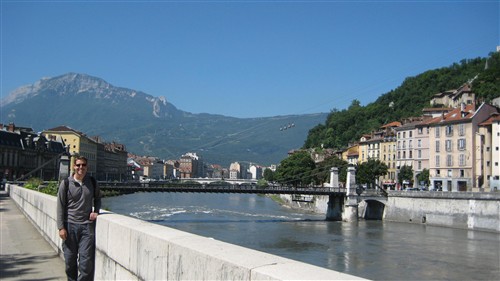
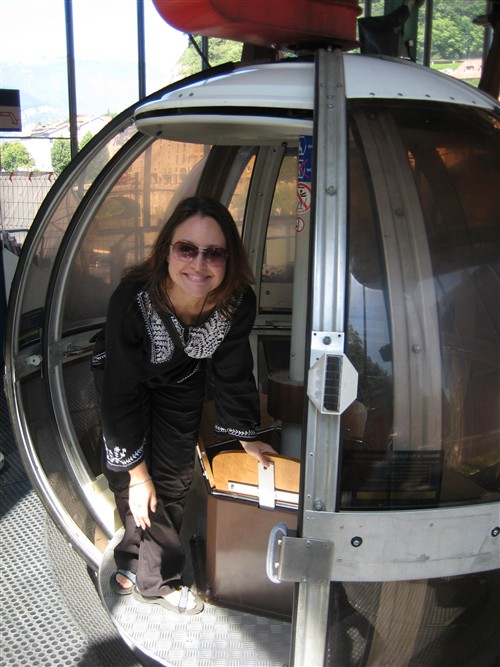
After hours of aimless wandering through the historic streets, we walked along the river snaking through the northern edge of town. It was lined with some of Grenoble’s prettiest old buildings. We rode the cable car to La Bastille, an old wartime fortress on the mountainside to take in the spectacular panoramic views of the valley. After that, we picked up some cheese and a warm baguette and made a picnic in the park. The weather has been absolutely gorgeous and the parks were full of people, young and old, enjoying the abundant summer flowers and fresh air. It was a lovely sight.
On our last day in Grenoble, almost as if to atone for the impossibility of Alpe d’Huez, the Tour de France race course ran along the main street just outside our hostel. Hours before race time, we joined the locals in lining the curb, patiently awaiting our chance to steal a glimpse of the riders.
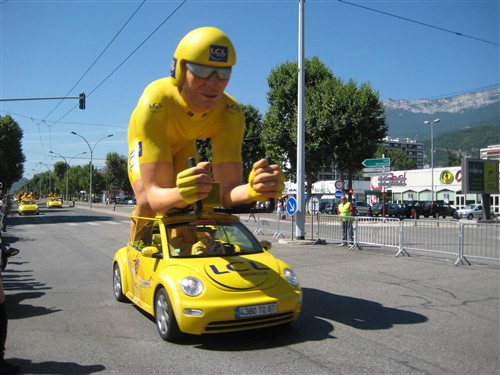 The caravan of sponsor cars preceded the racers, rallying the fans with incessant honking, blasting music and tossing trinkets into the crowd. An hour passed between the caravan and the riders. When the peloton finally whizzed by the level stretch of road in a mere few exhilarating seconds, our hearts raced at the sight – a kaleidoscope of spinning pedals and colorful spandex. And then they were gone. We had spent about four hours sitting around in the sun, waiting for those few brilliant seconds. While I do not share my husband’s passion for cycling, I looked at him in the wake of the peloton and exclaimed, “That was so worth it!”
We left on the evening train back to Paris – to meet Aaron’s mother who would fly in the following morning; to get closure on the miscarriage; and to revisit one of the most amazing cities in the world.
Comments Off on Goodbye Asia; Hello Europe!
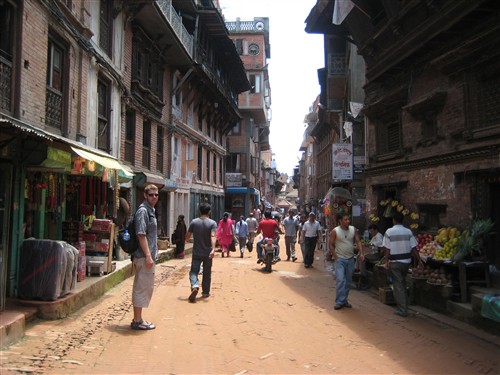 We returned to Kathmandu on an air-conditioned minibus, still anxious to leave Nepal. Due to our medical issue, we’ve been confined to Nepal’s two major cities and their nearby medical facilities, exacerbating our anxiety. This precluded us from trekking in the Himalayans or going on safari in Chitwan National Park to stalk Bengal tigers, but it was our reality. After the relative peace of Pokhara, Kathmandu was like a splash of cold water on our faces. The incessant honking horns and chaotic, traffic-filled streets made us reluctant to leave the serenity of our room at the Tibet Guest House. On the occasions when we did venture out, there were shopkeepers who expectantly greeted us as we passed their stores, hoping we’d stop to look at their tired wares. And there were beggars and rickshaw touts and trekking guides and a laundry list of others eager to separate us from our remaining rupees. After spending five of the last seven months in Asia, the majority of time in poverty-stricken developing countries, our patience and tolerance has worn thin. It’s unfortunate that our “Asia fatigue” has so negatively colored our last month of travel through China and Nepal. We’ve both agreed that had we visited Nepal or China as “two-weekers”, or without the anxiety of managing an impending miscarriage in a Third World country, our perspectives might have been different. C’est la vie. So with the exception of a quick day trip to the ancient city of Bhaktapur – the oldest and most pedestrian-friendly of the three cities in the Kathmandu valley – we hid out in our room, forced to bide our time until our flight to Paris.
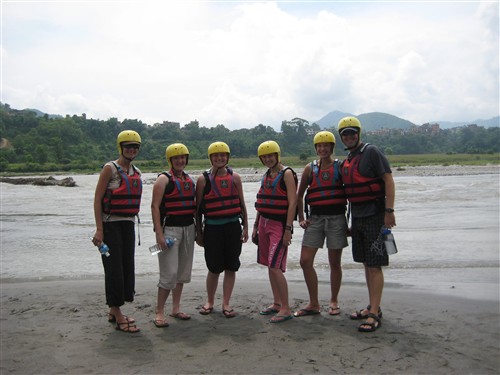 Tina wasn’t interested in anything involving camping but I was eager for another outing, so I ventured out alone on an overnight rafting trip. One of the local rafting shops, Paddle Nepal, put together a two-river, one night camping package; a surprising feat in the off-season. With our experiences on the Zambezi setting the standard, I was keeping my expectations low. Our party consisted of one guide, three safety kayakers, and six rafters: four twenty-something British girls – volunteer teachers at local schools – and a young professional woman from San Francisco on holiday.
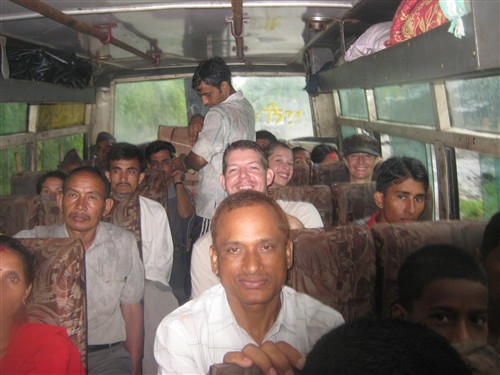 The next morning we were surprised to learn that we would be taking local buses instead of chartered transport. It wasn’t a big deal but I soon realized that it was going to be a lot longer day than I had anticipated. We hailed down a nearly full local bus heading upriver, and after loading all our gear onto the roof, we were off toward our drop point on the Trisuli. By the time we reached our stop and descended to the river’s edge, the rain was pouring down, really pouring, like where’s-Noah-with-the-Ark pouring. The Trisuli River was significantly colder than the Seti and with no sun, torrential rain, and violent rapids; I was chilled for the entire ride. The trip downriver was fun but underwhelming as our guide steered clear of the more menacing and fun-looking rapids. Our short two-hour ride was over as quickly as it had begun.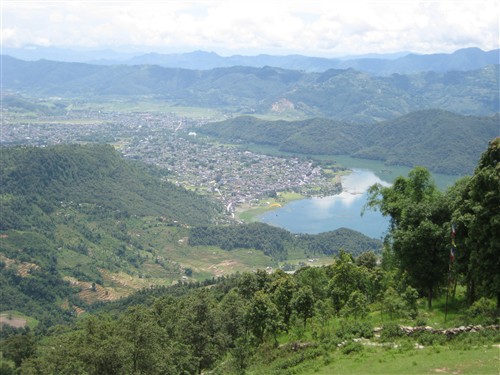
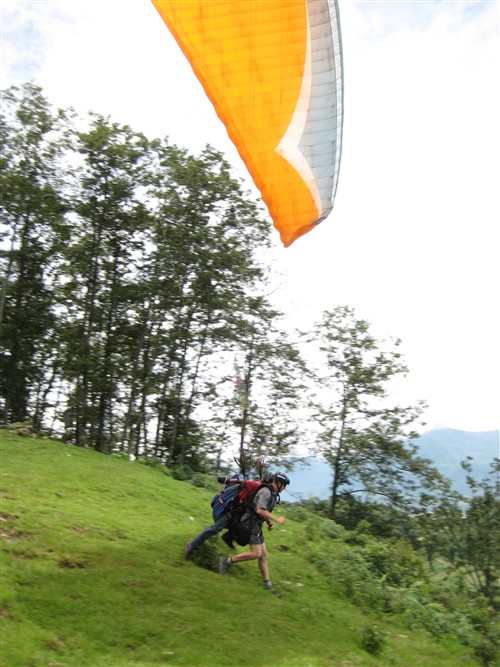 I was in the frame of mind to lay low in Pokhara and do everything possible to stay relaxed and prevent any further emergency room visits. As Aaron was feeling physically fine and needed some good distractions, we signed him up for a few adventure activities, the first of which was paragliding. I rode along for that one (in the truck, not the chute) and watched him leap from the top of the mountain and glide through the air over the breathtaking Pokhara Valley. I knew he was okay shortly after take off when I heard an ecstatic “Woohoo!” echo through the valley to which I replied, “You’re flyiiiiiing!” I excitedly snapped a dozen pictures of my falcon-like husband. As the driver and I made our way back down the mountain, we stopped to pick up an amazing sixteen locals, mostly women and children, to carry them down to town. I saw one woman pass him a bill but most paid nothing. There is just an unwritten rule that, if you have an empty truck and people need a ride, you stop for them. Though the extra stops prevented me from reaching the landing point in time for the landing, I was very moved by this beautiful yet commonplace Third World gesture.