Posted under Nepal
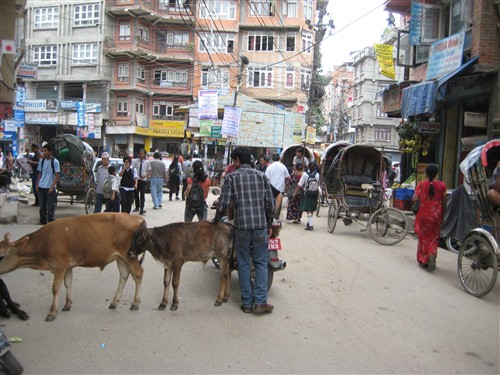
We arrived in Kathmandu after a long travel sequence feeling surprisingly rested. We took a taxi into the touristy Thamel district, where we had booked a room for two nights. As we rode into town, we took in our first glimpse of Kathmandu from the taxi window. The broken and pothole-ridden streets bore a striking resemblance to the streets of India: women walked in brightly-colored saris; the air was putrid from auto emissions and burning rubbish; rickshaw-wallahs snoozed between fares; farmers sold fresh produce by the roadside; the only traffic laws are 1) cows have the right of way and 2) it’s every man for himself. It felt good to be back amid what we feel is one of the world’s most fascinating cultures. At the same time, in my current state of volatile first trimester pregnancy, I yearned for the sterility of the Western World.
The hotel room was adequate, if not a little stuffy and cramped. It had Wi-Fi and satellite T.V. – a luxury that we haven’t had in months. We settled in and had lunch at the hotel before calling the travel medical clinic to see if we could do the ultrasound that afternoon, a request that was granted after some coaxing. We took a taxi to the clinic to pick up a referral for the ultrasound and then another taxi to the ultrasound lab.
The technician was capable and thorough, explaining everything he saw and speaking frankly. After the ultrasound, we returned to the travel medical clinic and waited while the clerk read the results to the OB-GYN by phone. After that, I spoke to the doctor directly. She explained what the ultrasound tech had already told us – things didn’t look promising. She said that I would probably be fine for the night but she would come to see me that day if I was upset. I told her that I was fine. She gave me her personal cell phone number and told me to call day or night if I needed to. Otherwise, we would meet at my original appointment time the next afternoon. We confined ourselves to the hostel that night and the following day, preparing ourselves for bad news.
Back at the travel medical clinic, we had arrived early and waited patiently for the doctor. She was a soft-spoken, middle-aged Indian woman sporting a nose ring and colorful sari. We introduced ourselves and moved into one of the examination rooms. We discussed the ultrasound results, which didn’t look promising, though it was too soon to tell for sure. The symptoms that I was experiencing pointed to miscarriage and we discussed our options. She suggested that we come back in ten days for another ultrasound. In the meantime, I could resume my normal activities, though trekking, rafting and travel to remote areas far from emergency medical services were out. We asked a lot more questions, taking full advantage of our English-speaking, Western-trained medical professional. Just before we left, almost as an afterthought, the doctor decided to do a pelvic exam.
There were no stirrups in the exam room. She asked me to lie back on the examination table and touch my heels to my buttocks. With a flashlight and a speculum, she gave me my first Third World pelvic exam. It was quite uncomfortable and I struggled to relax. When she finished, she said that, were it not for the ultrasound report, she would say that I was having a normal pregnancy. It was a glimmer of hope and though it was probably false hope, it was something to hold onto. Before we left, she gave me some painkillers for the cramping and a referral for the next ultrasound.
We tooled around Kathmandu for another day, taking in the city sights. We started with the Garden of Dreams, a splendid estate built by a young field marshal with funds won from his well-to-do father in a game of cowrie shells. The walled gardens were English-inspired, a nice contrast to the Asian gardens that we’ve admired in recent months. The property included several stately white buildings of European design and the pleasant terraced gardens with arbors, elephant statues, and a grand fountain full of carp. Young artists sat on the lawns, absorbed in their drawings. Families posed for photos and fed the fish while others lounged on shaded benches, enjoying the quiet oasis in the middle of bustling Kathmandu.
 Next, we visited Durbar Square in the older part of town. Once the site of royal coronations, the square has more temples and shrines per square meter than anywhere we’ve been. Most of the buildings date back to the 17th and 18th centuries and little has been done to preserve or restore them. What I found most interesting about the religious structures in Durbar Square was how casually they were treated. People climbed all over them, lazing the day away on the upper levels and watching the world go by.
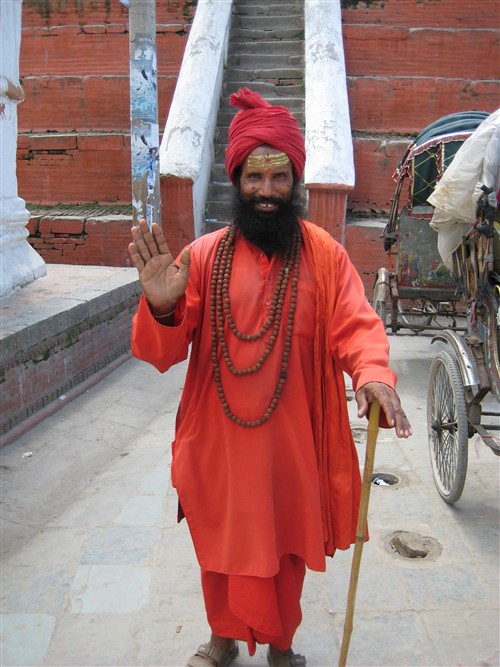
As we walked through the square, we were hounded by men offering guide services, beggars and saddhus, the “holy men” who live on alms. While Aaron was taking a photo of one of the temples, a spry old saddhu in a bright orange tunic and red turban scurried into his shot with a big smile on his bushy bearded face. We knew that he wanted money, of course, and Aaron put down his camera, asking the saddhu to move out of the way. “No money! No money!” insisted the saddhu. “No money.” Aaron repeated, and snapped his photo. Sure enough, the saddhu followed us around for a good five minutes after that, trying to extract a donation.
Next, we acquired another little follower, a boy of about eight or nine who walked alongside us, hounding me with questions despite my best efforts to gently discourage him. We knew that his interest was purely financial and he persisted for an impressive twenty minutes before finally getting up the nerve to ask me to buy him a biscuit. In hindsight, I probably should have. He was a sweet, shy little boy in an impoverished nation. This is the most emotionally difficult aspect of traveling among Indian and Nepalese culture. I group them because they are basically interchangeable, based on what we have seen so far.
The people of Nepal are truly impoverished and almsgiving is an integral part of religion and society. Still, it is disconcerting to see the way that any white face is perceived as a walking dollar sign. We experience the phenomenon time and again, both personally and as third party observers. The truth of the matter is that, despite or current status as homeless vagabonds with an ever-shrinking bank account, we are rich in comparison to the average Nepalese citizen. We tell ourselves that we should not reward the vile practice of begging so as not to perpetuate the white-face-as-dollar-sign stereotype. Sometimes I think we tell ourselves this to protect our own hearts from breaking when a filthy, barefoot, wretched-looking child or an elderly person or a severe cripple begs a handout and we look the other way. I think about all of the money and time that we once donated to American nonprofit organizations without a second thought; to organizations benefiting Americans who have access to social and welfare programs and opportunities beyond comprehension for a Nepalese citizen. Can I really not spare just a few rupees for everyone who asks? There are just so many people in need here, so many outstretched hands, so many desperate faces. Occasionally, I crack and start handing out money to everyone who asks until Aaron puts his foot down and reigns me back in. When I give, I never regret it. When I don’t, I mask my heartbreak with indifference. I think that, for the rest of my life, I shall remain conflicted on this matter. In the presence of dire poverty, I am plagued by my good fortune. I want to be good, to do right by my fellow man, but how much is enough?
Kathmandu was like a long awaited return to India. The vibrant colors, noise, traffic, pollution; the raw, unmasked hardship of life; the natural inquisitiveness of the people, the lack of personal space and the holy bovines together revived that familiar overwhelming shock of our senses. But things were different this time; I was different. I was in the first trimester of a presumably doomed pregnancy. Walking the noisy, congested, polluted streets was exhausting. The smells, the filth, the smoke and the spitting were nauseating. My senses of tolerance and patience were greatly diminished. I was overcome with a terrible homesickness, a desperate yearning for the First World, and I could tell that Aaron felt it too.
We decided that three nights in Kathmandu were enough and that the time had come to make our way to Pokhara. Our doc had given us her blessing to travel to Pokhara, though she strongly recommended the thirty–minute flight over the seven-hour bus ride considering my fragile state. The flight was more expensive and the scenery between Kathmandu and Pokhara was reputedly gorgeous but we were feeling more risk-averse than usual so we heeded the doc’s advice and ponied up for the plane tickets.
 Our last several days in China were a blur. We checked back into our Shanghai hostel for one last night and, on the recommendation of some fellow travelers, we went to see a Chinese Acrobatics show. We arrived early and watched the small theatre fill up as foreigners in enormous tour groups filed in behind their dutiful guides. The show began with a group of high-energy gymnasts bounding across the stage and soaring through narrow hoops, barely dodging one another in precisely choreographed stunts. Another performer was a young girl, who mounted a small elevated platform in handstand position, and did a ten-minute routine supporting her body weight with only one arm. The men and women were equally impressive; the men with their strength and agility, the women with their grace and poise while lifting and maintaining enormous heavy loads. The show was spectacular and we were mesmerized for ninety minutes by the talented performers.
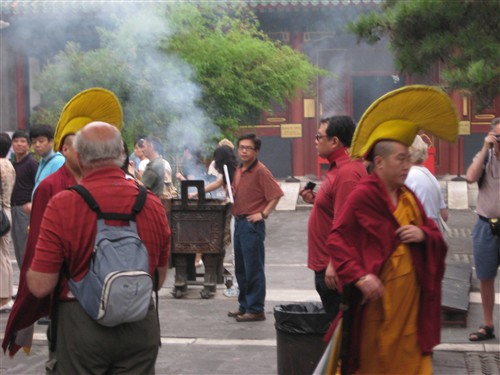 The Yonghe Temple, or Palace of Peace and Harmony Lama Temple, is most commonly referred to simply as the “Lama Temple”. The Lama Temple is a Tibetan Buddhist temple and monastery, one of the largest of its kind in the world. The expansive grounds contained five main halls separated by courtyards, and numerous other unimpressive buildings. I stumbled upon a religious ceremony at its conclusion and was fascinated by the costumes of the presiding monks. Their orange robes were standard issue, but they each wore large, yellow hats resembling the comb on a rooster’s head – a very entertaining sight indeed. The highlight of my self-guided tour was a 26-meter tall, gold-covered statue of the Maitreya Buddha carved from a single piece of White Sandalwood and housed in one of the pavilions – it was truly impressive. After my brief visit, I left the temple complex unimpressed and boarded the metro to return home to my wife…and ready to leave China.
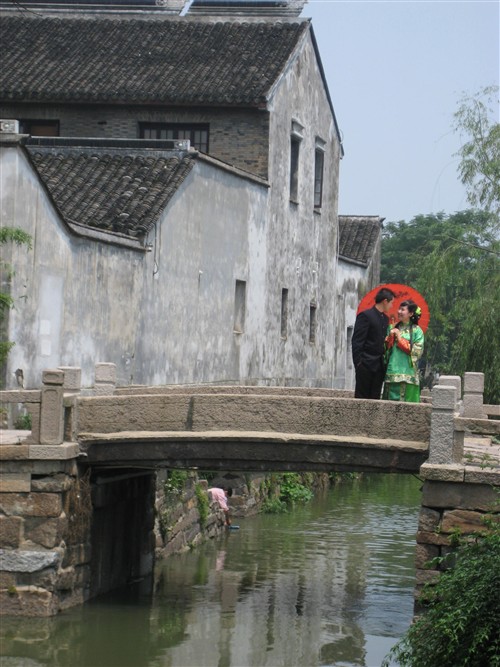 We boarded the morning train with our bags in tow, excited to spend a couple of nights in the quaint canal town of Suzhou, the “Venice of the East”, known for its beautiful Oriental gardens. The ride was quick and comfortable and we arrived at the Suzhou train station in wonderful spirits. We had a hostel room booked and planned to take a taxi from the train station. As we exited the station, we discovered that the city was in the midst of a torrential downpour. There were at least 300 people waiting in line in the rain for a taxi. After quickly exhausting all other options, we joined the taxi line.
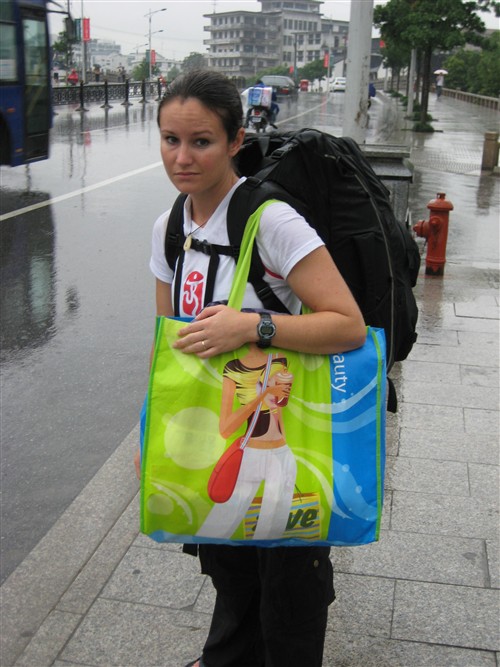 When a rickshaw driver pulled up, I didn’t even want to bother with him but Aaron was feeling more optimistic, or perhaps more desperate, and handed him the paper. The driver quoted us another 30 yuan and we didn’t argue. We just got in. There was a cover atop the rickshaw but the sides were open and we were almost completely exposed to the elements. We huddled together on the tiny seat, barely wide enough for two little Asian butts, much less our collective junk in the trunk. We rode for a good thirty minutes, passing the train station from which we’d come; the driver stopping several times along the way to ask other rickshaw drivers where the street was. After many stops and a few u-turns, we FINALLY arrived at Mingtown. I was ready to give that rickshaw driver a big smile and a hug. Aaron pulled out a 50 yuan note and handed it to the driver but rather than dipping into his little box for 20 yuan in change, he tried to tell us that we owed him another ten, that the fare was 30 yuan per person. Suddenly, I felt a powerful rage come over me, a rage fueled by three weeks of squat toilets, secondhand smoke exposure, pushing, shoving, spitting, lack of queues and basic manners, foods soaked in oil and MSG, foul smells, constant gray skies, pedestrians never having the right of way (even in the crosswalk)…and I channeled all of that rage toward the rickshaw driver in a wild-eyed, high-volume, curse-filled rant that he likely didn’t understand a single word of but still understood the point perfectly well. When the stunned driver attempted to maintain his ground, I lunged forward, snatched the 50 yuan note out of his hand, and told Aaron to get out of the vehicle. At that point, the driver realized that he was in danger of getting paid nothing; he reached into his change box and quickly produced two 10 yuan notes. The transaction was complete.
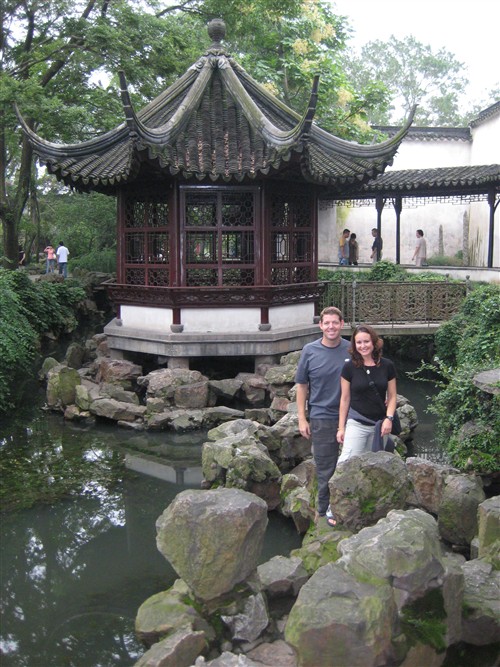 We spent the remainder of the afternoon exploring the Humble Administrator’s Garden, which is said to be the largest and most impressive garden in Suzhou. Dating back to the 1500s, the garden was vast and lovely with the usual combination of lotus ponds, bamboo groves, pavilions, foot bridges, and stunning natural rock formations. It was a beautiful, sunny Saturday and the garden was overcome with crowds of people, which detracted slightly from its charm and serenity, but it was still a great place to spend the afternoon.
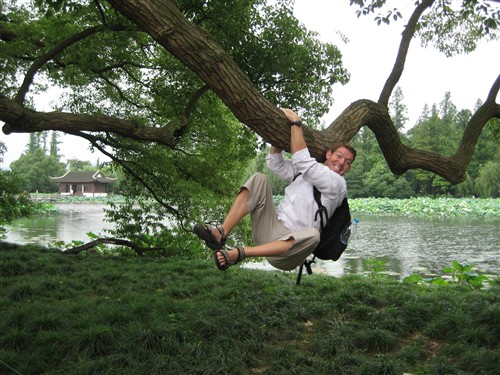 We boarded the morning train in Shanghai, and, after a wonderfully comfortable ride, reached Hangzhou by lunchtime. We had already booked seats on the 6:30p train back to Shanghai, which left us with just over six hours to explore. We took the city bus to West Lake in the center of the city. Hopping off the bus at the first sign of water, we grabbed a bite of lunch and then rented a pair of bikes to ride around the lake. A nice wide sidewalk bordered the lake but we soon learned that no bikes were allowed on it. After only fifteen minutes, we returned the bikes and began an hours-long stroll on the sidewalk. The surface of the lake was a pale blue that blended with the hazy sky. We spent the day walking leisurely, stopping to rest when we found a particularly pretty place. The lake was sectioned off by land bridges and islands, which made it seem like many lakes, each with its own unique atmosphere with gardens, parks, boats, pagodas and pavilions.