Posted under New Zealand
The eight-hour road trip from Christchurch to Queenstown was a dazzling display of astonishing natural beauty. The South Island is sparsely populated in comparison to the North Island and you can drive for hours without seeing a city. The landscape is breathtaking, diverse and constantly changing: hulking rocky mountains dominate almost every view; mountains shrouded in blankets of alpine forest, sheer gray rock faces cut by shadowy contours; rolling hills, fields of grass speckled with grazing sheep, meandering streams, rivers rushing through mossy, boulder-strewn valleys, and crystal blue lakes. The South Island of New Zealand seems to have more inland bodies of water per square mile than anywhere else on Earth.
After brief stops at the Rakaia River Gorge and Lake Tekapo, we rolled into Queenstown in the early evening. Set on the edge of the sparkling, S-shaped Lake Wakatipu and surrounded by jagged rocky mountains, the former gold rush town has fully realized its potential as a tourist magnet. In winter, the snow-covered Remarkables – the only mountain range besides the Rockies that runs truly North-South – draws vacationing skiers in droves while warmer months bring the hikers, adrenaline junkies and scenery buffs. The charming alpine town rivals any Rocky Mountain ski town with its high-end clothing stores, gift shops, boutique hotels, trendy cafes and bars, restaurants and day spas. Two peninsulas jut out into the tranquil, crystalline lake; one is encompassed by a botanical garden and the other by a golf course.
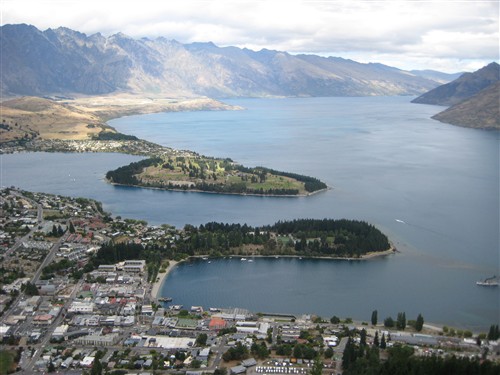 We checked into Scallywag’s Travelers Guesthouse and were awestruck by the million-dollar view of the lake and surrounding mountains from our bedroom window. We drove into town to pick up some groceries for the next few days – after two months of eating every meal out in India and Thailand, we’re back to self-catering – and then stopped at the charming Vudu Café in town for an appetizer, a couple of microbrews and some great people-watching. From our perch at a sidewalk table, we hypothesized that the tourist population in Queenstown was comprised of the following groups in almost equal parts: Australians and North Island Kiwis on holiday, Japanese tourists, Europeans (spending their soaring Euros and towering Pounds) and Americans (spending their sadly deflating dollars) on family vacations, and thrifty globetrotters (most of whom fall into the European category) like ourselves, monopolizing every camper van and backpacker hostel available for miles. Back at Scallywag’s, we finished the evening with some local wine and cheese and good conversation around the dinner table with some other interesting couples at the hostel.
The next morning, we met Julie Speed, a friend and colleague of Aaron’s from Fort Worth. She was in Queenstown on business, coincidentally, and we’d planned for a day of adventures after her business concluded. Over a quick cup of coffee in town, we decided on paragliding and a jet boat ride and shortly thereafter walked to the base of the mountain to check into paragliding. Unfortunately, the windy conditions shut down the paragliding operation for the day so we walked back into town to get tickets for the jet boat.
Originally designed in New Zealand, the Shotover Jet is a flat-bottomed jet boat propelled by two tubes that thrust water behind the boat at a volume flow of 300 gallons per second. Because the boat has no propellers, it is able to travel through water as shallow as four inches! It travels at speed up to 50 mph and can make a 360 degree turn in little more than a single boat length. The three of us boarded the sleek red vessel and with minimal delay, we were off. The boat glided seamlessly through the shallow Shotover River, maneuvering through the narrow, rocky gorge. The driver maximized the thrill factor as he skimmed past rocky outcroppings at close range and threw in 360 spins whenever possible, jostling the unbelted, helmetless passengers as we shrieked excitedly and held on for dear life. With only a metal bar to hold onto, my heart skipped a beat each time the edge of the boat narrowly missed a jagged rock face. The scenery was incredible inside the gorge and in the surrounding mountains, covered with lush vegetation in a full spectrum of greens. The jet boat ride lasted only 30 minutes but it was a truly thrilling experience!
A shuttle delivered us to town and, without hesitation, we moved on to the Skyline gondola and luge. A gradual, scenic ascent in the fully enclosed gondola car ended at a lodge near the top of the mountain. We paused to take in the view of Queenstown from the terrace before taking a ski lift even higher up to the luge track. Donning the requisite Speed Racer plastic helmets, we took our first run down the beginner track. The only luge that I’ve ever envisioned is the aerodynamic sled racing down a snowy half-pipe in the Winter Olympics. The Skyline luge is more like a go-cart sans motor – a wheeled sled, snaking through sharp twists, turns and tunnels of an all-downhill concrete track.
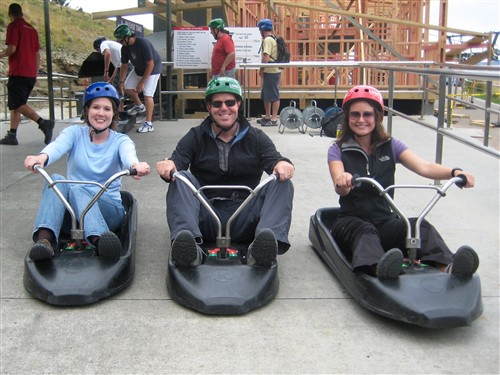 Needless to say, this activity was Aaron’s pick and he was, inarguably, the most antagonistic and enthusiastic racer. We moved onto the advanced track after our introductory run and Aaron tried to coax us into racing each other on the next five runs. I think the spirit of friendly competition overcame him as he took turns on two wheels, sticking his leg out the side to keep from flipping sideways, and flew over long drops with one hand in the air. On one run, he was so intent on keeping me in his sights as I threatened to pass him that he almost crashed into the side of the tunnel wall. He was like a teenager breaking all of the track safety rules and I was the scolding mother hen, flashing forward to the gruesome scene of having my thirty-year-old husband air-lifted from the mountain to the nearest hospital to set broken bones from flying off the luge track. Incorrigible! But it was fun to witness such youthful exuberance. Adulthood and its corresponding worries and responsibilities seem to suffocate the frolicsome, free-spirited nature of many people but I have a sneaking suspicion that it won’t happen to us. As I flash back to that cheeky, insolent, mischievous grin in sunglasses and Speed Racer helmet, in fact, I am certain of it.
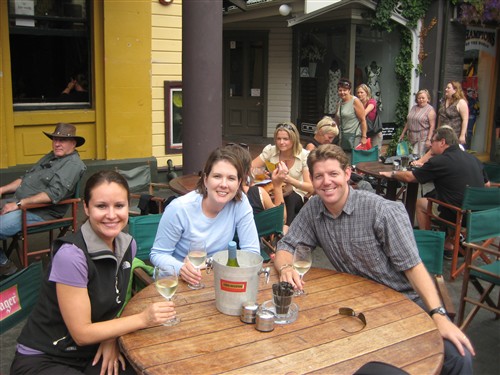 Six action-packed runs down the luge track left the three of us weary and ready for a grown-up’s beverage. We hopped back onto the gondola for the picturesque descent and then walked into town. Queenstown has so many tempting venues for afternoon (après adrenaline rush) cocktails and we didn’t walk long before settling into a patio table with a bottle of Oyster Bay Sauvignon Blanc from the Marlborough region in the north. The Central Otago wine region, just outside of Queenstown, is known for its Pinot Noirs; however, I would argue that there is scarcely a better wine to have on a sunny afternoon than a well-chilled Marlborough Sauvignon Blanc. Interestingly, it is more expensive to drink NZ wines in NZ than in the States.
For dinner, we chose a lovely seafood restaurant with outdoor tables overlooking the lake. The Cloudy Bay Sauvignon Blanc (another Marlborough) was the perfect complement to everyone’s meal and the food was delicious. What a treat for two crusty backpackers! In the midst of our full day of decadent spoils and splurges, we felt like two-week travelers again.
It was such a pleasure to be able to spend time with Julie, to catch up on news from Fort Worth, and share some great experiences (and NZ wines) with a good friend. The good times never last long enough but they leave us with cherished memories that last a lifetime. Thanks, Julie, for a wonderful day in Queenstown!
Comments Off on Queenstown
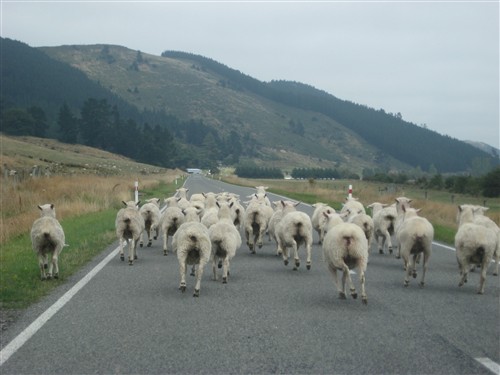 G’day! Welcome to New Zealand! Population: 4 million humans; 40 million sheep. The locals are called Kiwis, gentlemen are blokes, friends are mates, and vowels are consistently butchered in the endearing Kiwi-accented English. The most common fast food is fish and chips or “fush ‘n’ chups” and, not surprisingly, lamb is a staple entrée on Kiwi dinner tables. New Zealand’s two islands, the North and South Islands, are together about the size of Colorado and rival its stunning alpine landscapes. The Lord of the Rings films were shot against New Zealand’s fairytale backdrops. The remote islands attract almost 3 million foreign tourists each year who are drawn to the postcard-perfect views, outdoor activities, beaches, lakes, mountains, wineries and lack of terrorism. The weather in NZ is gorgeous right now – sunny, breezy and 70s during the days and cool enough for a light jacket in the evenings. The sun doesn’t set until sometime between eight and nine o’clock so each day is long and full of possibility.
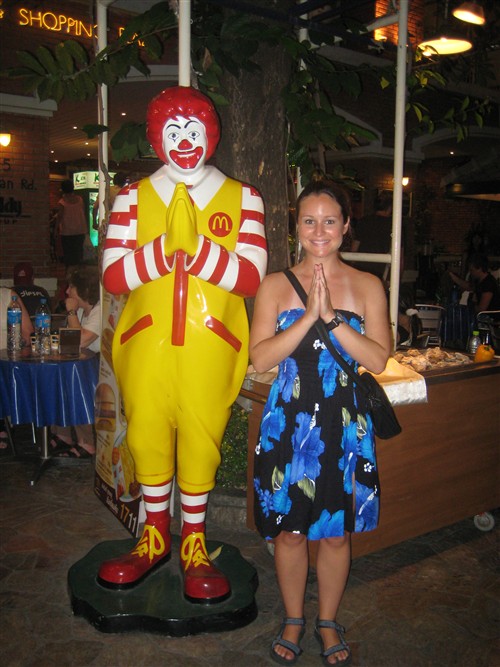 As we leisurely strolled by the lines of lobster tails, gargantuan prawns and all varieties of fresh fish, the candlelit tables with well-dressed two-week travelers toasting glistening glasses of vino, we were almost immune to the decadence in which our former yuppie selves would once have thoughtlessly indulged with the easy swipe of a credit card. No, after four straight days of Thai cuisine on the dive boat, we had tunnel vision and, at the end of the tunnel, was Ronald McDonald saying “Sawasdee Khrap” with traditional Thai prayer hands. In the States, our fast food cravings were few and far between but, on the road, those golden arches symbolize a little taste of home. So often while traveling, we order a dish that is considered “international” to that particular country and it never meets our wishful expectations. For example, I ordered spicy Chinese chow mein noodles in India and got spaghetti noodles swimming in Tabasco. Aaron ordered a grilled cheese in Thailand and got two slices of cold toast with lettuce, tomato and a non-melted slice of white processed cheese. An Italian restaurant in India isn’t owned by an Italian expatriate but rather an ambitious Indian whose interpretation of Italian food would surely induce a spew of curses from any true blood Italian. At McDonald’s, you know that the double cheeseburger and fries tastes exactly the same in Thailand as it does at home. With our bellies full of greasy fast food, we rolled ourselves back to the hotel to relax and hibernate after our long day.
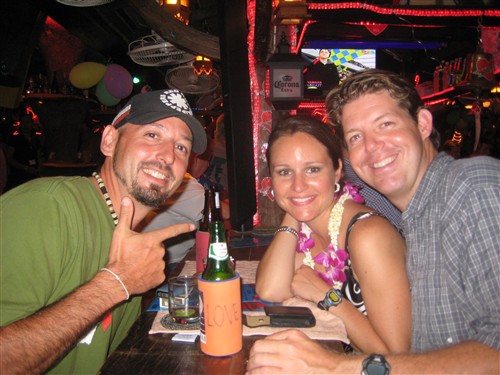 Back on the streets of Patong Beach, we learned that Jon would come over from Phuket Town and meet us around 11:30 so we had a couple of hours to kill around town. With our day at the beach finally pushing a wave of fatigue over us, we alternated between beer and iced coffee as we bar hopped and browsed the cute little clothing shops. By day, Patong is a family-friendly atmosphere but the blackening sky brings out the seedier elements – beautiful, young Thai prostitutes accompanying unattractive, middle-aged western men; scantily clad “ladyboys” dancing on bars and posing for raunchy photos with tourists for cash; costumed cabaret dancers beckoning patrons inside and plenty of adult entertainment venues offering menus of perversities. Sex is definitely for sale in Thailand. We met Jon and a few of his friends and had a spectacular night of alcohol-induced people-watching as we bounced around to a few different bars. When we finally made it back to our hotel, around 4 a.m., we passed out and woke the next morning (surprisingly not hung over) with just enough time to quickly shower and check out. It was the perfect end to our adventures in southern Thailand.
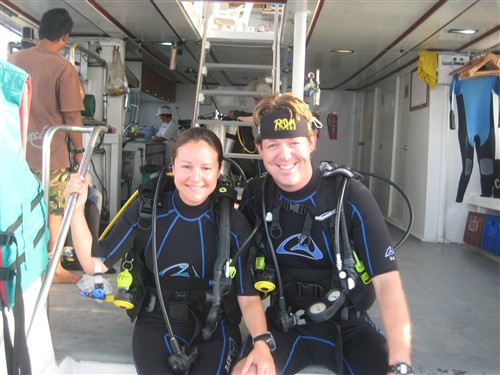 Most scuba divers will tell you that the best diving is done from a live aboard boat. A live aboard is basically a sea-worthy vessel equipped with sleeping berths and a dedicated deck to house scuba tanks, equipment and an air compressor. These boats usually sleep as few as six people or as many as thirty, depending upon the size and design of the boat, although fewer divers usually makes the experience more pleasant. The advantages of a live aboard are basically three-fold; you can reach far away dive sites which are practically undesirable for a day trip, there’s no need to switch tanks and gear between dives because your original tank is simply refilled by the compressor onboard, and minimized boat travel time means more time for diving. But diving from a live aboard can be expensive and you’re stuck, for better or worse, in rough seas or calm, in the middle of the ocean on a boat. Given our passion for diving and proximity to a world-class diving destination, we tossed our budget out the window and booked the best, last-minute boat deal that we could find; a four-day, four-night trip to the Similans aboard the Vilai Samut.
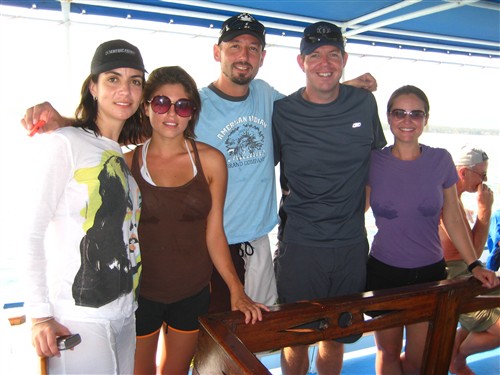
 The Vilai Samut (meaning Sea Anchor in Thai), has the capacity to carry 22 divers plus crew, but our trip had only 10 divers plus an all-Thai crew: two dive guides, two kitchen staff, two deckhands, and the captain. Our itinerary included the Similan Islands, plus two small islands north, Koh Tachai and Koh Bon, and an underwater sea mount near the Burma Banks named Richelieu Rock. For three glorious days we followed a full but relaxing daily schedule; 8am dive (one), eat, sleep, 11am dive (two), eat, sleep, 3pm dive (three), eat, sleep, 7pm night dive (four), eat, sleep. We lazed on the sun on deck, immersed ourselves in good books or quiet conversation, and took intermittent naps, lulled by the gentle rocking of the boat.
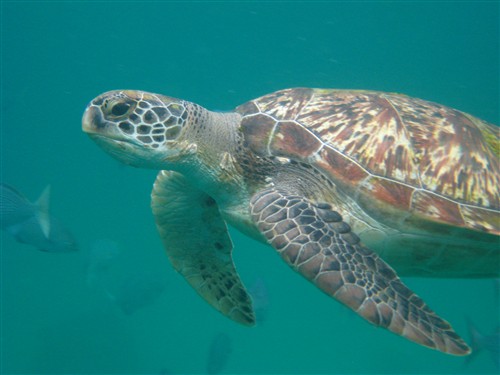
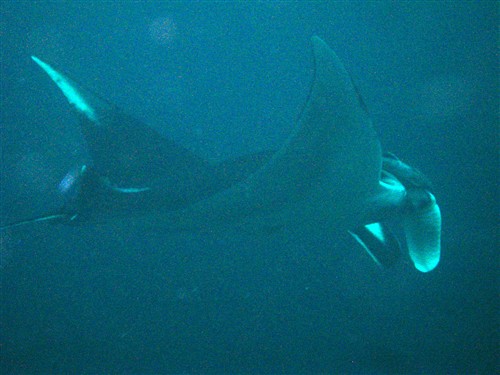 The diving was good to great, but varied significantly between dive sites. The visibility was better than average but we were often plagued by thermo clines, currents of cold water mixing with warm water, sending chills through our wetsuits and significantly reducing visibility. Most of the reefs were in very good condition, surprisingly unaffected by the December 26, 2004 tsunami that devastated the Thailand west coast. According to our dive guides, the greatest threat to these reefs now is the tourist masses, boating in each day to snorkel and dive the islands. During our twelve dives we found the reefs to be plentiful with fish life, big and small. We saw hundreds of schools of reef fish, numerous giant moray eels, gigantic tuna, a banded sea snake, blue-spotted rays, a great barracuda, a leopard shark, and on our last dive at Koh Bon Island, two majestic, graceful manta rays. During one of our lazy afternoons anchored in an island bay, two green sea turtles graced us with their presence for almost an hour, allowing me to swim with and photograph them freely. After four full days of diving we head back to shore and prepare to explore a different side of Thai wildlife, the tourist hotspot and omnipresent party scene at Patong Beach.
 Emerging from the airport in Phuket, the hot balmy air surprised us. Noticeably hotter and wetter than Chiang Mai, we were happy to finally be in southern Thailand; the land of idyllic white sand beaches, warm crystal-clear water, and world-class scuba diving. We decided to head directly to Phuket Town, in the southeastern part of the island to get our bearings and hopefully meet up with the brother of a Fort Worth friend. Phuket Town is the provincial capital and while it has its share of tourist haunts, there are very few tourists here in comparison to the streets of Bangkok or Chiang Mai. It was a refreshing change to be surrounded by more Thais than farang (westerners). The streets were filled with tuk tuks, cars and of course, the ubiquitous motorbikes which weave haphazardly in and out of traffic. And as we would soon find out for ourselves, the motorbike drivers in Phuket are some of the craziest in the world.